
Quick Guide to Higher Level Strumming on Guitar
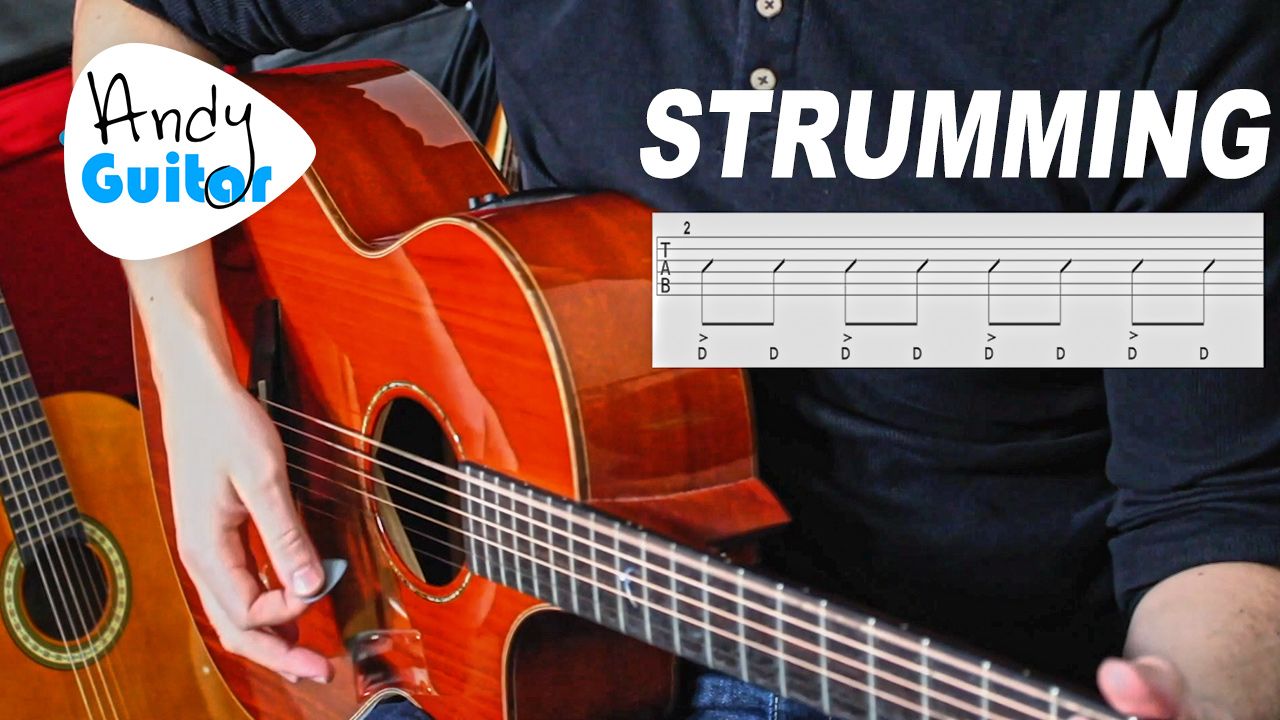
How's it going guys? Welcome to this lesson where we're breaking down rhythms and learning to read rhythms and checking out what 4th strumming, 8th strumming, and 16th strumming is to try and help you guys get to an intermediate level with your strumming patterns. We're also gonna look at. Sense, which can be the thing that will make you sound more higher level with your strumming than anything else. So, what do we mean? Let's take uh the easy E major chord first of all, let's just keep things simple. And let's just strum on the beat to a count of 12. 4, nice and simple first of all, but that's where we're gonna start. And Pause there. That pulse of 1234, we're gonna consider to be the beat for for the purposes of this video. That's how it would be taught to an absolute beginner. We can do a lot more with that actually and it it could be considered to be a lot of different things, but we're gonna consider that to be our count, OK? That would. What the BPM of a certain song is, that beats per minute. How many of those do we, do we have in a minute is literally what BPM literally measures. Um, most of you will be familiar with something called eight strumming, which could be considered to be just twice as many of those strums, twice as fast. So 1. Now notice that even though I called it 8th, strumming, we don't count to 8, because this is not a dance class, this is music. Musicians only count to 4, that's the running joke that a musician's no good at maths cos we can only count to 4. therefore we have what is called an onbeat and an offbeat, a 1 and 2, and. The count is the beat, so 1. 34, and the count of our and is what we call the offbeat. And if I was just to play that, it would be 1 and 2, and 3 and 4. OK. And uh often when we play the offbeat on its own, it's just kind of muted and reggae style 1 and 2 and 3 and 4. But we can also play those ands in particular with up strums sometimes, a 1 and 2 and 3 and 4 and. And with higher level strumming patterns, people that are often really struggle with the up strum, particularly with a pick, they can really feel like it snatches it or they're hitting, you know, the strings a bit awkwardly, it just feels a little bit awkward. And a great way to work through that is just to play on the offbeat on the end, and we just, with upstrums, we do typically just strum kind of the thinner 4 strings typically, not all the time, but we kind of just hit them nice and light. And that little offbeat kind of reggae pattern. That can really help and I have a separate video on the kind of reggae-based strumming uh just here to really get you guys comfortable with the offbeats before we move on from here and doing that offbeat with down strums and also up strums and getting them sounding totally solid before we move on to this 16th strumming. So 16 strumming as it may sound, we have 16 strums per bar. We had 4 strums per bar a second ago, 1. And then that repeats We have 8 strumming, which is 8 strums in a bar. And then we have 16 strumming, which is 16 strums in a bar, but to a count of, get this, 1. Yander 4ander. Quite the mouthful, but it is something that you can say at quite a rapid rate. 1 iyana, 2 na, 3 yander, 4ander. That is 1 e and ah and that would be per beat. Um, now we'd have to do 16 strumming with downs and ups. Down, up, down, up, down, up, down, up. And physically, if we can just get the, get the physical motion of this as soon as possible. It is down, up, down, up 4 times, and you will feel this and hear it and play it a lot better if we can make that first strum of every 4 a little bit louder, and in particularly play the other 3, the 3 after that quieter. So a loud strum, quiet, quiet, quiet. 1 E and da, 2 and da. And with a strum, with a chord. That louder strum is called an accent, and at the moment we're accenting on the beat to make the count easier and for you to still feel and hear this pulse, one. And that, to be able to still hear that pulse, no matter what strumming pattern you're using, whether it's 4ths, eights, or 16s. And that is the first exercise I would like to talk you through now, which is playing a bar of each, um, so a bar of 4 strumming, a bar of 8 strumming, bar of 16th strumming, and then back to eights, and just cycling that. In the following fashion, but always accenting the pulse. I'd recommend doing the 8th strumming with all downs at the moment, cause that will get your hand to the same speed actually as 16 strumming, but let me show you what's happening first of all. OK. That's what's physically happening. Now before we continue, I want to make you aware of two things. I want to reiterate that that 8th strumming, 1 and 2 and 3, for that 8th strumming, your hand is moving at the same rate, at the same speed as the 16th strumming. For 16th, we're just catching. The up strums that you're not playing for the 8 strumming when we do it on all downs. Alright, so we have down, down, down, down for 8th, and down, up down up down up down up down up. Feels like twice as many, twice as fast than it is, but your hand isn't moving any quicker, so long as you do the all downs with, um, so long as you do the 8 strumming with all downs, my apologies. Um, also. We, most people, when we're covering this strumming pattern, we need to really over relax and really get rid of any tension because we're playing faster. Playing faster means more tension, but the only way we can do this faster and play faster, more strumming patterns more easily and make it sound good is by really over relaxing. My example would be, or a good analogy for this is a 100 metre runner. If you have a 100 metre runner who's trying to run as fast as possible. If you're trying to be Usain Bolt, you cannot tense your muscles and be like this, you have to be totally free, you have to use the correct motion, which needs to be trained at slower, um, tempos or a slower running speed. But you need to be free in the motion. You need to be absolutely relaxed, otherwise you cannot run as fast as possible. Same thing with strumming. Be more like Usain Bolt. I guess, I don't know. Let's go for this one more time, let's just focus on the 8s to the 16s as well. So this will be 1 and 2 and 3 and 4 then. And back to eights. And to do this I'm just muting my strings. And that is the first. Little part of this exercise. And that is what they look like, even though everybody, uh, you know, kind of wants on YouTube, people get used to just using downs and D's and Us for downs and ups. Um, this is how the rhythm would look, and that 16th strumming can be, you know, said in this fashion, even though we can still add the downs and ups, this just makes it clearer on what that rhythm actually is. Really important, especially when we start missing out strums, basically, need to be able to read rhythms. Before we can get onto any of that though, we need to go from 4th to 8 to 16 strumming, and then back to 8 again and do that in a cycle comfortably. Let's change chord, which does make things trickier. Let's go for the D chord with my squeaky chair, sorry. Um, and what we're going to do here is the same thing, but we're only strumming like the thinner 4 or 5 strings. We cannot strum string 6, therefore it would be best if we put our thumb on top. Another intermediate kind of level technique. And we're going to go from on the beat. To 8. And on the beach. Repeating that at least for a couple of minutes, that would be the best thing. But notice now that we're doing it on the dechord, my hand motion and everything has become so much smaller because I'm not hitting as many strings, I'm hitting this area rather than this area. So important, and it can be really great, you can get a lot of great results when we start to reduce this area down that we're strumming with and be able to get your strumming. And plus there's loads of really cool riffs that uh acoustic, on acoustic guitar especially where we're using 16th strumming with that D major chord, but it does happen an awful lot. The second exercise that I want to work through with you guys in regards to 16th strumming is using it with bar chords, but allowing the actual chord, what we do with the chord hand itself to dictate the rhythm, and the strumming hand's just gonna keep hitting everyone and hitting 16 strumming. Let me show you what this sounds like. Pretty cool, right? So we have here an A major chord played with the E shape that we worked through in the previous lesson in this free little intermediate series on YouTube. And what we're going to do is play the 16th strumming, but after 2 strums. Which would be a down and up, we relax your fingers but keep them in place. This is so good for your technique and actually gets pretty high level very quickly, but most people can do it as long as you can put your fingers in that position. Mute mute. Repeat that until you're very comfortable with it. Damn. me OK, you can change chord. Just by moving the position of this bar chord, you can lift off that middle finger and try and get it sounding like the minor chord, and try and make sure that's ringing out. course. And a final note that's really important, and I think when we use this major chord ship. Say if I'm playing the B major chord, I put 7th fret, we move that down a string, that same barcode shape, so these fingers are in the same position. We're now playing a minor chord and we were playing a major. Major chord, minor chord, that really confuses a lot of people and it doesn't have to. And that first finger when we're playing thee minor chord really wants to be on string 5, and then the tip of the finger hitting string 6. That way, we can actually hit all 6 strings. And that thickest string never rings out because we're muting. All of this is called string muting with the left hand, left-hand muting, barcode muting. They're the search terms if you wish to look elsewhere on the internet to learn this sort of stuff. But you can also look at it with my intermediate course. Changing At the same time, the rhythm there hasn't changed, this chord hand is moving freely and dictating the rhythm. The right hand. Doing that all the time. It's never doing anything different, there's no accenting, there's nothing clever, and it's a really great way to do it, and then if you shake up the rhythm any more than that, it's all with when you do the barcode muting. So those are just some ideas of how to get your strumming to an intermediate level, and this is a summary of the things that we cover in the strumming section of my intermediate course, which is available at Andyguitar.co.uk. But 16 strumming core principles are definitely relaxing and being aware of where the beat is, and being aware that we're not necessarily missing out too many strums with the right hand. And it is often these accents which dictate the rhythm, or even left-hand muting which dictates the rhythm. And there's a lot more to strumming than just knowing which downs and ups to hit. I hope that video's really helped you guys. Here's some helpful links on the screen and a link to the uh intermediate course which this video is in promotion of. Thank you so much for checking out my lessons, I really appreciate it. I wish you all the best with your strumming progress.
In this video
This video is made in support of my intermediate Guitar course. Click the button below for more info.
intermediate course >>In many ways, the rhythm of whatever you are playing is even more important than the notes your play. The aim of this section is to make sure your strumming and rhythm is up to par with the rest of your guitar playing.
Here, we’ll cover how we break down a bar into quarter, 8th and 16th notes and learn how to really nail 16th strumming patterns!
4th Strumming aka The beat
You should be super familiar with this by now and is covered at Level 1 of my Beginners Course. However, i've added an accent shown by the > symbol on each beat in all the patterns on this page for visual comparison and also to hep you feel the beat when you strum with 8ths or 16th rhythms.

8th Strumming aka Quaver
Aka the 8th strumming from Level 2 of my Beginners Course, but with accents on the beat. This should be played with all down strumming in this exercise.

16th Strumming aka Semi-quavers
16th strumming is where we play 16 strums per bar using semi quavers, meaning there are four strums per beat. On the diagram above, the notes that fall on the beat are accented by the > which means they a should be played louder (in reality, non accented strums played quieter sounds more natural).

Like this? Want more?
This video is made in support of my intermediate Guitar course. Click the button below for more info