
Guitar Anatomy & Essential Knowledge

Hi guys, Andy Crowley here, and in this series of videos where I'm naming level 0 of my beginner's course, I'm talking you through the absolute basics and getting to know your guitar itself, whether it's electric or acoustic. We'll be talking you through everything you need to know about. The guitar itself, how to set up your amplifier, how to get your guitar in tune, all of those sorts of things. And as I say, this is what I'm calling level 0 of my beginner's course that's available on Andy guitar.co.uk at the website and on my YouTube homepage. So the guitar I'm holding now is a standard steel stringed acoustic guitar. We can tell it's acoustic because we have this hole in the middle which is called the sound hole, which is how it sounds much louder than other types of guitar that don't have this sound hole. We therefore call it self-amplifying basically. And the anatomy is very similar to a person. We have the head, neck and the body of the guitar. Starting at the head, we have tuning pegs which we turn to tighten your strings and er get your guitar in tune basically. The strings themselves before they get to the tuning pegs go over this white part called the nut. We have metal frets going down the neck, but we'd call this area fret 1, fret 2, and fret 3, etc. As I mentioned previously, we have the sound hole which amplifies your acoustic and we also have usually one of these things which is called a pick guard. It literally protects your guitar from. Damage from when you're strumming. And finally on the body of your acoustic guitar, we would have the bridge and these guitar pegs which hold your strings in place. Now this type of acoustic guitar is the most common use for any pop, rock, blues, or any sort of those popular styles, including country as well I should mention. Um, it sounds great, it sounds very bright. And it is the most common style of acoustic guitar that I would recommend. There is another style of acoustic guitar that looks very similar to this but has nylon strings. Now these are easily identifiable because of the change in the headstock. The nylon string acoustic guitar has holes in this headstock because of the different way that the strings attach to the guitar. This steel string acoustic guitar doesn't have those holes and it winds around the metal part of the tuning pegs themselves here. The nylon stringed acoustic guitar is best for classical styles and also Spanish and flamenco styles. Though because of its relatively smaller size and relatively smaller expense, uh these nylon string guitars have become very common for beginners and certainly for children because they can be easier to press down because of the nylon strings. However, I don't really advise going down this route as you're never gonna accomplish the sound that you can get from either a steel string acoustic guitar or. The electric guitar that I will be talking you through shortly. So if you're looking for a guitar for a child or for yourself and you're worried about that, I'd really recommend putting thinner strings on your guitar and if you still struggle, just go for an electric guitar because it will be easier. So this is my main electric guitar. I love this guitar, the type is called a Les Paul type, and on the whole all electric guitars are very similar to the acoustic in anatomy and everything that we're gonna cover in my beginner's course. Works on both electric and acoustic guitars, we still have the head, neck and body, 6 strings, same kind of frets, tuning pegs, everything like this, but we have these added controls on the body of the guitar. But what we don't have typically on electric guitars is a sound hole. This is because we have replaced the sound hole by pickups which are essentially magnets that act like microphones so that we can plug it into an electric guitar amp and we get that electric guitar sound. Which I will be talking to you in a second. On this electric guitar in particular, we have double pickups known as humbuckers. On the next electric I will show you, they will only have one of these. So these humbucking pickups essentially allow a higher output from the guitar and therefore they can sound heavier and with less noise when you turn up the overdrive all the way. Now we have two of these pickups which is selected by this toggle switch here. When it's in the down position. This toggle activates this pickup. When it's up, it activates this one at the neck and then in the middle, it activates both of them but keeps the volume even between each pickup. 99.9% of the time I'd recommend this pickup is in the down position which activates this pickup, which is how to get the loudest, brightest sound from your guitar itself. And if you want to attenuate the sound at all or turn anything down. You would do that on the amplifier, but we want the maximum amount of sound from your guitar. And we're gonna get that by making sure that each of these controls which include volume from the guitar and tone, are turned all the way up to full, and you can do that by screwing them clockwise, which means the output is to full, and that's the same way as you would screw on the top of a bottle. Then we have. The output of the guitar which we will need a jack lead for. It doesn't matter whether you have a straight jack lead or an angle one like this, um they will all do the same job and that will take it to your guitar amplifier, which I will be talking you through in the next lesson following this one. I would like to briefly show you the other common style of electric guitar which is the Stratocaster style guitar. Uh, this is a Yamaha Pacifica, so it's not a Stratocaster, but it has a very similar look to it and that sort of style characterised by these cutaways in the body and the difference in headstock. These guitars usually just have these single coil pickups, though you can see we do have one double humbucker there. Uh, these will typically give a cleaner sound with your guitar, however. You can still turn the overdrive up on your amplifier or your effects and it will sound just as heavy as the Les Paul Humbucker style. So just to finish up, let's hear what the electric guitar sounds like compared to the acoustic. This is with the settings set to er the overdrive channel so that we get some fuzz, which we'd call overdrive or distortion. And we can also turn that overdrive off so it sounds like the normal steel strings just amplified. A much cleaner sound that sort of emulates an acoustic in many ways and for any of the beginner's course, typically we would wanna keep your electric guitar on this clean channel and I will say clearly in the videos when it's appropriate to you. Use the overdrive and it mainly depends on your song choices whether you want to activate the overdrive or keep it on the clean channel. So it'll be the next video where I'll be showing you about this overdrive and clean which is all done on your amplifier. I hope to see you there guys, take care and bye for now.
In this video
Andy Guitar Beginners Course eBook 2016 - 2nd Edition
Here I talk you through the different parts on both electric and acoustic guitars and how to use them. I also give you my recommendations of which guitar you should choose!
Acoustic Guitar

Acoustic guitar means that it is self-amplifying due to the sound hole. This also means it doesn’t need an amplifier. These sound great for acoustic pop music or folk.
Electric Guitar

Electric guitars are much easier to press down the strings when you are doing your first chords. Even though its’ an electric guitar, it makes plenty of sound for you to play by yourself. You will need to get an amplifier asap. If you're unsure of whether to go for acoustic or electric, I recommend getting an electric guitar as your first instrument.
Nylon string Classical/ Spanish guitar
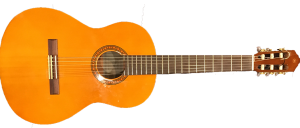
The Nylon strings have a softer sound and are much easier on the fingers. A lot of people start on these, especially kids. However, what I really recommend and what I think is the best option if you’re just going out to buy your first guitar, is getting yourself an electric guitar.