Essential 2-5-1 Chords
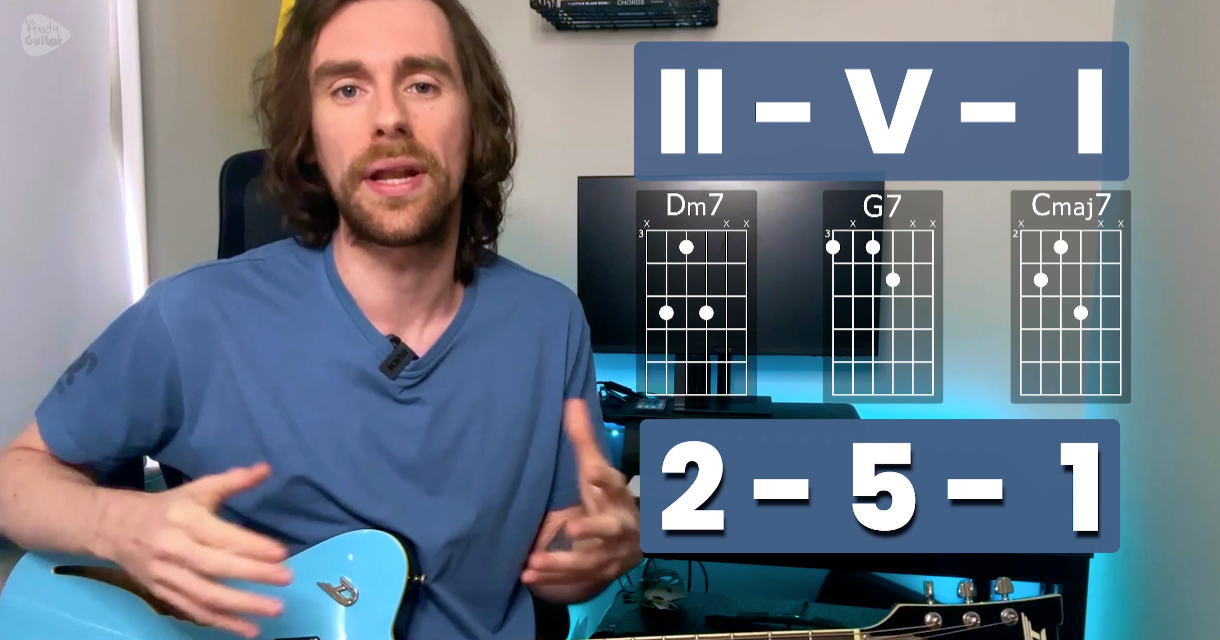
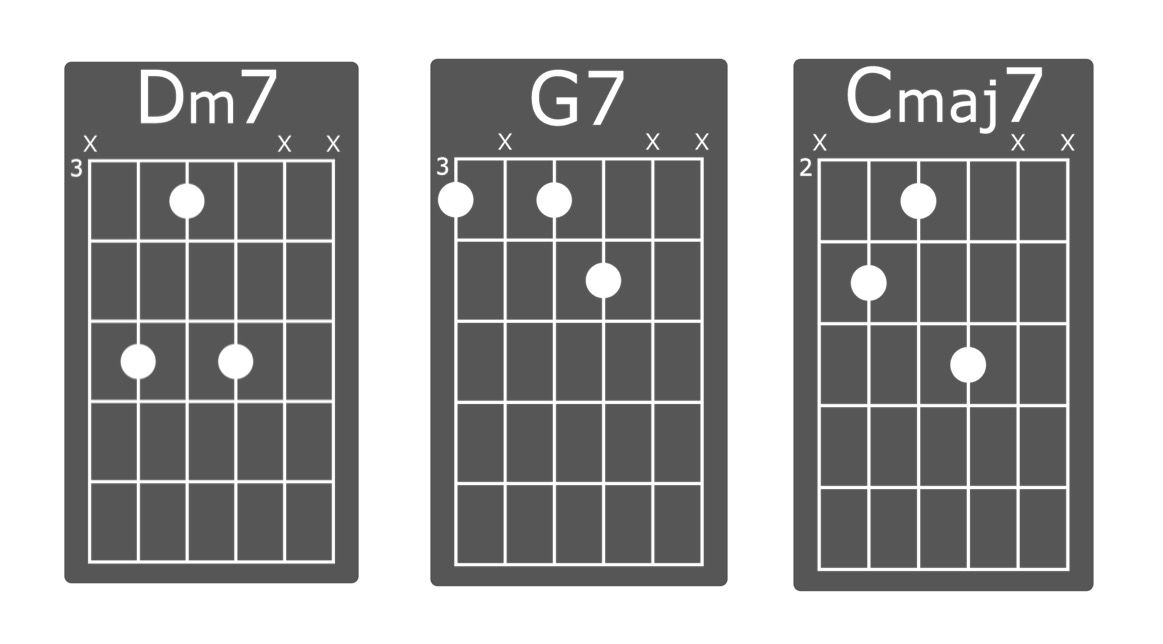
Welcome to day one. This is the essential jazz 251 chords, and this sets down the core harmonic foundation that we need. So these three chords that we need for the 251 chord progression is a D minus 7. To a G7. To a C major 7. And you might have noticed there's only 3 notes in those chords, and they are also 7s, so they're worth taking a note of. There's a D minor 7, a G7, and a C major 7. We're going to introduce a basic jazz comping feel with a bit of swing, and we're gonna be looking for smooth chord changes. This is all part of the smooth jazz feel that we're looking for. So the fingering of this D minus 7 chord is I'm putting the middle finger on the 5th fret of the A. Which is the D note, and then the index finger, which is a bit of a stretch onto the third fret of the D string. Which is the minor 3, and that is an F note. Then with our ring finger, we are going to add that to the 5th fret of the G string. And that gives us all the notes that we need for this D minus 7. You may notice that the full version of this, for example, on the route 5 barcode position. Will sound a little bit like that. And that's the full card, but all we need for this is this lovely sounding 3 note card. Then the G7, this time the index finger is on the 3rd fret of the E. And then the middle finger is on the 3rd fret of the D string. And the ring finger then goes onto the 4th fret of the G. So we've got 12341234. And you might notice straight away, that's starting to sound like a pretty competent jazz sort of combing feel already, just by playing 4 beats, 1234 change. 1234. Let's focus in on those changes. So with this finger in. All we have to do is keep the ring finger down on the G string. That goes down a fret. The middle finger and the index finger swap a little bit. So the middle finger drops down a string, going onto that 3rd fret, and the index finger comes up 2 strings to the root 6. I'd give them a practise just like this. The next card is a C major 7 of our 251, so 25 and 1. One being the tonic, so the C major 7 here is our sort of first card. But we're playing him in a 251. So this is the middle finger on the 3rd fret of the A. Then the index finger on the 2nd fret of the D. Which is a major 3rd there And then we've got the ring finger, it's kind of in the same shape actually, same position should I say. So it's a quick change there to get these two fingers into the next position. You can see how you can develop. Quite smooth chord changes, especially going when we go around in a loop and we want to go back to our D minus 7. Fingers are actually all in the same positions on the strings. Chosen the same strings, but all we have to do is move them. Into those. Various shapes. Now for the strumming, like I was saying before, straight up just 1234, change, 234, change, 234. Now you will have noticed, I stayed on the C major 7 for double the amount of time there, so 8 beats, and that's in order for it just to loop round. And it's the 251, but we stay on the C for a little bit longer. If we want to add some swing, it'll sound like this. 12, and 34. And it's not straight, remember, cause this is a swing, so it's not 12 and 34, it's 12 and 34. So it's got a little bit of a bounce. This is what it sounds like. So you can see I'm going 12 and 3. And the way I'm doing that is by 2 down strums, 12, and then an up strum. Which is a little bit delayed and then it's quite fast again from the up to the down. Like that, that kind of motion. I'm choosing to add a little bit of a passing note there, just to show you. A little bit like what a jazz bassist would do because chromatic and passing notes all add a lot of flavour to the jazz, as we'll see later in the course. A little bit of a tip just with the bounce, um, not the swing, but actually more to do with when we're just playing on the 4 count. I am just ever so slightly, every time I'm wanting to play the card, I'm adding a bit of tension in my hand. And then I'm actually releasing that tension once the card is finished. So I'm not actually muting with my hand with the picking hand like this. It's actually, the muting is actually coming from this hand. So you just release. And just keep the fingers actually on top of the string, so they are touching, but they've released the pressure from the fretboard.
In this video
I introduce the three core jazz chords of the 2-5-1 progression in the key of C: D minor 7, G7, and C major 7. We keep things simple with three note triad shapes that capture the full seventh chord sound, and I walk you through the exact fingerings for smooth transitions.
What you will learn:
D minor 7 fingering — middle finger on the fifth fret of the A string, index on the third fret of the D, and ring finger on the fifth fret of the G
G7 fingering — index on the third fret of the low E, middle on the third fret of the D, and ring on the fourth fret of the G
C major 7 fingering — middle on the third fret of the A, index on the second fret of the D, and ring on the third fret of the G
Smooth chord changes — using anchor fingers and minimal movement to transition cleanly between the three shapes
Straight comping — playing four beats per chord with a steady 1-2-3-4 feel
Swing comping — adding that signature jazz bounce with two down strums followed by a delayed up strum
Passing notes — adding chromatic bass movement between changes for extra flavour
Palm muting technique — releasing finger pressure on the fretboard to create natural note separation without hand muting
2-5-1 Jazz Chord Progression in the Key of C
Interactive Tab
Become a member to access this interactive tab section.