
The Clave Rhythm: The Gateway to Syncopated Lead and Rhythm Patterns
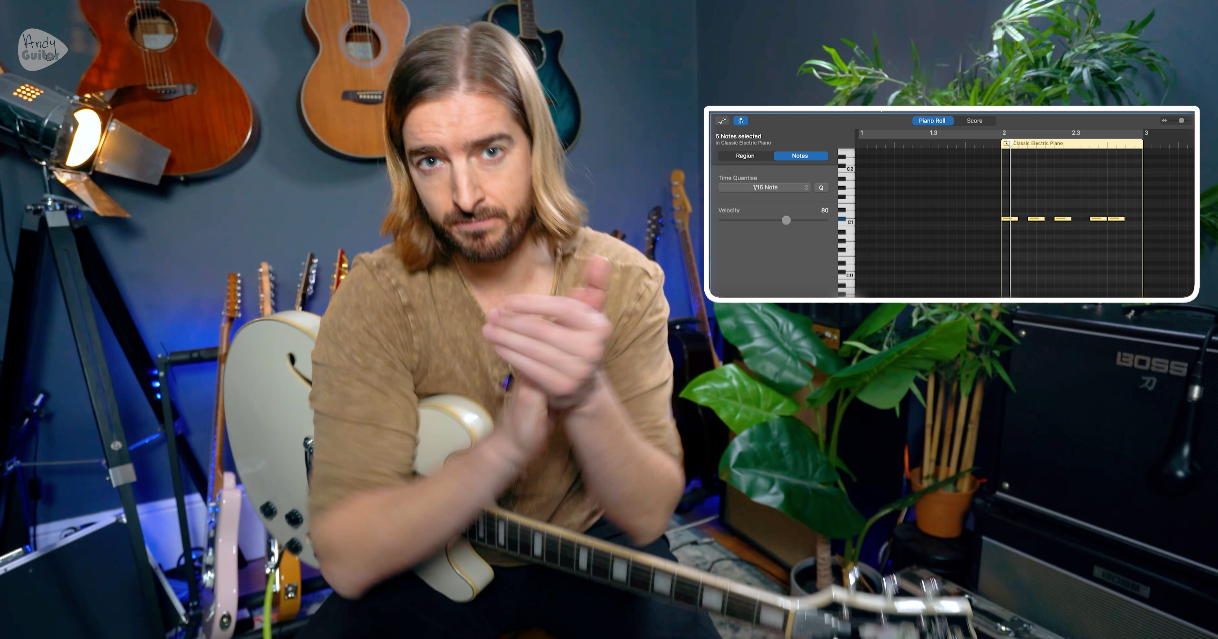
In this video
The clave rhythm is one of the most fundamental patterns in all of popular music, and at this level we go far beyond the basic beginner strumming version.
Known most commonly in guitar music as the Bo Diddley beat, this three-long, two-short pattern (a 3-2 clave) appears in everything from 1950s rock and roll through to modern EDM-influenced pop. Mastering it with 16th note strumming is the gateway to all intermediate rhythms - and it applies equally to rhythm guitar and lead lines.
What you will learn:
• The 3-2 clave rhythm and how it sits within a 16th note grid
• Applying the clave to 16th note strumming with muted strums
• Using the clave pattern for lead lines as well as rhythm parts
• How displacing one note transforms the feel of a rhythm
• Three key song examples: Not Fade Away, Faith, and Sky Full of Stars
The 3-2 clave rhythm and how it sits within a 16th note grid
The clave pattern is 5 hits spread across a bar. We break this down visually using a DAW grid so you can see exactly where each hit lands relative to the 16th note subdivisions. Understanding where the hits fall - rather than just feeling your way through - is what separates intermediate rhythmic control from beginner strumming. Once you can see it, you can reproduce it accurately every time.
Three key song examples: Not Fade Away, Faith, and Sky Full of Stars
These three songs give you the clave rhythm in three different contexts. Not Fade Away is the classic rock and roll application with barre chords. Faith works beautifully on acoustic with a slightly modified version of the pattern. Sky Full of Stars applies it as a lead line with a modern EDM feel. If you can play all three with accurate 16th note strumming and the clave accents in the right place, you’ve genuinely nailed this skill and can tackle any rhythm at Grade 3 and beyond.
Interactive Tab
Become a member to access this interactive tab section.
Applying the clave to 16th note strumming with muted strums
The intermediate-level skill here is maintaining a continuous 16th note strumming motion (down-up-down-up on every subdivision) while only letting the chord ring out on the clave hits. On every other subdivision, you lift the fretting hand slightly to produce a muted percussive strum. This works particularly well with barre chords, but it also applies to open chords where you release pressure to mute. This constant strumming motion is the engine that drives all intermediate rhythm guitar.
Using the clave pattern for lead lines as well as rhythm parts
The clave isn’t just a strumming pattern - it shapes lead melodies too. Sky Full of Stars is a perfect example where the lead line follows the clave rhythm note for note. Learning to apply this rhythmic framework to single-note lines trains your sense of timing and phrasing in a way that scale practice alone never will. If you can feel the clave in both your rhythm and lead playing, you have a rhythmic foundation that serves you at every level.
How displacing one note transforms the feel of a rhythm
One of the most powerful concepts at intermediate level is rhythmic displacement - moving a single note by one subdivision to create a completely different feel. In Sky Full of Stars, the second repetition shifts one note to a different position in the bar, and the whole character changes. This is the core principle behind how rhythm, melody, and harmony interact: learn a basic pattern, then displace it. That concept will carry you through intermediate and into advanced playing.
Intermediate Electric Level 3
Recommended Songs
Enjoying this course? Want to test out your new skills? Find out my recommended song tutorials that accompany this course and get total access to the site by signing up today!