
Learn the Fretboard: 6 Key Tones, Power Chords and Note Finding
In this video
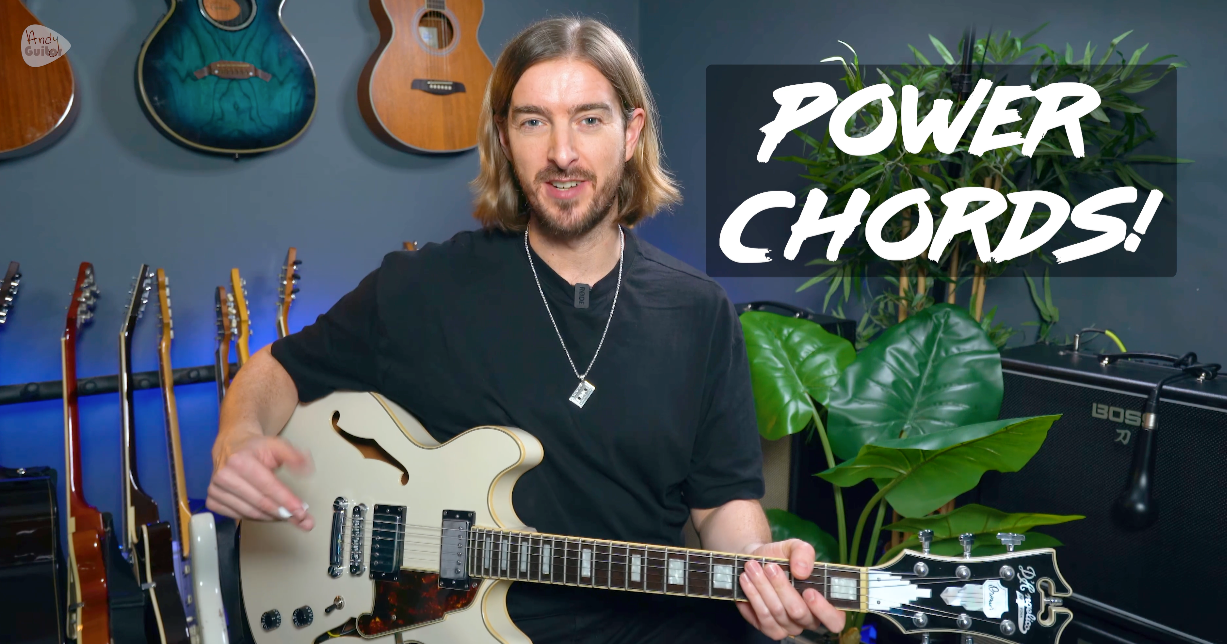
Knowing where you are on the fretboard is fundamental to everything that follows in this course. This lesson focuses on G, A, B, C, D and E — the six key tones found at frets 3, 5, 7, 8, 10 and 12 — and builds a power chord workout around them. The jam track increases in tempo through each cycle, developing both speed and accuracy.
What You'll Learn
• The six key tones on the low E string and where to find them
• How to use the note circle to understand sharps and flats
• A power chord riff workout that builds from 100 to 130 BPM
• How to use lighter picking and smaller motions to play faster
• When to switch from all downstrokes to alternate picking at higher tempos
Jam Track
Audio Jam Track
Audio Jam Track - No Guitar
The Six Key Tones
G, A, B, C, D and E sit at frets 3, 5, 7, 8, 10 and 12 on the low E string. These are your anchor points for the entire fretboard. From them you can work out any note using the note circle — including sharps and flats, which sit between any two natural notes that have a gap between them.
The Power Chord Workout
The jam track uses a riff built from G, D, E, C and D power chords, starting at 100 BPM and building to 130 BPM. This is the same approach as level 7 of Beginner Electric, but at a faster tempo. At slower speeds, all downstrokes work fine. As things get faster, switching to alternate picking becomes more natural and efficient.
Playing Fast: Small Motions and Light Touch
The trick to playing power chords at higher tempos is keeping the picking motion shallow and light. Less depth in the string, less pressure, smaller movement — all of these make speed easier to achieve. Tension is the enemy of fast playing. The goal is to feel effortless, even when the BPM gets challenging.
Intermediate Electric Level 1
Recommended Songs
Enjoying this course? Want to test out your new skills? Find out my recommended song tutorials that accompany this course and get total access to the site by signing up today!