
Jam Track: Alternate Picking
In this video
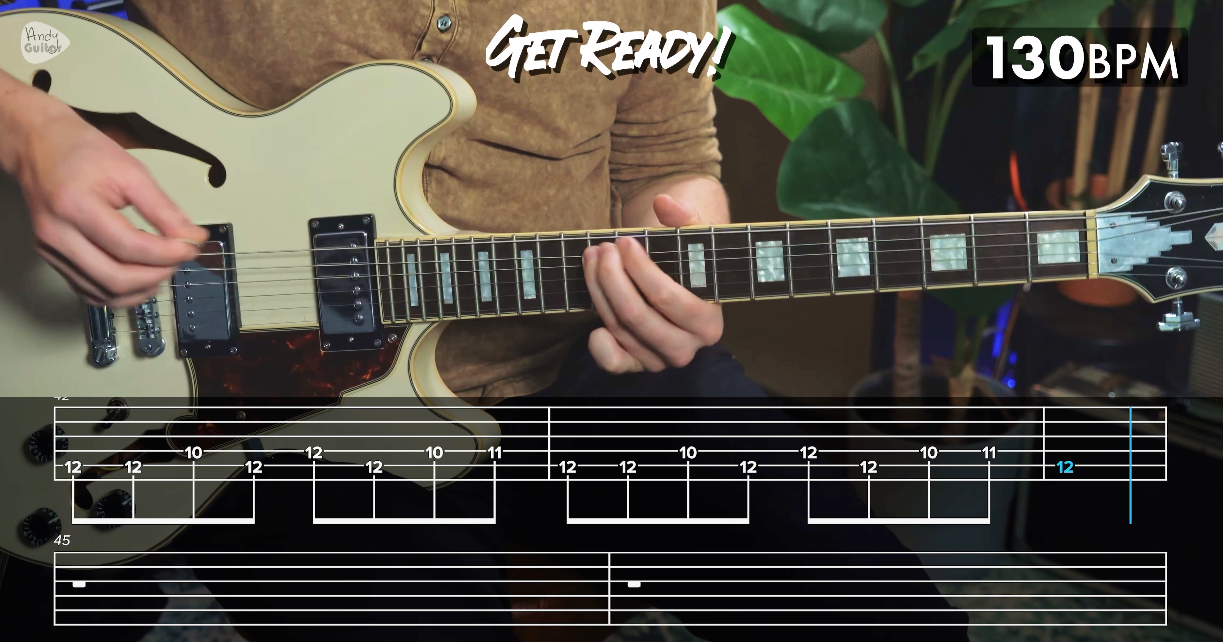
We return to the very first jam track from the Intermediate course, but this time the riff is played an octave higher — which introduces new technical demands and pushes your picking hand and fretting hand synchronisation further. This is a speed-building exercise structured around four increasing BPMs with breaks between each round, and it’s designed to expose any gaps in the coordination between your two hands.
What you will learn:
• Playing a familiar riff at a higher octave position
• The rolling technique for moving between adjacent strings with the same finger
• Mixing major and minor pentatonic notes within a single riff
• The minor-to-major note movement common in blues and rock
• Speed building through incremental BPM increases
Playing a familiar riff at a higher octave position
Taking a riff you already know and moving it up an octave is an excellent way to build fretboard confidence. The notes and intervals are the same, but the string set and fret positions change, which means your fingers have to adapt. This also reinforces the octave knowledge from earlier in the level — you’re applying it practically rather than just as a theory exercise. The riff moves across three positions (A, D, and E), giving you practice at each string group.
The rolling technique for moving between adjacent strings with the same finger
When the same finger needs to play notes on two adjacent strings at the same fret, you can’t just barre across both — one will ring into the other. Instead, you roll the finger from its tip (for the higher string) to its flat pad (for the lower string), or vice versa. This subtle shift in finger angle is essential for clean playing in this position and appears constantly in intermediate and advanced guitar. Getting comfortable with it here will pay off in countless future riffs and chord voicings.
Mixing major and minor pentatonic notes within a single riff
This riff introduces a major note (one fret above where the minor pentatonic would normally sit) alongside the standard minor pentatonic framework. This is your first taste of blending major and minor tonality within a single phrase, which is fundamental to blues and rock guitar. The important thing is to hear how the major note adds brightness and tension against the minor backdrop — it’s a sound you’ll recognise instantly from countless classic riffs.
The minor-to-major note movement common in blues and rock
Almost every time major and minor pentatonic are mixed in rock and blues, the movement goes from minor to major — not the other way around. Think of the classic AC/DC or Chuck Berry move where a phrase climbs up on the major note and resolves down on the minor. Recognising this pattern helps you understand why certain riffs sound the way they do, and it gives you a go-to move for your own improvisation that always sounds right in a blues or rock context.
Speed building through incremental BPM increases
The jam track runs through the riff at four progressively faster tempos, starting at 80 BPM and increasing with each round. The breaks between rounds are deliberate — they give your hands a moment to reset before the next speed. The goal is to keep the riff clean and even at each tempo, only moving up when the current speed is comfortable. If it falls apart at a certain BPM, that’s your current ceiling — stay there until it’s solid, then push again. This is how real speed is built: incrementally and honestly.
Jam Track
Audio Jam Track - All Instruments
Audio Jam Track - Backing Only
Intermediate Electric Level 3
Recommended Songs
Enjoying this course? Want to test out your new skills? Find out my recommended song tutorials that accompany this course and get total access to the site by signing up today!