
Arctic Monkeys Player Study - Intermediate Electric
In this video
Throughout Level 5, Arctic Monkeys have appeared repeatedly as reference points — for the natural minor scale, the harmonic minor, pattern studies, and the three-note runs that characterise their guitar work. This player study pulls all of that together. There's a main riff and a higher secondary riff, both using the seven-note minor scale rather than the pentatonic, in F sharp — a key that's underused by most players and will immediately get you out of the habitual E and A comfort zone. The jam track is below, and the challenge is twofold: learn the two written riffs well enough to play them in time, then improvise over the backing using the natural minor and harmonic minor scales you've covered in this level. The goal is to start using the full scale vocabulary you've built, not retreat to the pentatonic when it gets uncomfortable.
What you will learn:
• The main muted riff and its structure in F sharp minor
• The higher secondary riff and how it uses the seven-note minor scale
• The difference between natural minor and harmonic minor in this context
• How to approach improvising over the jam track using the full scale
• Why F sharp is an important key and what Arctic Monkeys songs to reference
The Main Riff
Palm-muted and repeating, built around F# minor — the complexity is in the feel and the muting, not the notes
Consistent muting throughout — the rhythm needs to lock in with the groove
Practise it with the backing track, not just in isolation
This riff sits between your improvised sections — it needs to feel completely automatic
The Higher Secondary Riff
Comes in during the quieter sections — angular and melodic, uses the upper part of the natural minor scale
Think of it as a spider walking up and down the stairs — deliberate and precise
Uses the full seven-note scale, not the pentatonic — every note has to be intentional, no drifting
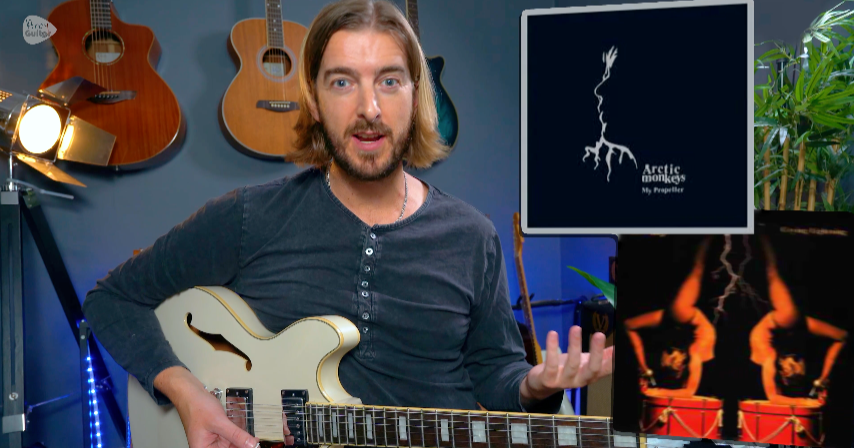
Directly related to the lead work in My Propeller and Crying Lightning — both worth listening to alongside this lesson
Natural Minor and Harmonic Minor
The track uses both — they differ by only one note, the 7th degree
Natural minor gives you the flat 7th — harmonic minor raises it by a semitone, adding tension and a darker edge
In improvisation, move between the two instinctively — reach for the raised 7th when you want more tension
Crying Lightning is the clearest demonstration of the harmonic minor version in action
Improvising Over the Backing Track
The main challenge: resist the pentatonic — it's the safety net, and this lesson is about leaving it behind
Use natural minor shape one and the three-note patterns from the earlier lesson
Listen for where the extra notes add colour — the ones the pentatonic doesn't have
You will hit wrong notes — that's expected, that's how you find the right ones
Arctic Monkeys Jam Track
Why F sharp and what to listen to
Most players live in E and A.
F# feels unfamiliar at first, but that unfamiliarity is useful — it forces you to think in scale shapes rather than relying on familiar open-string patterns.
Are You Mine? and I Bet You Look Good on the Dancefloor are both in F#, and both are worth listening to with this lesson in mind.
F#minor sits one fret above E, which means all your scale shapes translate directly — just shifted up one fret.
Once you're comfortable in F#, you can apply the same logic to any key.
That generalisation is the long-term goal of everything covered in this level.
Intermediate Electric Level 5
Recommended Songs
Enjoying this course? Want to test out your new skills? Find out my recommended song tutorials that accompany this course and get total access to the site by signing up today!