
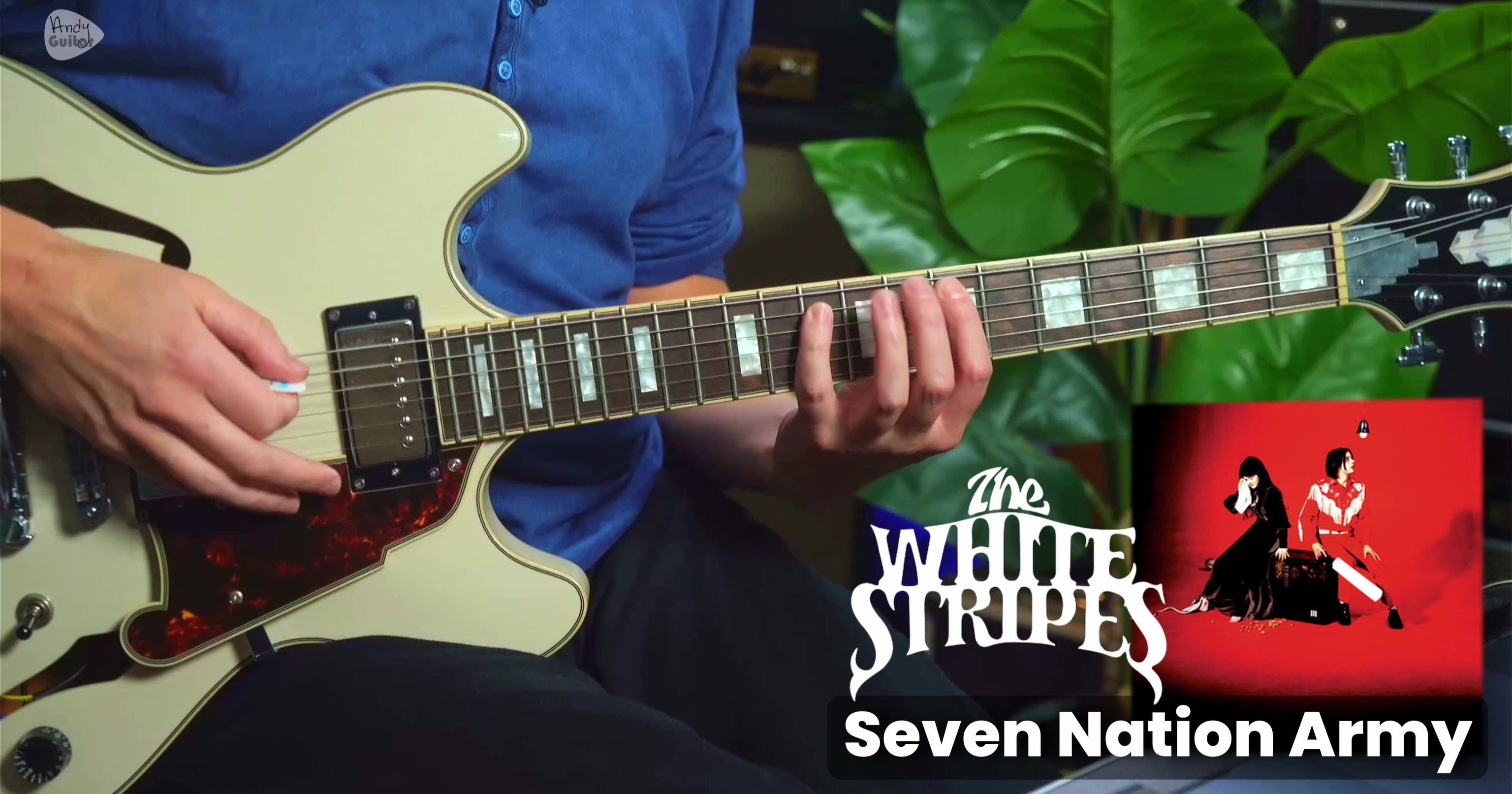
In this video
Two iconic lead lines that teach essential intermediate guitar concepts, starting with "Seven Nation Army" by The White Stripes. The solo uses the natural minor scale - your minor pentatonic with one added note. This creates that "Paint It Black" sound. The pattern goes 9-9-12-14-12-12-14-12-11, then jumps up to the octave at the 17th fret. The technique includes overbends and vibrato, originally played on slide but works great with standard technique.
Learn the full solo, not just the riff. If you're intermediate going toward advanced lead guitar but only know basic riffs, start learning the lead parts from songs you already know - even if they're short or originally played on slide. "Highway to Hell," "Wonderful Tonight" - whatever songs you currently play, add their lead parts.
"Apache" by Hank Marvin and The Shadows is a perfect instrumental for learning melody-based lead playing. Cliff Richard bought Hank Marvin his first Fender Stratocaster (probably after hearing Buddy Holly), one of the first in the UK. The iconic opening riff moves down as the chords change - when it goes from A minor to D, the lead line goes to a D note (the octave connection across the fretboard).
The key insight: the melody follows the chords using triads. When the rhythm plays F chord, the lead plays F chord notes. When it changes to G, the lead plays a B note (part of the G chord). When returning to A minor, it finishes on an A note. This principle applies to most lead parts and riffs - understanding triads is essential for melodic playing.
"Apache" also features rhythm guitar techniques like palm muting on single notes on the low end, which is why single-note riffs appear throughout lead guitar courses. Arctic Monkeys' "Brianstorm" demonstrates this with its quick hammer-on slides using the little finger. The song also uses whammy bar techniques for that authentic 1960s Shadows sound.
The breakthrough happens when you learn more lead parts than just riffs - you start seeing how melody and harmony connect through triads across the entire fretboard.