
Beginner's Guide to Electric Guitar Gear (Accessories)
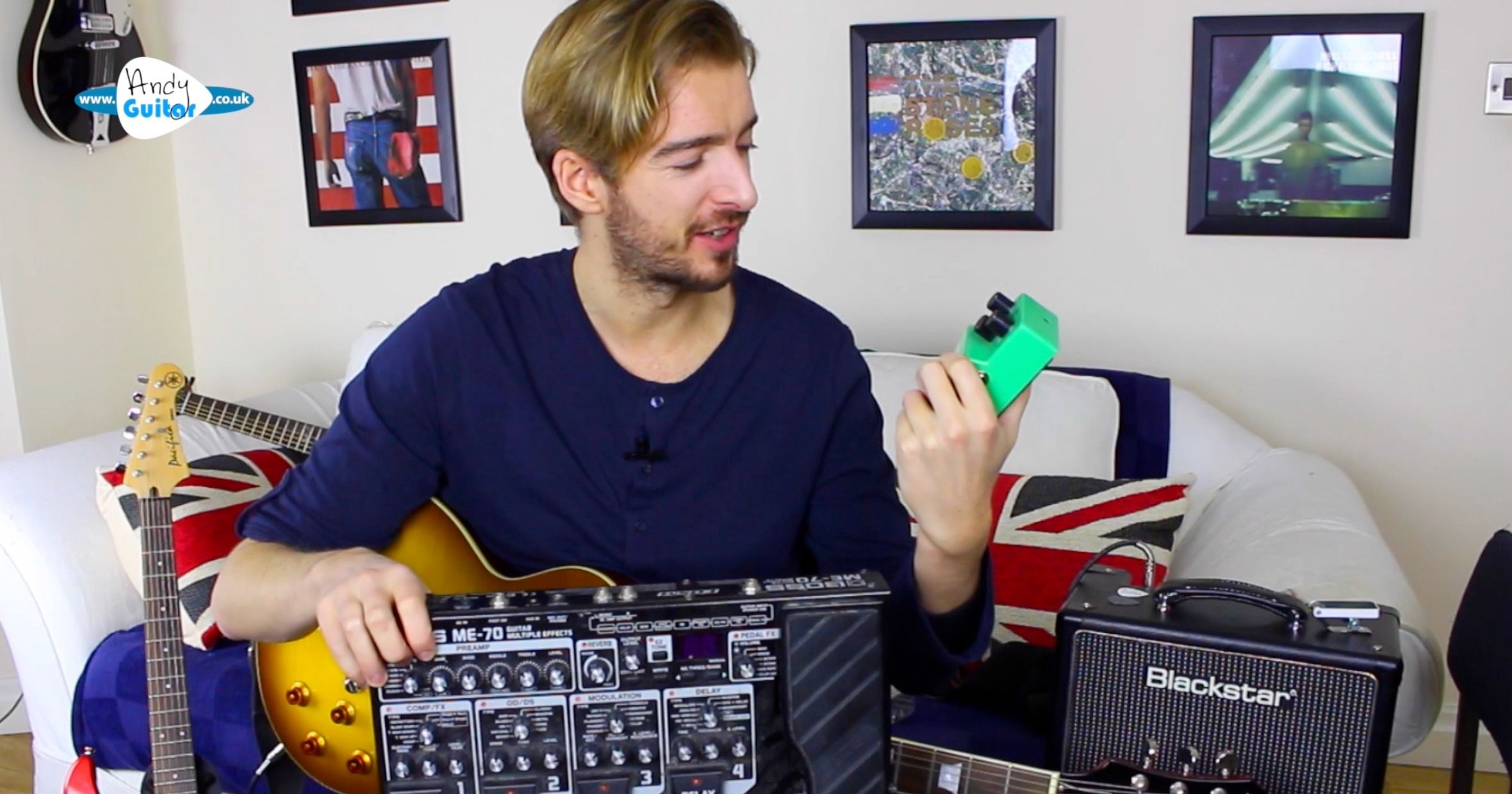
After having your guitar, a lead, and the amplifier, the next thing that I'd really recommend that you invest in, and it costs as little as a few pence, is a guitar pick. Now we do have Andy guitar branded picks, so we can see one there in uh available from my store. On the shop page, one thing that a lot of students complain about with any picks is that they drop them a lot. And the one pick that I'd recommend if you do drop your pick all the time is a Dunlop Maxi Grip pick which has a sort of textured edge to it. And especially when I'm recommend recommending that you hold the pick between your thumb and your first finger like this. um we'll have more detail of that on the website if you click through to there how to hold a pick. um. That can be a lot of struggle, it can kind of move around people's fingers, kind of spin around. So if that's a struggle for you, Dunlop Maxi Grip picks, and this particular one is a 0.73 which kind of does everything. It will do the strumming, it will do a single string picking. Um, that's a real, a real goer for a lot of people. I really think, um, if you drop the pick, that's a good example to go for. The next most crucial thing to make sure you get is a tuner. Now this one is a clip-on style tuner by TC Electronic. It's uh really super because it tells you what what notes you're actually playing. Um, so for example if I hit my thickest Estring, you can see that it's a little bit low there but it is saying an E. If I change this note, so maybe if I put it down and I want it to be a D. So I put myself in something called drop D tuning. Um, it actually tells me that that note is a D, and a lot of tuners don't work unless they're in standard, uh, unless you're going for standard tuning, and that's the same with a lot of apps, especially the free ones. They don't tell you what note you're tuning to so it's hard to put yourself in other tunings. Now that might not be, you know, the most important thing at the moment, but it is a good thing to know that some tuners. Offer as you go forward. If you need a free tuner, just download Guitar Tuner from the App Store. I believe it's on Android, but I don't know 100%. But at least it's a free app to make sure you can get your guitar in tune. But make sure you know that only works in standard tuning and you might wanna get yourself something like a clip-on tuner to make sure that you can do some other tunings later on. Now we are talking about electric. Guitar here, so you might want to invest in a guitar strap. A guitar strap simply allows you to be able to stand up and uh look cool while you're playing your electric guitar. Now is that absolutely essential? No, but why not go for it when guitar straps cost as little as around 5. So I'm sure you can get them for $5 as well, but I know they're for sale for 5 pounds in the UK. Um, it allows you to stand up and, um, not only look cool, but there's a tendency when we're playing guitar, electric or acoustic, when we're sat down all the time to kind of hunch over and kind of wanna look at our fingers like this. And you know it's quite common for people to complain of neck ache and I I've certainly been in that in that position uh in in the past. Just from kind of leaning over and doing this. And if you stand up it suddenly kind of eradicates a lot of those problems. Um, the best advice I can give you is all straps are adjustable with the the length of them. And if you set the strap while you're sat down. Then it shouldn't matter whether you're stood up or sat down, it will be in the same place, but when you're stood playing guitar, it should sit in a lot more natural position and your strumming hand in particular will sit in a nice position for you to be able to play these riffs. And if you sit down, especially if you kind of slump on the back of a couch like I know many people do when they're practising cos you're practising at the same time as watching lesson. Or whatever, it's the guitar slumps down like this, you play like this and it's not the correct way to practise, you're gonna develop a lot of bad habits. So set the strap length while sat down and then practise stood up as much as possible. The Les Paul type in particular can be quite heavy. So if you wanna stand up with it, maybe do it fifty-fifty or consider a lighter guitar. Um, but again. That's why you'd go down to the guitar shop and try these sorts of things out for yourself. But electric guitar, definitely go for the strap. If you start gigging either professionally or just with a band, it can be handy um to either get strap locks. So what I recommend, just put a washer on your guitar so there's no way my strap is gonna come off, um, even if I swung it around my neck, which I'm not gonna do, but even if I did. Um, because I have a washer on it at both sides and my strap's not going anywhere. It's a nice little tip. They're the bare essentials to make sure you can do everything that's in this course. So we'd have, um, electric guitar of your choice, a lead, the amplifier, picks, tuner, and then hopefully, uh, a strap at some point. Um. That should take you through around the first year of playing electric guitar, no worries at all. The extra things that I'd really recommend just as a couple of little extras, at some point you're gonna need to change your guitar strings. Now the guitar strings that I recommend and I'm recommending Ernie Ball strings because they offer the um thinner strings which are fantastic for guitarists, especially beginner ones, and especially when you if you start doing the harder stuff like. bending, thinner strings are fantastic. When you first start out, a lot of people, even on electric, complain about big lines on their fingers and the fact that, um, guitars are really, guitar strings are really hard to press down and hard on your fingertips. Thinner strings really helps that in my opinion. And you can try them out just by buying a set, changing the strings and going for it. And the other thing is, make sure you change your guitar strings around at least every 6 months. And if you're playing really regularly. Maybe every 3 months or when you see that they're kind of visually not as bright as as they once were, but it can be kind of, you know, you you don't always tell that the strings are losing their brightness, um when when they're on. So at least every 6 months, I think a lot of people either online or beginner beginners have a pathological fear of changing their guitar strings. It's something you've gotta get over, guitar strings are, you know, like. Like pencils, you you you're constantly gonna go through them and and kind of they they will break. And they are consumable things. They're you're gonna go through them, they're not gonna last forever. Um you can extend string life with something like fast fret, so kind of coating the strings with uh something called fast fret. But really you wanna be changing your strings typically more often. And the thickness of these strings. From 8 to 38. And um if that's a bit too thin when you try them out um the the other ones could be 9, so that would be 9 to 42, that's the pink set. Um but I highly recommend thinner strings, especially for beginner electric guitarists. Um, it will make everything easier to play, be more forgiving on your fingers and I'm sure you will thank me again at some point. Another great thing to get yourself if you're learning electric guitar as a beginner or at any level is a capo. Now a capo essentially clamps down the strings at a certain fret. In this particular little short starter course of mine for an electric guitar, we don't use a capo at all. All in this course, but for loads of beginner songs that are on my website that work for both acoustic and electric, we do use a capo. Now this is a trigger style capo. There are many different ones available. I don't recommend any particular one, this is just one that I kind of grab to hand. And this one, it looks like this. I do recommend the trigger type guitar because you can squeeze it and put it on more easily and they are as affordable as you know 2 or $3 so a couple of quid on eBay if you're unsure about them just give one a go for a couple of quid and um it essentially means that we can play the same chord shape for example an E. And then move it higher up the neck by putting the capu on, we can play that same E ship. But it sounds higher, so we're changing the key, um, as I say, not essential for this course but highly advised for any beginner. The other awesome thing we can check out with electric guitar is guitar pedals like this one. This is a Tube screamer TS 808. It's a bit of a vintage one, a lot is secondhand. And um pedals, guitar pedals for electric guitar can do any number of things. You can even make your guitar sound like an acoustic guitar by plugging into a pedal like this. I highly recommend kind of checking out what's available. They're pretty inexpensive, you know, they start from $20 or $30 especially secondhand. Um, up to whatever price you want to pay for them. But they do such a range of things. If you buy individual pedals one after the other just to try and try them out, um, it can get a bit expensive. So one way to kind of get a lot of pedals en masse, and the thing that I got when I was a beginner electric guitarist, is a, uh, multi-effects. So this is kind of. You can kind of tell by the look of it. Many of these sorts of pedals doing any number of things. Far too many for me to demo in this particular lesson at home. This one's even got a whammy pedal which controls everything from the volume to giving you a wah wah pedal to making your guitar sound like a bass or a kind of space laser. This thing does absolutely everything. Um, these are available from anywhere from 100 pounds to 200 pounds, um, again up to whatever you want to pay. I think knowing that they're available. Here's a great idea just to keep an eye out when you feel like you know you're learning songs and you're not able to recreate the sound because it maybe does use a wah wah pedal or it does use delay. These are a very affordable way to kind of get all your pedals that you could ever hope for and more all on one, you know, starting from very budget in in in the multi effects range. They're pretty good these days. Or you can go what many guitarists prefer. And by individual pedals and you know these make uh great pedals for a guitarist in your life or to you know ask your mum and dad or friends for for for Christmas because um the single guitar pedals are quite inexpensive and they are awful fun when you get into them. So something to consider but not essential when you're first starting out. But they are there for your consideration when you fancy them. Thank you very much for watching guys, bye for now.
In this video
Common guitar FX
Some amplifiers have effects built in, many don't. I prefer choosing an amplifier without effects as you tend to get a better quality amp if it doesn't have a lot of flashy effects on it. You can then choose the effects stomp boxes you like, or purchase a multi FX to cover all the bases. in my experience, FX that come in stomp box or multi FX format tend to be of higher quality than those that are built into an amplifier.
Reverb – the sound of a space, a room or hall sound, basically a lot of echoes but they sound just like a room or a big hall.
Delay - can be a single echo, or many echoes, but each ‘delayed’ sound can be heard think the guitar sound of U2 songs, or when you shout down a tunnel
Chorus - The sound is duplicated to sound like many guitars at once, like a 'chorus' of singers. Very 80s sounding with a watery/ ripple like sound quality, used in the intro of Knocking On Heavens Door by Guns n' Roses!
Phaser - Similar to chorus, but sounds different. Hear it on the intro of Mystery Song by Status Quo!
Flanger - again similar effect type to chorus, but sounds more like a jet plane taking off! Hear it on Breakdown by Foo Fighters!
More gear and effects pedal talk to come later in this course. That's enough gear talk for now - let play some electric guitar! See in the next video.
Electric Guitar Starter
Recommended Songs
Enjoying this course? Want to test out your new skills? Find out my recommended song tutorials that accompany this course and get total access to the site by signing up today!