
Big Truck - 2000 Trees Interview
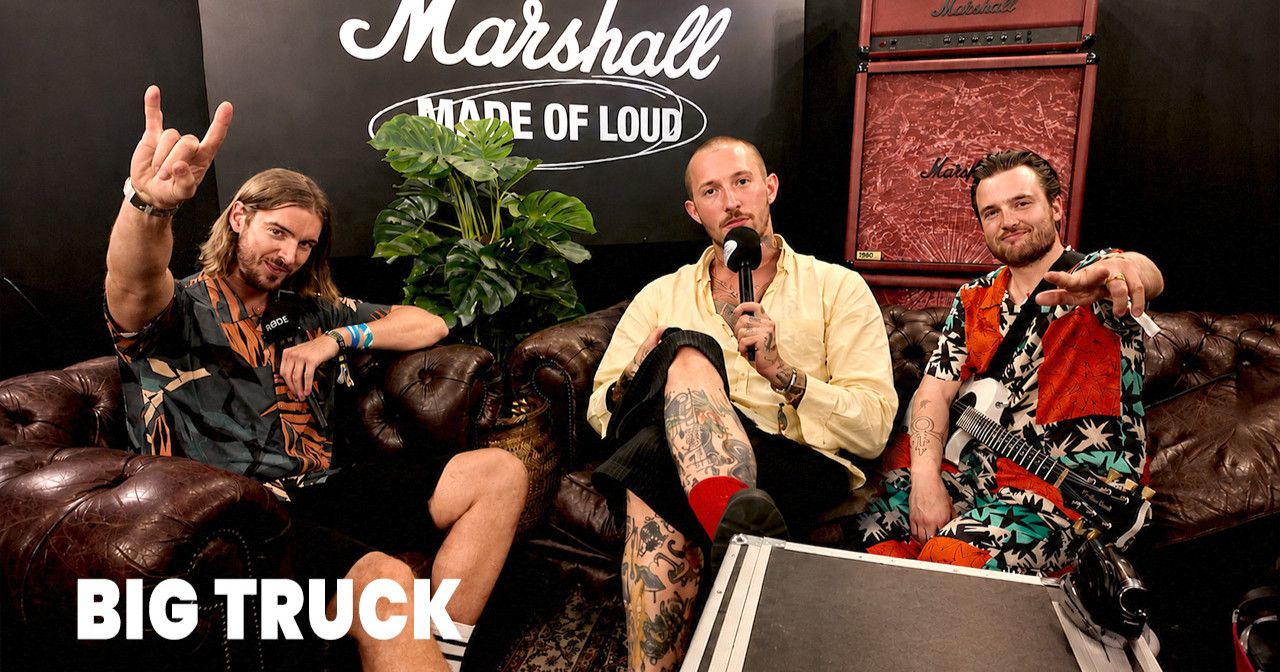
Yeah, so I was so desperate and driven to learn guitar that I actually went through about 5 guitar teachers. So I started at school and they taught you how to play Happy Birthday, and I was like, this is bullshit, I wanna learn how to play rock music. So then the rock guitar teacher turns up and he goes, what do you wanna do? And I was like, I wanna be like Slash. So he sat there for an hour confusing me, playing um scales, and I just didn't understand why and what it was for. And then I had another one and another one and eventually a guy called Chris Waters turns up to my house. He pulls out an acoustic guitar and he goes, This is a G chord, and then he showed me some other shapes and he went, That's Wonderwall. And then he left and I was like, Holy shit, I can play. And by teaching me songs he let me access music. Hi, my name's. And I'm Sam, and we are Big Truck. You are, and we're at 2000 trees, and we're very excited. You're playing later on the marshall stage. Yeah, that's the marshall booth, lovely to be here. Um, obvious questions first, you know, you're in a band, big band already, soft play. Why big truck, why now? I think about this a lot and the easiest answer is. I wanna like explore my full creative potential where there are no limits or boundaries set, and that's what I'm doing. Good man. And you obviously, this is, you know, your sound outside of soft play. And we are very familiar with that sound, but this is very different, and from my research you Sam, you bring a bit more of the jazz background into all of this. You've got you've got some skills as far as I'm aware. Oh cool, I like the idea, I like the idea of that. Um yeah, I play um I play drums in Softly, thank you so much. Um I play drums and um we've got a um. Of of a great history, um Laurie and I and uh yeah, so jazz, I was always, even when I first, we first met I was playing, you know, in big bands sort of like after college or whatever just to try and get my chops up and um, and it was, it was, it was a a it has been a theme in my life but also like kind of uh, producing music that's influenced by grime music and punk music and, All over the shop basically, but yeah, it's been quite a marriage, isn't it? Yeah. And rightly so, and what we've been talking about a lot this weekend is resilience in musicians, but also this unbridled creativity, like you're not pigeonholing yourself. Often we get forced to, as creators on YouTube like myself and musicians, you know, you find your sound, find your voice, and then it's like. Well, that's a very narrow way of thinking about things, and this is you taking the guardrails off and doing what you want, right? Yeah, I guess inherently we all have a sound and a voice the same way we have handwriting, but what happens is we become distracted by trying to emulate our heroes, and then we actually become something that is not ourselves. So the real goal and what I think we've accessed. Is, like you said, take the handrails off and actually be yourself, and it's a far more scary prospect because no one sounds like you. So you have to be vulnerable enough to show the world who you are, regardless if it, if it sounds like someone else successful before you or not, and just give it to the world, because we don't have you yet, they've got everyone else already. I couldn't agree more. What have you got anything to say on that sound? Oh, just beautiful. I love it. um and also watching Laurie come into his uh full power. You know, he still was in a state of disbelief when we were recording this album of like how awesome he his treasure is, you know, and uh that his lyrics are and his songs um so this was. Wicked as a friend, you know, to see it unravel and become self-aware. Absolutely, this sort of thing doesn't happen overnight. Tell me, was this sort of thing encouraged at all, like as a as a teenager? We talk about inspiring the next generation, but sometimes. My my feeling was that my parents really gave me the foundation to do music. They took me to gigs, they bought me instruments, they paid for lessons. So where they couldn't necessarily give me that themselves physically, like they didn't play guitar or write songs, they enabled an infrastructure to allow me to learn, which is a real privilege um and it was still hard even with that support. What about yourself, Sam? First songs, first riffs? I mean I didn't dig the one note things but I also couldn't play chords very easy, it took me a long time to get my head around that. I remember a friend of mine learning guitar. You know, I'd been doing it for years and he'd played all these chords. I was like, Um, but, but your chord playing is percussive now. Sam's a drummer by trade. And lots of people don't know that cos he was the leader of Ladybird. But when I watch you play chords, they have a percussive energy. Yeah, my one of my favourite guitar players is Keith Richards for that reason, you know, he's like, he's like a percussive player, so his thing's being behind the beats. That's the Charlie, he's trying to rein in and they're all super behind the beat and it gives it that swagger and sway that they have in their personality anyway, yeah, but it's in the, it's in the music. Miles Davis says that white guys are always behind the beat. Oh really? Yeah, I'm always ahead of the beat. That's the punk thing and that makes small gigs more exciting, but sometimes when you play a huge stadium, the slower stuff uh hits to the back of drag the room. It pulls. There's a drummer, I can't remember his name, he's an experimental jazz drummer and he bought a load of heart monitoring equipment and he basically through his amateur scientific studies proved that your drumming is directly linked to your heartbeat. Or your beekeeping, so your style, so whether you push or pull, it's your heartbeat, really, well, look, there's a reason the uh. You know, most songs are between what, 60 and 140-ish BPM, that's about the range of a human heartbeat, isn't it, BPM. Exactly, it comes from the soul, man. What do you think, you know, speak more on this. What, what do you think playing rhythm, and rhythm can be the hardest thing to teach. Especially when people just ain't getting the underlying beat kind of thing. What do you think learning drums first and being a drummer at heart has given you on guitar? That it wouldn't give someone who's only played guitar all their life. You can stay in time. Music, yeah, staying in time, I try, I try, you know, but then being able to play with stuff like that and how you hear the guitar, the attack of the right hand perhaps. Yeah, I think so, and knowing how to dial that in as well, cos you do too much for sure. um and and and depending on your amp settings and stuff like it can be that's not sound great, right? um but uh. Yeah, I do think I've translated a lot of stuff from guitar to drums as well, um, like listening to the mood of the other players as well, um, and then playing off of them and listening to dynamics is like really hard to do, especially if you're, you know, like. Like this, you know. But what would you say, how, how are your songs coming about, because you know, this is, this is a new band for this year, but this doesn't all come together. This must have been a lot longer, that you must have had a stockpile of ideas and songs and now you've gone, OK, this is, this is the act, this is the band. Yeah, I guess it sounds like a band, not a solo project. Yeah, do you know what, it almost feels like um an artistic exploration, a spiritual enquiry, um. I had an interesting moment with Sam where I was playing him like soft play demos and my demos and he was like just as excited about my demos and my spirit in its songwriting infancy needed some encouragement. I found my voice by belief and confidence and you can hear the fragility in like. The Larry Pink, the Human material versus now, I'm like on stage going I can sing and he's always been like, well of course you can. There's this unwavering self, or unwavering belief in me that has opened up this tap to just channel songs that are just, and it is very much a band, Sam brought in the other members. And it's become significantly obvious how important each individual, I didn't want a keyboard player, I'm old school, I'm like, oh, they're lame. The Doors are the only people that have ever got away with it. And he brought Justin in, and I was so wrong. And it's, it's liberating having 4 musicians coming from different angles, all influencing a project. It feels like that's what pure creation is about, it's what being in a band used to be about. It's not about finding 4 dudes that are all the same. Or even the best musicians, that's why supergroups never actually work. Yeah, because they don't have a shared, the shared thread we have is our past together and then the geography of our place. To have four people that geographically didn't land in the same place just for the purpose of making music, it can work if you have, yeah, I could go on about it for ages. An interesting thing about what, cos what we're talking about, someone said to me the other day. Because Soft play's a two piece, I always said that Peter Hook was my biggest influence. So I played guitar like a bass, in my opinion, that's what I wanted to do. And then someone recently from Marshall said you play bass like a guitar. It's this idea that you actually can, there's still stuff that hasn't been discovered on these things, and your version of doing it is still so valued, rather than someone. I don't know. Rather than someone just like picking it up and going, oh I can't shred, and it's like, well, do something else. I couldn't agree more, I've just reread Peter Hook's book on the hacienda. I've read all of them. They're fantastic, aren't they? he writes so well about it, but so influential. Speaking on the sound is the one. Bit of gear um that just defines the big truck sound that you couldn't live without now, and it can be a Marshall stack or it can be a 15 pound pedal. Well, it costs £1. What comes to mind? Yeah, it came, it came from Hospice in the world and it's this old um Farfisa keyboard. Yeah, and it bargain. And this bargain has been used on maybe 6 out of the 6, over half of the album basically. It's, it's the kind of thing that if you're trying to find a synth or a keyboard sound on a, on a door, um. You spend hours and you're like none of it sounds good, whereas this thing has got like 6 settings and that's it and they all slap. Yeah, yeah, and, and no one's got them, you know, um, but also, you can tell it's a mainstay piece when, you know, we go to gigs where we're just taking the minimal rig, and it's always, it's always there, you know, but it reminds me of it's a lead instrument. It reminds me of the uh Damon Albar's er Grill, one of the gorilla songs is literally just. It's literally just one press play and that's it. But it's what you do with that and stamping your care and having something to say which I think talking from you guys, I've talking to you guys I've learnt it doesn't happen, it doesn't have to happen overnight. It can be cultivated over time, but when the time is right, you've got to double down on it, right? Yeah, so there's something that I discovered or realised through doing this project, that a lot of bands are in such a hurry to be a band that they forget to do it for the art. And what I mean by that is they get to the point of playing a gig like this, and they've already somehow forgotten that making the music is the most important bit or playing the music. So you get swept up in photoshoots, in attitude, in riders. And I've done that, like, it's like, like it's become about how big can we be rather than like what, what, what creative decision do I wanna make next. This was never meant to get to this point, but because the intention has always been pure, people sense it and they champion you. So the only thing I like really can suggest to people that wanna get into it is do something that genuinely feels real, feels about you. I couldn't agree more, just as you're playing guitar there, final question, what's something you found hard on guitar that and you had to overcome? For some people it's bar chords, for some people, for me it's vibrato and string bending and stuff. One thing that you found hard to play on guitar. Um, remem just remembering stuff. Yeah, yeah. Like how does that one go again? Yeah, just like, um, cos depending on how your brain works, you, you approach it in, in a different way. Some people do it like just from their ear, some people do look at shapes, and some people, you know, count numbers, right? Um, so yeah, I feel like just remembering what, what sounds good. Yeah, and, and, and, and not being intimidated by what other people do and yeah, being authentic, yeah. Mine is the. I often think about this, I still struggle with um notes, like, if you call out a chord, I can just about manage most chords now just by the like G chord, yeah, fine. As it gets a bit more confusing, like I can do, I know some diminished sevenss like quite quick. And I still like in my head I only remember G, A, B, C, D, E, yeah. And then I have to work around backwards and forwards. Or, or, or through octaves because that's a, yeah, through octaves. So I actually have done this thing where like I think about it, I'm like I could have spent the last 26 years and just done it and just learnt it. But now my body does, my fingers do this thing where they feel where the next note is. And they are being led by the creative mind rather than the visual I know where that note is, so I'll play it. And in like in jazz, there's like that theory that as long as like the first note is right and the last note is right, you can play any note. You know this one, this one's fun. This is um this helps me out loads. Because it's the, the motifs and the vibe you're playing can basically trick people's minds into you doing the right thing. So if I had learned too much theory, and it's something I witnessed when we were younger, that much far superior learned players were stuck inside boxes because they thought too much about theory. I, I use a lot of theory unknowingly. But you're putting emotion on every note and recalling it, remembering it, so it's there to use when you, when you're inspired, right? Yeah, this guy's tonal palettes on lock, on speed dial. Yes, it is. Yes, yeah. And that's the one we're using and therefore that's the thing. We'll have to leave it there guys. All right, Sam, thank you so much for pleasure to finally meet you, dude. Indeed, likewise, big truck. Check them out. We look forward to your set later on the marshall stage. Thanks dude.
In this video
Andy speaks to Laurie and Sam from Big Truck at 2000 Trees. Topics include why Laurie started a project outside of Soft Play to explore his full creative potential, the importance of vulnerability in finding your own sound, Sam's background as a jazz and big band drummer and how that feeds into their guitar playing, the theory that drumming is linked to heartbeat, their essential piece of gear (a Farfisa keyboard bought from a hospice for £1), and why bands that focus on the art over the image tend to connect more genuinely.