
Do you need a special guitar for percussive playing?
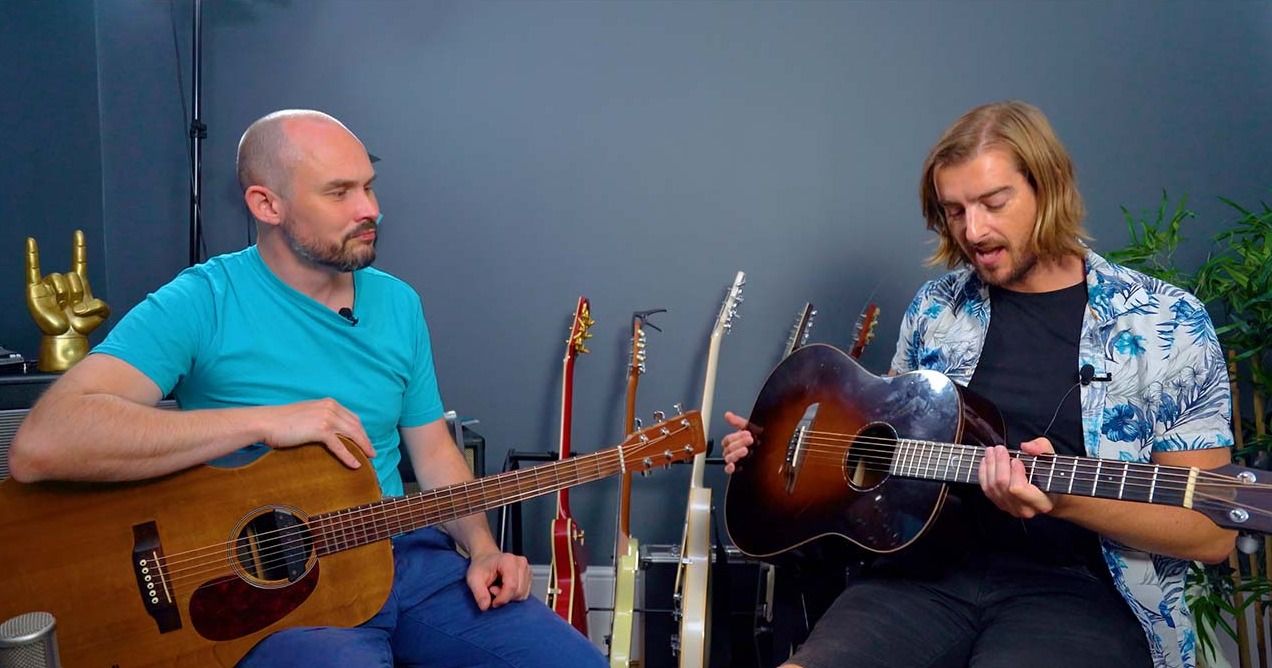
So on the guitar itself, is there anything at all that people should be looking for or does any guitar work for a percussive finger style? 100%, it all works. I mean this guitar that I've played and had for years is a a real cheap guitar, well in the. Vast in the continuum of uh of guitars like this is a sort of a 500 quid X series Martin and I love it and it's been everywhere with me. It's also, it's quite a shallow guitar as well, so it's not like a huge sound in that sense, and it works great. So, I mean that's just the crucial thing to know that anything works and it's fine. There is like a real movement in. Having bigger and deeper guitars in a sort of a modern guitar making thing, but actually it's a wooden box, so it's just, it works, it works. String gauge, I think if you're experimenting with different tunings, yeah, which tends to be quite a crucial part of all this stuff, then I think having sort of heavier strings, if we're using like elevens and stuff or tens. Might end up with a little bit more wobble than you want. I mean really, you can really hear a gauge 10 or 11 string on an acoustic guitar, way more than you can like 9s and 8s on an electric. So kind of a standard gauge acoustic guitar string I would say is 12s. That's like the middle. That's what will probably be on a guitar if you buy it from the guitar shop, brand new. And as soon as we're down tuning to, to what, for example, as soon as you get to dad God, so some of those strings that have gone down a tone. Yeah. Are we making the string gauges heavier than you could get away still one in Daga with a 11 or a 10 even. But yeah, once you go past that one for sure, you wanting to compensate. Yeah, it's the lower ones, but also sometimes we're doing, I mean, I, I dropped my G. To an E quite a lot, for example. OK. So you would definitely get two tones down similar like you going down to see. That's when you're looking for sort of for what would you be going for? I play with 12 to 56, but a lot of percussive players work with 13s as well. I'm basically a wimp. So you know, I've always liked to slinky top heavy bottom, electric guitars. You want to be able to bend the strings still and you don't want that to really compensate you playing, but you want to boom your low end. And acoustic guitar, you'll hear it a lot more on electrics. You hear in the amp and the pickups way more than the strings, but on acoustic was kind of enough. We haven't got an amp given as overdrive and stuff. So it does matter. And the resonance in the room when you're playing it with thicker strings on the low end. Feel it. You literally feel it. It's hitting your body. Yeah, but then at the same time when, when you pick up a guitar that's got lighter strings that do what I tend to go, oh wow, this is amazing. Everything's easy with thinner strings. It's true, you know, and yeah, I'm all about making it easy. So I, I think for me 12 to 56 has kind of come to, I used to be 12 to 53, yeah, um, but then I sort of did some push-ups and stuff now. 56 the fingers. I want you to as well just by comparison, play something on this guitar now and we'll compare it to my. Uh, beginner acoustic, my signature model. In the room It's sounding pretty close, like it's not a world of difference. Oh absolutely. I know from playing that guitar a lot for videos though that if you had to do that for a gig, not even for being plugged in and stuff, just for the length of time, you would tyre more quickly doing it on that guitar than on this one, wouldn't you? That's what I feel when I'm literally filming videos compared to some more expensive acoustic guitars. I just, it sounds. Very good by direct comparison, but you just fatigue more because of the nuances that you can get right with more expensive woods. I mean, I can just feel how solid this feels and how thick the wood feels. I, I'm kind of into the character thing of guitars. Do you know what I mean? And I, I do particularly like this very one instrument. There's been some. There's good times, there's bad times in that guitar. There's, there's nothing, there's no direct copy of this. Even if there were other models on the line, the woods would look differently. It would literally be a different instrument. Yeah, yeah, totally. But I mean, this is, well I, I said to you when I picked it up earlier, I felt, I felt emotional because it's just such a beautiful thing. But I think, uh, Um, man, the thing is, is you can just do this on, on anything, really. Do you know what I mean? And both of these are shallow, quite shallow guitars, aren't they? Yeah, that has a little wedge to it. So it's a little narrower at the top than it is at the bottom, which helps as well. Yeah, yeah. But yeah, you can still, you know, get real warm, bassy tones out of these thinner guitars. So even with that. Just over 100 pound guitar, you can actually do all of this stuff, advanced or otherwise. Yeah, totally, man. It is accessible. Important to mention that the one that I've spent my entire career playing is like a 500 guitar. I have other instruments that are in the thousands and I love them too, but actually it's just, it just works, you know, it's about, it's about vibe, man. It is about vibe. Is there anything with, uh, wanting to travel with it and always wanting to play the same instrument, but that not wanting to be a. A guitar in the thousands, you know, if you have a gig abroad or anything, you can take this one. Or is this more precious definitely more precious. Wow, there you go. It's just, yeah, cause you just sort of connected with it every little tiny nuance you've sort of picked up and there's actually when you do travel with it and you pick it up and it's. It's like a homely feeling. It even has a particular smell. No, of course it does. Yeah, you know, it's a physical thing. It is. It's such a personal choice. It is why I recommend where possible, like, especially if you're spending hundreds and hundreds of pounds on a guitar, I try and play it beforehand and try and play that one if you can. And I think you sort of blend to the guitar as well. Do you know what I mean? Because I'll be quite honest, I actually got that because at the time I was learning a load of stuff from Clapton's Unplugged album. I was using a many people will be very familiar. Exactly, and I was like, well that looks cool. I like. That guitar and went in and I was like, can I have that 000 Martin and it's like oh no that's 30,000. It's like, well what about that one, that's 500, thank you. And I, and I liked it, you know, but I just, you've sort of, I've bonded with it and got to know it. Body shape though, why I'm particularly quite happy. Playing this as well is that it's, um, the same sort of shape. It's like comfortable. It's not a big thing to. Yeah, I always used to cover the jumbo ones because of, you know, the Noel Gallagher or Elvis guitar. Gibson jumbos. As soon as you actually hold them, I didn't get on with them at all. So even money no object, I wouldn't go for that now. It's a cool sound though, isn't it? It's a cool sound. I always, well, because I always had. As well. The first ever acoustic guitar was a crafter and it has this um bolded plastic back. So it plays more like an electric and it was easier to play because I was 14 when I was learning and this would have felt huge at the time, but I always wanted that bigger sound and that is a nice halfway house just because of the size of it and the shape of it. You do get enough of the big body without it being too difficult to play. Slim body, slim neck, right? But there is a balancing act with that and that can happen on a lot of different guitars, but it is something to watch out for because it will impact how you play, right? And wanting to play it for a good amount of time. Yeah, definitely. I think it's worth considering if you plug it in or not as well because that everything changes and You know, you can do what you want then basically. How do you feel about putting a pickup into a guitar that someone currently loves to play, but that doesn't have a pickup in it? Someone absolutely loved this guitar, for example, and they wanted to get a pickup in it. Have you ever known that to work? Is that always the way to go? Or yeah, I, I think definitely man. OK. Because I think, well, OK, let's look at cost of stuff. So the guitar is about 5-600 pounds. I think the Martin X series. But actually the pickup, you'll have to check the website, but I think the pickup is about 400 to 500 pounds. So in itself. So you've already, you've currently, you've eaten up your budget of 1000 pounds for an off the shelf guitar. Yeah. Which you would know if you're going to spend that money anyway, in some ways you may as well spend it to get the exact one so you can test it beforehand. It's like I'm getting that. Sometimes we think we're going to put a new pickup an electric guitar for example. Sometimes it really works. Sometimes it's like, oh, that's not what I thought. So there's a knowing what you're going to get element to it as well. But it's good to hear that if you've already got a guitar for not much more money, you can actually put a pickup in it and do anything. Definitely. So yeah, for a, for a 100 quid on top of your 100 quid guitar, you can get, you know, a pickup with a microphone. You can even get little contact mics as well. Yeah, I've seen these. I saw some, um, uh, at a festival not long ago actually. Uh, where they had 5 guitars actually, but it was sort of clip on to here. Yeah, I think to save on mic stands and stuff like that. Yeah, yeah. I mean, there's so many options. It's, it's, but that's the downside of it, isn't it? It's the minefield of and getting overwhelmed and then people don't go for it. Yeah, but I think, I think it's just there's no rights or wrongs. That's why so many guitars aren't coming with pickup standard for picking up percussive stuff, right? Because I think, I think, I think because there isn't. A sort of a standard, this is the industry way. Do you know what I mean? Absolutely. If it sounds good, it is good. There's no substitute for actually playing an instrument and then going, that's the one, because every instrument is personal and this particular Martin you've really bonded with over and even Eric Clapton's Martin, you'd probably go, I'm not going to give up mine. Definitely, definitely. Definitely. It's just, yeah, a personal thing. Right, I'm going to give you this one back. Cool. Thanks. You pass that one. We'll stick that one back on the shelf.
In this video
Welcome to Percussive Fingerstyle Vol.2 with Chris Woods!
In lesson 1, Chris and Andy discuss the guitar itself and what kind of requirements percussive fingerstyle players look for in their guitars to perform the style of music.
Key learning points
Understand what type of guitars are needed to perform this style
Observe Chris’ comparison between different acoustic guitars
Deep dive into string gauges and the effect they have on guitar playing
Regardless of price and 'quality', this style of music possible on anything that resonates...in the room and with you as an individual player!