
Absolute Beginners Percussive Lesson
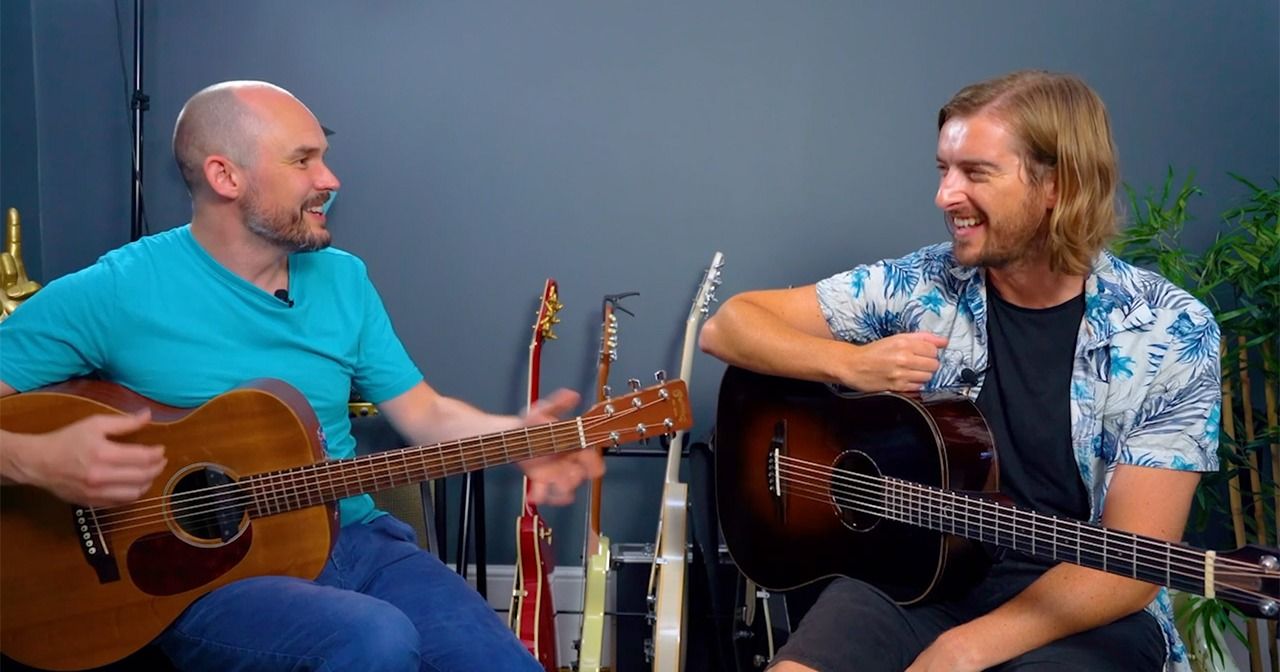
Chris, can I ask you what is your absolute beginner's percussive finger style lesson? Now this is again, presuming some people have got basic open chords down, but what would be the first way to add a bit of all this stuff that we see you doing to make the one man band thing? I think string percussions the best place to start. OK. So. Thinking percussively on the strings, and that snare drum hit really, then sort of working up to putting other stuff in, there's two different routes we can go, we can go down this sort of ornamentation, playing all over the guitar, just opening it up way, or we can go down this one man band kind of way. But I definitely think that string slap for a snare drum is the place to. And any chord, any chord, but a safe E minor is always a great place for demoing, isn't it? And just understanding within a basic strumming pattern of 1234 is gonna work great as a foundation for what we're doing, how sort of advanced we are, just to understand, the snare drum usually falls on 2 and 4, so we can replace 1. 4, and the reason to sort of skip over that string slap is because I think most of us do it. Anyway, yeah, when you get to a certain level, you add it. Toddlers are great at it. They sort of come in and just go, there you go. And I've had this in a million adult classes where, you know, you're teaching guitar and I'm explaining the string slap and then everyone's overthinking it. But if you've worked with kids in this way that you're teaching it, then actually usually they're sort of doing the amazing percussive sounds already before they even go. So it's very intuitive. However, if we're overthinking it, which is something I do a lot anyway. We are just turning our wrists. For me that relates directly to a downstroke down strum up strum. There's this little twist of the wrist for sure. Especially when we get beyond the beginner level. It's more risky to be able to do the, um, faster strumming. Now the first thing that I saw you doing there, which I'm like, I know people will have questions. About all that they should do is you played an E minor chord and then did the slap on the thicker string so that we still got the other strings ringing out. This is something I remember when I was learning some John Mayer songs and I was like, how does he do that? Because it sounds like more than one guitar. One man band thing. If you do the percussive hit or the string slap. On the thickest string or the thickest couple of strings, you can keep the other ones ringing out. So that's the top tip. Is there anything else on that side of things? Because again, it's the most applicable thing. Yeah. Whatever you play. I think top tips as well for that is trying not to change your handshake. Because there's often a tendency to open our hand, for example. Which obviously because you see people doing the ornaments and they're doing big motions. But that's because they're performers I guess. It's not necessarily on the sound. You actually want to keep it as something that you can pull out at any point. And therefore economies, right? So using the muscle, using whatever movement you're currently doing, but just dropping the thumb twist to the wrist. It also keeps in that fluidity of movement of, OK. If we're putting it on 2 and 4, then usually we'd do a downstroke on 2 and 4, so it's easy then to translate 1234 as 12341. Literally sort of millimetres difference to make that click. I think the biggest one out of the songs that we have written down to cover, I actually think Thinking Out Loud's probably the one that most people will have heard of. And on the original recording, even though it's electric guitar and live, you can hear that. 1234, most clearly. Yeah, yeah, yeah. Whether it's with a full stop or whether it is with this. Keep it going. You know, cause we can, we can have play this. And do that thumb slap without giving it a go. Is there anything else you would talk about with thinking out loud? Well, or is it just a modern example that you had on that's OK. Would there be any other, um, songs that you'd recommend as the first thing to try or any rhythms beyond just the basic 44 down strums? I think extreme more than words gets gets used as a, as a real example. Something along those lines really beautiful. I'm glad you're playing them as well. And that's um thumb on the root note, first three fingers plucking, but, you know, very blocky, not this kind of. I'd certainly stay away from the arpeggio based stuff if you haven't added this tap in. Treat it like a strand, treat it like a block. And yeah, thinking out loud more than words, great examples. I think actually just putting it into any other songs that we know anyway. Yeah, yeah. And I, I really like that explanation that you're giving of treating it like a block because it is, we, we're going from somewhere where it's almost like classical finger style where we've everything's coming from the fingers and it's so I wouldn't put it in anything with a melody for sure as well. And that's always, they're the ones that are harder to learn, aren't they? They take a lot more to learn if we have an arpeggio and then a melody, something like um. Yeah. That's going to be harder to add some percussion too. If it sounds along, along the lines of the intro of Nothing Else Matters. Just because it's not got that repetitive, blocky rhythm. So that's how you can add it sort of more straightforward.
In this video
Andy and Chris look at what techniques a complete beginner should learn to start their percussive fingerstyle journey. These first steps may already start to open a completely new door of guitar playing style. If this is totally new to you, this video helps to break down the techniques and stylistic approach, so you can do it yourself!
Key learning points
String slaps - specifically the ‘snare’ string slap which is close to a strumming ‘down-stroke’
Put the ‘snare’ string slap into a strumming pattern, landing on beats 2 and 4
Exercise 1 - Simple but essential 'Snare' slap
Use the side/joint of the thumb to produce a 'slapping' or 'clicking' sound
Use the twist in the wrist, like a 'downstroke' when strumming
Aim roughly for the E, A and D strings over the sound hole
Work on producing some dynamics (loud/soft) and as much consistency of the sound as possible