
Does it all start with Steve Cropper?
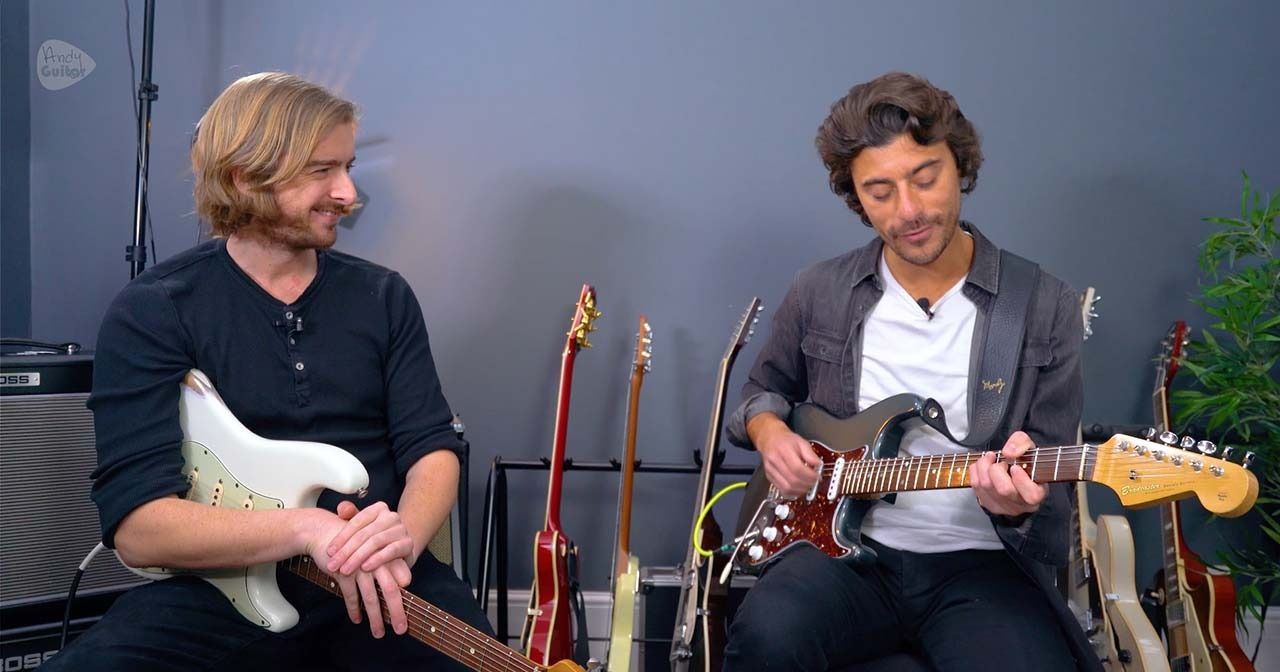
When I invited you down today, you said you wanted to do something on Steve Cross. Yes. Why, and, and you wanted to do this at the guitar breaks events that we do and stuff like that. You, you're constantly referencing him, so he's clearly been a big influence on you. Well, it's, it's through teaching, really, and er and a lot of people, myself included, especially when I was a younger player, that rhythm lead, you know. to just sit and sit down on a chair or on the end of your bed or whatever and just play the guitar and not have to rely on I need a band or someone or a backing track or obviously now when I was playing, I didn't have a loop pedal back in those the weird days of the nineties, you know what I mean? But it is your own looper pedal if you can do rhythm but no, it's better to sit there and just, you know, play. Or if you're doing the kind of dock in the bay. That kind of stuff. And so I, I remember it clicking when I saw Prince. Oh wow. Uh, I saw like um no, no, no, it's on video unfortunately, just before when YouTube kicked in and I saw, now it's quite an infamous video, but I saw him with a purple telecast, a purple, sorry, Taylor acoustic, and he was kind of, this is it. You and desire. So all the Hendrix thing really, get on top, all that kind of, I was like, oh, you know, and then through kind of watching that it clicked how it happened. You play an A chord, you play a bit of stuff. And then so through teaching people, you know, for years and that, Hendrixy things or that kind of thing, I realised that it kind of all stemmed from Steve Cropper and those early R&B guys of the kind of late 50s and early 60s, you know, because you think something like Lock of the Bay. Where you got that G chord to a B7 to a C. But then you got all the. And he's putting those little fills in, and especially the. Little 6s and stuff. Throughout verses and things like that, so this isn't a typical soloist thing. Although we could do that. It's more decoration throughout the whole song as, you know, rather than a full chords rhythm part, right? It's a little. It's just kind of, I suppose, filling out the holes, a bit like a drummer might put a little like little decorative fill, it's decorative, right? So just to give a bit more context on Steve Cropper, he was a guitar player with um Booker T and the MG's. Yeah, absolutely, yeah. So he did some songwriting there, but, but he was, he was the, the Stax like go to guitar player. I, I, I don't quote me on this, but I'll have to double check it. I think like all those like Sam and Dave, I think he's on that though, so he's played on. And even we realise and we've done some research. It's all that kind of stuff as well, you know, all, all, I think all that era is kind of him, you know, obviously with um. Uh, oh my God, why is he, Otis Redding, Otis Redding, all that kind of, no, obviously with him, with Doc in the Bay, he's a co-writer on it, you know. Yeah, so, um, but also, so Dock of the Bay's a co-writer, but also in the Midnight Hour and Knock on Wood, I believe he's a co-writer as well. I think maybe on Green Onions as well. Yeah, yeah, he was at least in the room, so he can't, I remember hearing once he followed the dots. So that's the cool thing about, that's Zeddy Floyd knock on wood. And that one literally follows the dots as in thick ki the string. Again, I always think that there should be a dot at the 10th rep rather than the 9th. I always, so if we imagine there's a dot there, it usually does. And that goes up, right? But then he clearly, I don't know which one came first, but in the midnight hour he does the same thing but in reverse. And then just DNA. So all that dun dun dang in it is you can kind of see where the Hendrixy thing comes from, you know. Just do it a little bit higher, it's the same thing, right? Absolutely, yeah. So there's some great examples to give like a background in who, who is Steve, Steve um Cropper.
In this video
Andy and Mike discus the origins of the Hendrix style of seamlessly jumping from rhythm to lead with soulful, interesting parts that are a blast to play.
We argue that perhaps this all stems from the playing of Steve Cropper.
Cropper was the guitarist and songwriter in many classic Stax records. He was a founding member of the Stax House Band and was the co-writer and guitarist on countless classic recordings such as;
(Sitting on) the dock of the bay
Soul Man
Knock on wood
In the midnight hour
Green Onions
Cropper's playing can be described as having melody, phrasing, timing, arranging, restraint, and coming up with parts that are a blast to play. And he manages to do it all with fewer notes than anyone else! He is one of the earliest and most prolific examples for exquisitely crafted rhythm and lead guitar parts and was a huge influence on Hendrix and countless other players.
Learn How To Play Like Hendrix, Frusciante & SRV
Recommended Songs
Enjoying this course? Want to test out your new skills? Find out my recommended song tutorials that accompany this course and get total access to the site by signing up today!