
How to add lead fills
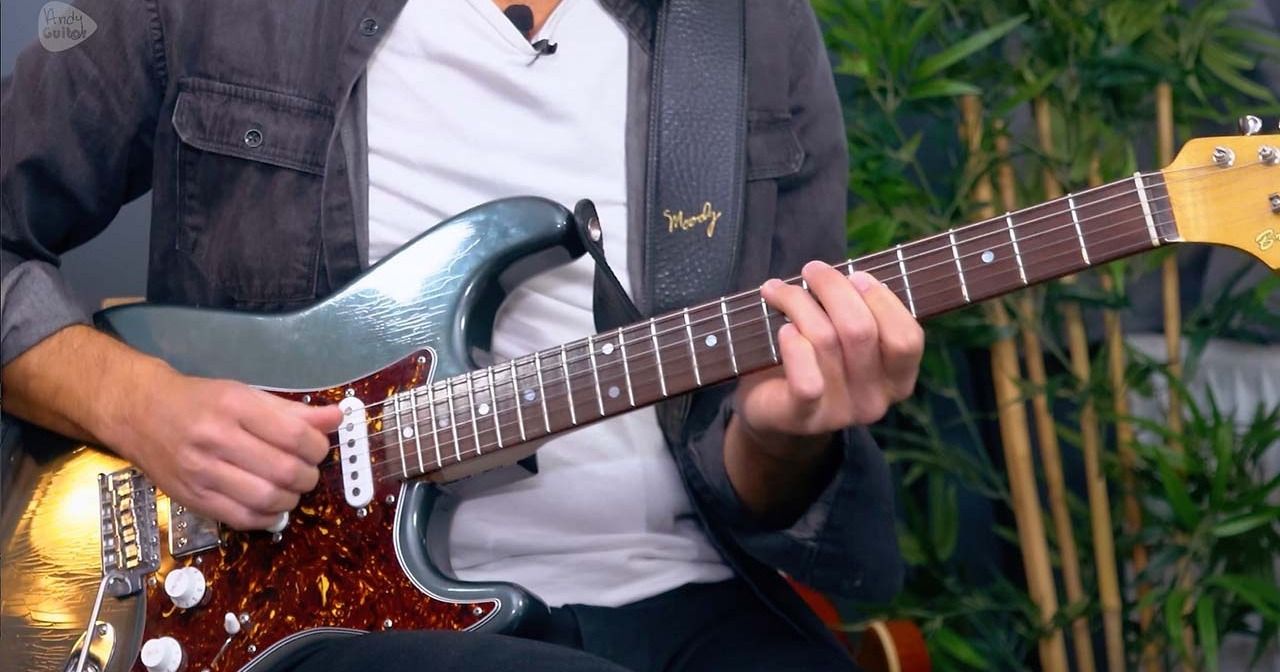
What we wanted to talk about was this. How can we add these licks in general? How can you get towards doing rhythm and lead at the same time? Yeah. So you started off with a little jam which was a bit of a two chord vamp. Was it just G2 C? Yeah, we, well, I was doing, we're doing a cheeky little inversion as well. So you had the. But so if we reduce it down, it was G to C. Yeah. But then we're using different voicings of that, cause there are different levels to this, isn't there? So like absolute level one if you just wanted to jam along to this. Oh yeah. G chord and a C chord. Yeah, just do regular, you know. But I'm not doing a conventional, we're using different yeah it's straight away we're not, we're not playing on every beat, we've gotta allow space. That's probably like the first thing to realise with this, isn't it? Even if you're the rhythm guit player accompanying yourself, you need to give space. Yeah. Even if you're just doing it with chords. I always think as well, like, try and think of the drums in your head. You know what I mean, and straight away you're getting that. And so on that C you're kind of coming on up, 234, and, which gives it a vibe and a rhythm straight straight away, you know, so that'd be coming no uh in musical terms on the offbeat, isn't it, but if you've got that. Let's do it. That's a cool little kind of kit, so if I just do open chords. She And if I do it to bar. And obviously the bar, you've got the kind of bit more of a. We've got more control. Because you can mute the strings with that hand. And then what's quite tasty, if you take, so where our bar would be for a C, if you just put your first finger down, put your third finger on the E. It sounds all fancy, that would be classed as a C over E, a C chord with an E and a bass, but it gives it a slightly different sound. And then by doing that, we're there, we're in C, but also. There's a C major pentatonics, so that's where we're getting that. All that malarkey. This, this can seem so alien to people, and yet they've done it literally since their first scale. Exactly, yeah. From the A minor pentatonic, C major pentatonic. And then this is also considered like the G shape in the cage system. Yeah, yeah. Um, but we're just yeah, when we use that G shape, we tend to just use this one, so 2 strings, or 3, but just 2. And the third finger there, right? Put that in the base, it's different, we can hear it from. Having that eat in there just. And then if I wanna put in it all. That. It's really simple, um, well, I say really simple, obviously it's already. It's getting used to hitting pairs of strings, maybe when people are learning they're just used to hitting single strings. What I always discovered though when I was learning this the first time round, it's easy to hit pairs of strings as soon as you know that it's OK. Of course. And that first finger, it's like A minor pentatonic, right? As soon as you get used to that idea rather than. One string at a time. It's easier because you can hit, you've got more area, you've got less room for. I think where a lot of um students will find it hard, no, double stops basically this is now, isn't it? I guess with double stops though you gotta get used to muting with but as soon as you did that just then I was like, that sounds like Chuck Berry, you know what I mean, like straight away you've got that kind of where it's, that's where it can be, it's a really cool messy sound, do you know what I mean. But I think we're, because here we're, we're kind of strumming, and we're still keeping the strumming happening, but we're not. Doing that is That and it's still keeping that same technique, so the, the, the only bit where I think people might fall is er the muting the unwanted strings, you know, if I'm doing cos I'm not going. But now we've missed a beat and we're out of time and it's gone, you know, it's not changing your hand, it's still kind of keeping that. Exactly the same, but. And I'm putting in those kind of sounds because I think of drums again. This is like your high hat, isn't it, all these little stickers.
In this video
Andy and Mike discuss the concepts behind playing rhythm and lead at the same time and how to approach learning to do this yourself if this is totally new to you.
Interactive Tab
Become a member to access this interactive tab section.
Key learning points
Chord inversions, specifically the G CAGED shape and E shape with the thumb
Playing muted, percussive style rhythms
Learn How To Play Like Hendrix, Frusciante & SRV
Recommended Songs
Enjoying this course? Want to test out your new skills? Find out my recommended song tutorials that accompany this course and get total access to the site by signing up today!