
Day 3 - Free Ukulele Starter Course

What's going on guys? Welcome to day 3 of this free 10 day ukulele starter course. And in this video I want to prove to you that it is wrong to try and learn loads of chords at the same time when you're first getting started on any new instrument, but particularly ukulele. And what it's better to focus on is fewer chords and learning how to use them, how they work together, and really how songs work if you're new to music in general. And ukulele might be one of, or the first instrument that you've ever learned to play. There's a lot of other skills that we need to look at, as well as just changing between chords and learning new chord shapes. So what we're gonna be looking at in this video is the same four chords that we've already looked at, but what we can do with them. This will allow you to go ahead and learn any of the songs that you want, and even songs that don't use these chords, there's a little trick that we can do. To change the key um to basically the key of C, so that you will be able to play it with the four chords that you'll know if there are any other chords that happen in that song, it will only be the case of learning one or a maximum of 2 new chord shapes and you will be able to play that song. We'll be looking at the common strumming patterns, etc. etc. But without further ado, let me give you a quick blast of uh loads of songs that you can play with these 4. Uh, I will say that this is completely ripped off from the four chord song by The Axis of Awesome. Um, I'm also doing something here very similar to what I've done on my guitar lessons and piano lessons channel. Um, so this is nothing new, but I'm sure there's plenty of you that are wanting to learn ukulele that aren't aware of the benefits of this method, and I want to communicate that to you. By covering as many songs as possible, so without further ado, here's a demo of loads of songs with the same four chords. it The front So I knew I then Um, Right Shame. I can I I can't hear you say God. won't stop Oh I. And those four chords are in this order, the C major chord played with just the 3rd finger. G major, which kind of looks like a D if you're a guitar player, but on a normal ukulele, this is a G major chord. The A minor chord. And then the F chord. And especially with the two strumming patterns that we looked at in the previous day in day two of this course, we can play loads of songs with this. And that's by keeping those four chords in the same order. If we can shake up the order a little bit and be comfortable with more chord changes, we can get loads of more songs. I got this feeling. Inside my bones. It goes electric wavy when I. with you it. I So how brilliant is that? I mean, so many people think that to learn any instrument, ukulele, guitar, piano, we have to have loads of skill and learn loads of chords, when in fact if we just learn a handful of the basics, you will then have the skill to actually be able to get the result that you're wanting. Play with other people, get a sing-along, play loads of songs really quickly that people are going to recognise. That is the focus, the entire focus. Because of this 10 day course, I will be doing full tutorials of most of the songs that we're looking at when I'm doing little demos of uh other songs. Doing full tutorials very soon. I'll link to as many chord sheets as I can, um, that you'll be able to follow in the description of this video, even on YouTube. But what we're gonna be looking at now is those two strumming patterns with this chord sequence that I would recommend that we do, and then some other options. Shoots of it, just to give you some ideas of what songs you should be learning at this sort of level as soon as you've got this. I want to give you the freedom to look at any song that you want, but when you know what you're looking for, and you, you know which songs you can take on, it makes everything so much easier and allows you to get the result that you're wanting really quickly. So let's have a look at the uh the easier one of the two I would say, the down, down, up, up, down. The down, down, up, up, down strumming pattern, and we would do this strumming pattern. Once per quart. That's the first option to enable you to do a whole chunk of songs. The a different strumming pattern or something else would allow you to do another chunk of song. That's how it works. What we're gonna be going for is this down, down, up, up, down, changing chord, and lifting off after that last down strum. So let's have a go for that now. Join in with me if you can. If you can't, I'll give you some more tips in a second, but let's go for broke, let's go for it, I've got confidence in you. From the C major chords, in 1234. OK, and that strumming pattern is great to be able to do songs such as Don't Stop Believing, Wrecking Ball, With or Without You, She Will Be Loved, Paparazzi, or Country Roads, some great sing-alongable songs then, sing-alongable, that's definitely a word. However. The secret that I want to let you into now, um, and how people are able to do this, I'm sure you've seen loads of other people do 100 songs with 4 chords and that kind of thing. What people are generally doing is they're putting them into the same key. So when you look for your chord sequence online, on Ultimate Guitar or any ukulele websites or anything. You need to make sure that you change or transpose the chords to put them into the key of C, so that when you're looking at the chords, basically just keep changing transpose up or down till they look like chords that you can play. That's, that's as easy as I can make it for you. And that would work for pretty much any song. Um, and what we're looking for here, for it to be in the key of C, is looking for those chords C, G, F, and A minor. If they've got those chords in it, there might only be one or two that you then need to learn, you know, cause you're familiar with those chords already. And that's fantastic for having a simple sing and strum along and getting you used to playing music and having a sing along with your friends and that kind of thing. The only other thing that is then going to give you a problem is structure. As in the chord sequence changes from a verse to a chorus or trying to get the words to line up to the strumming and things like that. But it's really structure that's the main thing, um, and if we can sort of tick off the chords thing is like we're looking at plenty of songs that you know the chords to, it just limits the amount of things that are gonna go wrong, it just means that it's so much better for you to work on all the. The skills um because we've got the chords kind of taken care of per song. It's very difficult to play and sing at the same time. It's very different to play full complete songs, even when you know how to play the chords. So we've got to try and get that chords bit handled and choose a lot of songs with the same chords to work on those core skills of actually strumming, singing, playing, all those sorts of things really. So the second strumming pattern that we looked at, um, this one was from, uh, day two as well, down, down, up. Little bit quicker, but a really cool strumming pattern and works very well for for ukulele, for a lot of ukulele songs. Um, even if it's not even the proper pattern, it's not in the song, it can just work really well as kind of a second option when it's a little bit, when the song's a little bit quicker, basically. If that doesn't work and the chord sequence is a little bit longer, we can go for 2 bars of each one of those chords with that same strumming pattern, which would be. And that's what I did for I'm Yours, Where Is The Love, Hey Soul Sister, um, even kind of Country Roads and some of the other demos that I did earlier. But that if it doesn't work with one bar of each, it will work with two, with the song suggestions here. Basically, often it's not the actual chords that are different, it's just the length of time that we're on each chord for that changes between the songs that you learn. So the real key points here are to learn plenty of songs with the same chords, there's a few great options for you, but when we're talking the key of C. Um, there's one fantastic song example that is just, it's like the bible for all these other pop songs. Um, and this is Let It Be by The Beatles. Now actually the Beatles only have, I think, just a couple of, um, four chord songs as we were, but this one sort of, you know, defines them all, absolutely. And this is. Those same four chords in the same order but just doing 2 strums of each. When I find myself in times of trouble. Mary comes to me And it's almost the same thing again, speaking words of wisdom. But it's F then C at the end. So just ending on F and C. Other than that, it's doing the same thing that we've done already. So this would be. have OK, and this is your sort of classic by the book four chord song, but we've got a little bit more structure in there. To teach you how to do the stuff that I was sort of demoing with titanium dynamite and he ho and all those sorts of things. Can't wait to get tutorials for all of those, but if there was one that I was gonna show you to sort of solidify all those things, it is Let It Be, for sure. So let's have a go at this from the C chords, just with the third finger. In 123. For Self in times of trouble, mother. Mary comes to me. Speaking That same thing happens again, the 4 chords, and then just in in the same order. That same thing then happens again. The 4 chords in the same order, but ending F then C. 234, and in my hour of darkness, she is standing. me Speaking words of wisdom. Remember, let it be as ever. See. OK. That is our core four chords thing. Uh, the chorus shakes it up a little bit more, but again, teaches us we don't need another chord to shake it up. We're just gonna sort of tinker with the order and um and work within those same confines of using the same four chords. This would be A minor. G OK. A minor, G. Speaking words of wisdom, let it be, it's the same thing, OK? So, and let it be. it. Let it be There will be an answer. So there's some ideas of what songs you can check out and how to look for your own songs using any of the multitude of free chord websites that there are. I'm sorry I can't put the tab on my website um because of copyright reasons, you know, exactly in chord sheets and that. But I can link to other chord sheets and that's what I've chosen to do in this series of videos, both on the website and in. the description direct on YouTube. Thank you so much for watching this video. I hope to bring you more tutorials of the songs featured in this video soon. But for those of you that are sticking with this 10 day course, I hope to see you in day 4 either tomorrow or whenever you choose to come back to it. And thank you so much for watching and I hope you enjoy practising your ukulele.
In this video
Welcome to day 3 where we're looking at Four chord songs in the key of C!
Think of this as a how to play loads of songs with four easy chords lesson, which is what most people want to learn! We'll be covering more about what the Key of C means in tomorrows lesson.
Day 3 chords
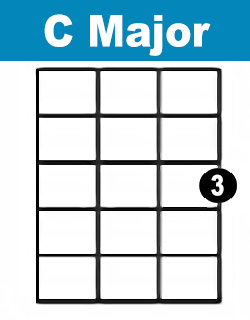
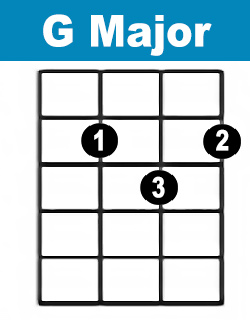

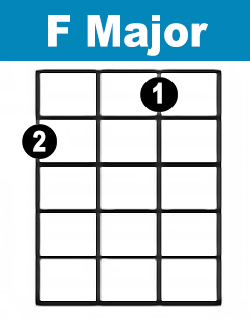
Day 3 Music Theory - Why these chords?
The chords listed above are all in what musicians call the 'key of C'. A musical 'key' is like a family of chords that sound right in any progression. Just like some colours go together well, so do some chords go together well, but also many do not. This is another reason why I recommend you learn fewer chords and more songs with the few chords you know so you can make the most of all the early days of playing your Ukulele or any instrument you can play chords on.
Day 3 Songs
Jason Mraz - I'm Yours chord sheet link
Train - Hey Soul Sister chord sheet link
Black Eyed Peas - Where Is The Love? chord sheet link chords shown in key of F
The Beatles - Let It Be chord sheet link