
Dinosaur Pile-Up - 2000 Trees Interview
Trying to impress my brother, so I learnt the solo of Plugin Baby so I could play it behind my head. And I play and I got my bro to come in my room and I was like, check this out. And I just played him, nothing else, no other music. So he's just listening to me with my she out-tune guitar behind my head playing a, a diabolical version of Plugin Baby. I was like, I was like, what do you think? And he was like. I don't know. I just left the room. I was like, good. Anyway. Hey there, we're doing as a pile up. I'm Matt. I'm Mike, and I'm Jim. And we're at 2000 trees. Guys, it's lovely to see you here. Not for the first time, but I've been following you guys a long time. See you, seen you live many times over the years. Fellow Yorkshire bands. Where did we find you? What's your, what your year looking like at the moment? You in festival season? What's happening? Yeah, I mean, to be honest with you, this is, this is kind of the End of our small festival season this year, we're heading out to Italy and Spain at the end of the year. We're starting to cook up new stuff between now and then. We were going to make a quick trip out to the states next week, but there's been a change of plans there, so that's going to happen next year. Of course, yeah, this is the one that got cancelled, right, so uh and you've spoken quite openly about that, and I, I want to bring up right away that yours is a story of resilience, I think, because you guys have been a band for a long time. And uh you still are, but it it the longer you are, people can perceive you as a big band, and even if you're a big band, it doesn't make it easy. There are advantages to it, but there are things you have to do to be resilient on it and um but songs are a big part of that. Let me ask you about um what's your favourite song on the setlist at the moment for you? For each of you as well. I love to talk about songs on this channel. Jim, what's your fave? Quasimodo, I think, is my favourite. Of the new record, so it's fresh and feels good. My favourite song is er Big Dogs, to play live, and er I like it because it gets a really good crowd reaction, and I think before it even, or it was out for like a day, we played this show in er Sheffield. And the whole crowd was barking throughout the entire show. Um, so that was a vibe. That's why I love, I love big dogs. That's, that's very true. Big dogs kind of had a reaction that we didn't expect very, very quickly. And people have sort of adopted it immediately, which is super fun. But to be honest with you, all, all the songs, there's something like they all have something that I'm like, wow, I, I really love that, that song. Is there something different that we did with the writing? The longer we're a band, the longer I'm a writer, the more. Honed my taste is, so I'll always pick the songs that I just keep on coming back to, cos I always write more than we release, and I'll, I'll always come back to certain songs. I'm like, well, the song is raising its hand, so it has to be on a record, you know. Punkkiss is a good example of that, that song is, is years old, it's not like a. A 1 year old, it's like 7 years old, and it's, and I, I would still, when I'm listening to stuff that I've written, I would still come back to it and be like, this is, this is a banger, so it's just got to be on a record. There's not, there's nothing really like creatively different that we're trying in terms of writing. It's just about I guess honing our tastes and doing what makes. Us feel good and what feels, feels right, you know. And is there any way you can cultivate that, even in the studio or er any other time? I've heard stories this weekend of people, um, looping a certain riff or something and then just singing nonsense over it just to try and get a melody, sometimes working backwards from the title or a theme. Anything like that that you guys have done in the studio? I mean, I, I do all of those things, often, often there will be a title that will become a song later and I, I'm. Constantly sort of saving, writing down words, writing down titles, writing down lyrics, recording audios of melodies. I'm like collecting stuff pretty much every day. I love when Matt shows us a demo, an early demo, and it'll be musically, basically fully formed, but the lyrics. Yeah, that's, that's often switching. That's often uh how, how you form a, a, a sentence in words and stuff. Often I'll just like sing whatever. I can hear something in my head, I'll just repeat that, and it's not words. But and gradually words come out of that and the sounds that you're naturally making will become what later sometimes it is the lyric, and sometimes you'll write that and then realise that that's not the lyric. Something that I do very often is I, I write and write over songs for months and sometimes years and, and sort of craft it. I, I'll write it and then I'll leave it for sometimes 6 months, sometimes 2 years, whatever, and I'll come back to it and be like, oh, that bit's not working. And I'll rewrite that bit. It's obvious when you come back to it, right, you're able to, it's a different process, creating and then what do they call it, curating. Yeah, totally. Time, therefore, and perspective, time gives you perspective. If you're writing over and over, if you're trying to craft this song for a week or a month or 6 months, you're and you're in it every day, sometimes you don't have the perspective of whether. It's working, or this is good or that's good. You can't hear it accurately. When you've taken time away from it, you can. That's why I think time is a songwriter's greatest gift. I think, I think that's a really good point actually, and Matt's got unbelievable vision when it comes to actually writing a song in terms of where it can go and the, and the, the difference it can, in form it can take from a demo to an album track, and. Sometimes it's really difficult for me to hear where it's going, but then when we hear the finished album version, I'm like, oh shit, I get it. But Matt confidently pressing play in the studio, me and Jim listening, but harmonised to it as well, yeah, and I'm like, and, and I, this is it, right? And they're like, yeah, I, I guess it is. Yeah, yeah, yeah, yeah, comes to the screams and it's. Sometimes I do, on demos I do like quiet screams cos I'm where I would be going full on, I'm just kind of hanging out and I'll be like. And that's a scream. So when I play, I sort of forget that. So when I play the demo, it's me like people are like, what they're like, what, what's that bit? The climate for songwriters and for bands and for artists in this day and age with content being what it is, it's about permanently releasing music all the time as quick as you can. Tell me about it. And I think that's the worst thing. That, that's a, that's a, a way of thinking that's been. Made by someone that doesn't write songs or doesn't paint paintings, it's, it doesn't fucking happen in two weeks. Like that's a rule that's been made by Daniel Eck or the head of Spotify or whatever, being like, we need more content. Music is content. No, it's not. Music is art, it takes time. Sometimes a song will take 30 seconds to write, sometimes a song will take 7 years to write. We've, we've released songs that are 11 years old, you know, like before they've seen the light of day. It also means. That you're then writing songs to serve a certain audience or a situation, or literally an algorithm, let's be honest, be that Spotify or anything else, and it does reduce the value. It makes me really worried that we'll we'll lose the album track, you know, which is often. You know, I'll listen to an album, some of my favourite albums, like, my favourite songs off that aren't the singles, but everyone's looking for the next single, the next big thing, and like, we're gonna release this, gotta be a single, and some of these album tracks are like the really emotional one, or, you know, somewhere that goes somewhere that you didn't really expect, it's not a 3 minute banger. But it's like there's something to it that's just way more enjoyable, like for me. That's, that's such a good point, in, in, in some ways the, the streaming thing and the consistency of releasing music, it's just steamrolling. The art, everyone, like Mike says, just stay relevant, everyone's like, fuck, I've gotta write a banger, every song has to be a single, it has to be 2 minutes, blah blah blah, no, like that's not, that's not why we're fucking doing this, like that's not self-expression, that's just trying to hit numbers. Our favourite song off the new album is the last track, yeah, right, absolutely, I, I don't love Nothing and Nothing Love me, that, that's not a single, but it's my favourite track, it's our favourite track because it, it has something uh deeply emotional to it. And it's not a hit, a hit single, but that, it has value, and, and what I hate about the climate that we're in now creatively. Is that people that don't understand that have never been a part of that part of the process are making the rules and that sucks. Yeah, they think it's a button you can turn on or just do more of that, that's been popular, do more of that. That's not what works. People are putting their unfinished songs, putting a verse or a chorus on on Instagram, being like, hey, is this good? No, that's like, what is the, what is that? Are you just making a product or are you making your art? What are you doing? And also that album track, that one, that, that song that your audience wouldn't expect, will end up connecting with more people who will then turn up to your shows, buy your merch, buy your vinyl, because they want to support. Because you've connected with them. I'm pissed. I'm pissed. I get pissed when I and you should be. It's, it is a, it's an unfair system at the moment and we both know about it. Um, however, one thing I do want to touch on, we haven't got long left, but I'd love to ask you what your first songs you learned on your instruments were, what your gateway into all of this was. What was the first riff you learnt on Great question. Embarrassing. My first riff that I, I learned on a guitar was Deep Purple, Smoke on the Water, which is probably everyone's, it's probably everyone's 1st, 1st riff. It's a lot of them, but um, it's, it is for a reason, right? You've gotta start somewhere. Yeah, that's a classic, I, I learned that very early. And then I remember trying to impress my brother, so I learnt the solo of Plugin Baby. So I could play it behind my head and I play and I got my bro to come in my room and I was like, check this out, and I just played him, nothing else, no other music. So he's just listening to me with my she out tune guitar behind my head playing a, a diabolical version of Plugin Baby. I was like, I'm the coolest person. I was like, what do you think? and he was like. I don't know, and just just left the room. I was like, good. Anyway, that's my story. Mike, what's yours? First songs? Uh, mine is, I, I, I lied to some friends cos I wanted to play drums in a band and I didn't know how to play at all. But I was like, I'd, I'd heard the Hives hate to say I told you so, around at the time, and I was like, I can play that, I can play that. So we did it, the worst version of it you've ever heard, but it was the first song we'd ever all played together in like a band, and they were like, cool, OK, we've done that, so what do you wanna play now? I was like. The, the hives again? Can I just say, I reckon, I reckon Jim's gonna come in and say something really fucking sick, really fucking sick, considering his first band was a Rage Against the Machine covers band. The first thing, like, cause you learn like E major, A, D, is back and back. 100%, it was probably the first thing on an on like an acoustic beat up thing. I told you. But probably realistically, Smoke on the Water. Yeah, yeah, yeah, it's the easiest. But what about the gateway songs that led you to the musicians you are today? That would be doing the rage, rage, rage covers, so like um Killing in the Name probably. Yeah, I learned a lot of rage. I learned a couple of Weasel ones. I remember I learned Death Tones mine Summer when I when I did that, when I figured that out, I was like, I'm. Fucking in, I'm fucking in. er dude, hello cos they're the best band in the world. But we've, you know, rightly so called up the, the algorithms and all that, but thanks to things like TikTok, a lot of this heavier music is now getting played in arenas when, um, even er yeah you get even stadiums. That's so true about the arena thing. When it just was not a thing, I, I've seen Deaf Tones in Leeds Academy. Yeah, what was that, 1015 years ago, like, that was, their cap was 2000. Yeah, dude, I remember seeing them at a festival, they'd never be higher up than halfway. Yeah, and now, now they could, they're, they're high up the line-up, this heavier music is early days Reddings, Reddings and stuff. They were, they were halfway up, halfway up. And, and now every new band you see on Instagram. Now every new band you see on Instagram is, is just, is just, I mean fair play to them, they've got good taste, but they're just, it's just Def tones, and I'm like, I love that. But it's great visceral experience, that live experience that you can't get anywhere else, that people do want to hear on vinyl and CDs and what. I have great nostalgia for. CDs, I don't remember. Oh my God, so do I, man. It's it's the thing, you get them in the wallets and like, and you play them till they're all scratched up and oh yeah, but Digi packs. Digi packs, yeah man, that was disappointing when that happened, that was a, a disappointment. Anything you want to give a shout out to, anything you're doing for the remainder of the year? You said you're coming to the end of your albums, so you know, the, the touring cycle. I mean, yeah, that's crazy to say that we're coming to the end of the album cycle. It doesn't feel like that at all. This album feels like it's just been released, which it kind of has. However, uh, we were saying in another interview earlier, with COVID being a 4 year break, me having to take another 2 years off for health stuff. In that's 6 years, we probably could have released 3 records in that time, so I feel like we're, I'm pent up, I've got a lot of songs that I wanna release. We, we all wanna get behind that, so really we wanna move as quickly as we can into getting new music out. That doesn't mean this, that, that this album's done by any means, but I just wanna, I wanna get cooking. Whilst I'm alive. Absolute, look, that's what it, that's all we're all doing, to be honest, we're making the most of this weekend in sunshine and rain. That's all we've got time for dinosaur pileup, thank you so much for talking with us. Check them out if you haven't already, the love, peace and love.
In this video
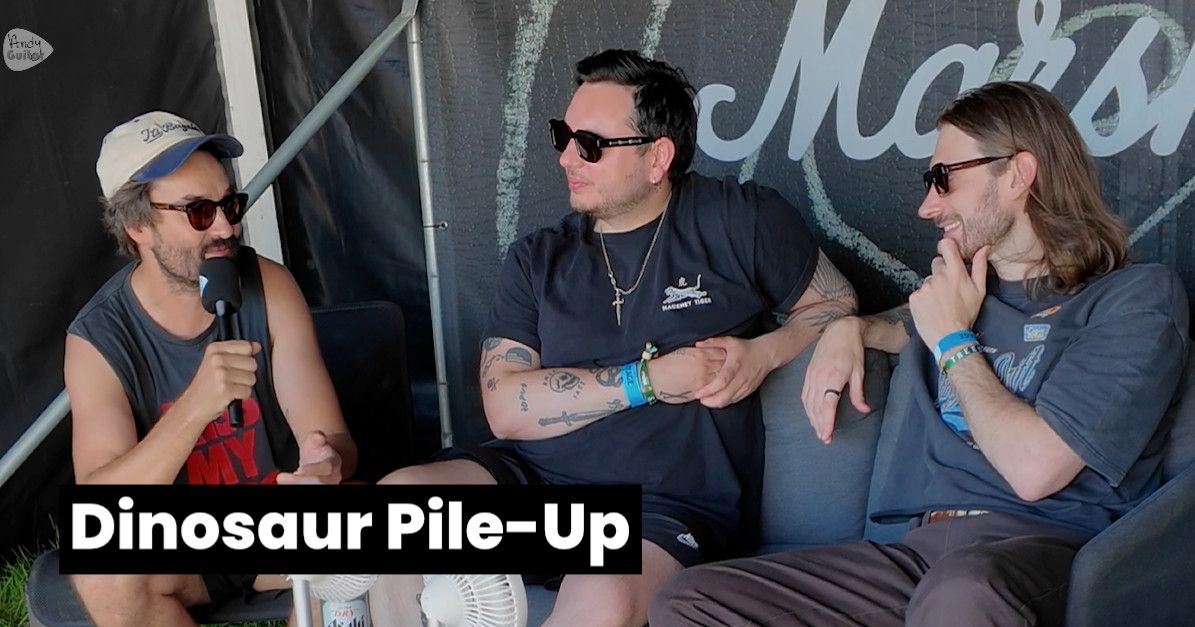
Andy speaks to Matt (guitar/vocals), Mike (bass) and Jim (drums) from Dinosaur Pile-Up at 2000 Trees. Topics include favourite songs from the new record, Matt's songwriting process of collecting lyrics, titles and voice memo melodies daily then leaving songs for months or years before returning with fresh perspective, the band's frustration with the streaming-era pressure to release constantly and write everything as a single, early guitar influences including Rage Against the Machine, Weezer and a formative Deftones summer, the rise of heavier music from mid-size venues to arenas, and the fact that Matt is already pent-up with new material after a six-year gap caused by Covid and personal health issues.