
Dirty Nil - 2000 Trees Interview
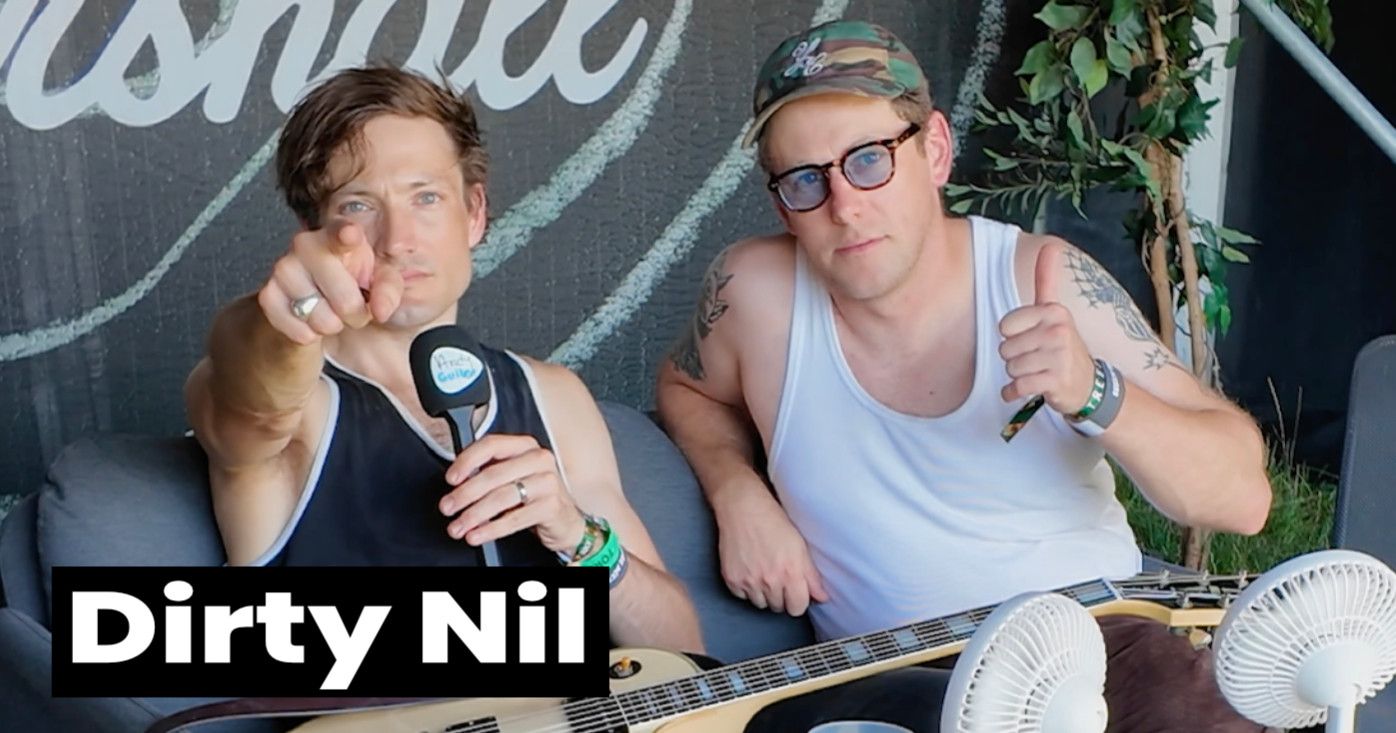
Hi, I'm Luke and I'm Kyle, and we're the Dirty Nil. We're at 2000 trees. Woo! And it is hot. You guys have played already, but you've got a superb, um, slot on the marshall stage later on. We're looking forward to it. Uh, what's your favourite song on the set at the moment of yours, I play a lot. Um, I really like playing, uh, honestly, like all, like there's not, there's songs that I'm like, ah, here this one comes, damn it, like you gotta focus, loop, focus, uh, there are more challenging ones, but I'd say my favourite one is probably, uh, I gotta go with, uh, rock and roll band. Yeah, yeah, great. No, that's good. I like I I always like Damage Control. I find that the the UK audiences really like that song. So it's been a good time to play that one. It's hard for me not to be starting to sing these songs cos I, I listen to you guys a lot, so we saw you at uh the Roundhouse in London last year. Oh hell yeah, that was an amazing Spanish love songs gig. And yeah, since then you're on my regular like, you know, gym playlist, car playlist, like you have some great singalong stuff. And er I just wanted to ask you kind of to be honest. You've got, you've been playing, you've been a band a long time, 20 years this summer, this summer, right? So, but there seems to be the last couple of albums in particular, they're the ones that I've been introduced to you guys. Um, was there something that kind of kickstarted that batch of songwriting, just that for me it's so much fun and in the kind of classic rock sense, but there's, there's really deep lyrics, like there's a lot of fun, joy from pain is why actually, I can see why you're on the Spanish love songs kind of bill, you know what I mean, yeah, well I think that. I think the short answer of it is that like, we just played so much that we just got better. Like we got better at like, uh, being able to, um, you know, consistently do things. Like, I think that, you know, in our earlier years that we had definitely like, we had times where I was like, this is amazing, and then like we couldn't quite do it again or something like that. You like, uh, but now I think that just because of the amount of sheer hours that we've had doing what we do that, uh, We are consistent enough on our instruments to be able to make stuff that we at least like, and, uh, you know, uh, it's, I mean, one thing specifically was like, my voice was wildly, uh, I just didn't know what to do with it. I like, I know it would freak me out a lot, and like, it was like I'd have good days and I have really bad days, and I was like, And just singing a lot, a lot, taking lessons and stuff, like you kind of learn how to use it better and how to, and, and also just like, don't worry about it, dude, don't worry about it. You know what's gonna, worst-case scenario, you know what it's gonna be? It's gonna be a rock and roll show. Best case scenario, it's gonna be a rock and roll show. It's gonna be fine. So, absolutely, yeah, I think that we've just learned to enjoy it and, and through enjoying it, our music I think has gotten better. Absolutely, can you say anything about that journey of the band and and particularly this last few years when things seem to be certainly internationally stepping up for you, you know, playing these festivals again. It was like 2018 when you last played here it was a little while ago. So you, it seems like you don't, you're in the UK plenty. uh, Canada as well has so many, like, I know a lot of musicians from Canada who are are so well trained, but this, you have to travel, don't you? If you, if you want to be a touring musician, you go to tour. With Canada especially, I always find out there's always that working against us. Canada kind of gets the oversight, uh, but I mean, there's a lot of good Canadian representation here. For example, our friends Pop who are just next door and us and Drew Thompson who's with us doing Smug LLC. But, uh, I don't know, we just, you know, we always have put the work in, uh, to keep things growing. Uh, Luke Luke works really hard with the songs and I, I do my best to help make them become. You know, the final thing they are, um, and in particular with those last few records, you know, I felt like, I don't know, I don't know where Luke seemed to be able to write from a more vulnerable place for whatever reason, and it comes across, it comes across in the, in the songs, I think a lot, and I think there's a lot of emotion. I mean, on all, in all of our music, but the Lash in particular, like was a real, was a real growth in that department, and, uh, I think, you know. It was just a new, a new flavour that the fans have really resonated with and it started, it just certainly connected with me anyway. We have a Gibson Les Paul here. One thing I want you to demo is, look, how do you, how do you play any major chords? Just like this. There's some people go like this, right? They're like that. That's the one I teach, that's the one you teach. See, see, I'm like that. Yeah, I get quite a few YouTube comments, like kind of 3 in a line rather than the middle figure like this, but he he does it like this. And I just, I just wanted to show that for every beginner watching that there's no right or wrong way to do any of this. There is a way that works for more people than less. Ohh, that's that's how you get the tone. Yeah, there's a stain. Yeah, yeah, yeah, yeah. Uh, yeah, no, I like the E chord that way because then you can just quickly shift to a C, like boom. I like it, that look, you know, and there's, and honestly, there's about 15% of people or maybe 20% that I've taught that do prefer that way. I like the one finger personally because I'm lazy, like this one. Well, yeah, 100%, and it frees up the other fingers too, you know. Absolutely, that's like my, my favourite chord on the guitar is the, is the lazy finger 8, yeah, the lazy, I like that, cos then I can windmill. And let me ask you, what was the first song you learnt on guitar? Do you remember back in the day? The first song I learned on guitar was, um, my parents, yeah, it was, OK, quick, quick, quick side note, I knew a guy in university whose dad could only play one song, and it was Stare, the intro to Stairway to Heaven, and he could only play it if the guitar was behind his back, like, like behind his head. That's the only way he could play the intro to stereo to Heaven, and so thought you were because you're holding it like that, I thought it was gonna be like slash, you know how slash is down by his knees, but as soon as there's anything technical he's like, he's way up classical position, you probably like he practises, but behind your head, yes, I mean, but to practise it like everyone tries it behind there, that's one of the few stage moves you didn't do yesterday. That is not, I did not do that one. I didn't. I asked of them. We had a friend in junior high school and we were all getting into guitars that uh. Tried to pull the Hendrix with the uh playing the guitar with his teeth, but he had braces and you can see where that one went. Oh yeah, that's what I, I even suspect that Hendrix actually was just doing hammer-ons and stuff, you know what I mean, yeah. Did he actually pick with his teeth? I don't know that's like just the, but again, print the myth, you know, he said things on when when there's truth or the myth, print the myth when it comes to this stuff. I yeah, I, I uh that's the rock and roll law, right? You must have had some er spinal tap moment. on tour you brought them up already. Every time we enter and do like you guys, you guys have some curly whirly venues over here in the UK and I don't know what you mean, uh, uh, sense of direction is not one of, uh, God's gifts to me. And so I find myself in the Spinal Tap looking for the stage thing like basically every day and I'm just like I sometimes I like literally have to like draw a map on my hand of how to, to get. Places in a city, if it's London, Manchester, wherever, there will be, if it's a small venue, grassroots venues, God love them, there will be a big pillar, it will be a fire escape that you have to load up a big marshall stack through. God love it, right, that's just, again, that's the, that's the circuit, that's the stripes. And we love it, I mean like it is, it is, I think that one of the things like coming from North America to the UK uh specifically is just kind of. Being in a music venue that like, is, is typically like in a building that is hundreds of years old, and you're kind of like, just marvelling at how, like, you could incorporate this music venue into like this centuries-old infrastructure and make it work, and like, my imagination is like, is, is incredibly stimulated watching how all this stuff works versus in North America, it's like, There's a stand-alone venue that was built in a strip mall because we have nothing but space and so, so I mean it's, it's constantly amazing to me how you guys are able to kind of pack a venue into a place that in North America would have no business having a venue. I couldn't agree more. I don't think we got your first riff. Oh, my first riff. It was, uh, my dad had a broken classical guitar up in his closet. And uh I took it out and uh I taught myself by ear ode to joy just like God, yeah, it was, it was like I thought he was gonna be ripping Van Hale or something. I was like let's let's mic an acoustic. I have taught that on my channel as well cos it's, it's melody, isn't it? It is what it is. I mean I was just kind of picking it out by ear, but like I, I think that the first riff that I actually learned when I got my. First actual guitar, which was a Squire Stratocaster that I still have, uh, it was uh the Mission Impossible theme song bo bo bo bo bo bo bow bow. I played it with my thumb. And uh like those film music tunes or those those TV theme tunes as well, they're so, they're so that that's our way into a lot of this music, I mean, Back to the Future, it's a movie, how many rock stars. Did that make over the last year, so I know certainly inspired me. But can you say anything about that there's so many guitar players that are like chords, chords, chords and they're trying to sing. First thing you learned had a melody to it. Yes. Is there anything, you guys have great melodies with your song, was there any way that you kind of trained yourself onto that or followed that rather than just, you know, staying strumming or being content with strumming? I think that I just like I was, I was er. Personally raised on, uh, Women in Songs, which is a CD compilation of like Enya and like Alanis Morissette and stuff like that. And so my mom would play that in the car and my dad would play Stomping Tom Connors, which is, it's, uh, I love Stompin Tom, but I don't know a whole lot of ladies that like Stomping Tom Connors. Uh, he sings songs about getting drunk. Uh, he's Canadian folk hero, but, uh. Anyways, um, so I do like to think that that is kind of like, like that is inescapably my musical DNA is, is, is these, uh, very brash kind of country songs with like a bit of a yodel to them and, uh, and Enya. Yeah, that wider influences, I think so, even uh you were at the Metallica gig, were you were at the Metallica gig. Like even Metallica, if you talk to any of those guys, the wide influences are insane. I wanna ask you, what did you think of the Metallica gig? We loved it, I mean like it was, there's a bit of that influence in like Gallop of the Hounds for sure. We're, we love thrash music and uh we, I think we kind of like. We kind of do it all with like a bit of a smirk, but at the same time it's like we're doing it because it's sick, like we're not, we're not making fun of it or anything, like we're, we like to thrash, bro, so talking of those heavier or faster styles, was there something that both of you maybe found really difficult to play on your instruments, like really difficult to learn either individually or as a band, and how did you overcome it? Like what comes to mind when you ask that? The hardest stuff for, I think like I think it was, it was hard getting used to playing really fast consistently like, um, because it's, it's like I think it's just way more about like stamina and technique than like about like sheer energy. It becomes more, more like a sportsman you need to be in training for it, right? and and it requires constant practise and like kind of like conditioning of your own technique to be able to play fast. Consistently, like, honestly, even like if I don't, if I take like a long break from guitar, which almost never happens, but like, if, if it does, like, I almost like have to like reteach myself how to do like fast gallop palm muting and stuff, I have to like refresh my mind on it because like, um, it does, the, the devil is in the details when it comes to that stuff, like, uh, I think that when we first started out, it was all just kind of like, You know, hit as hard as you can, play as hard as you can, and like cruise it, but like as we started getting faster, we really had to kind of like put a lot more work into our technique to be able to just, just literally do it consistently, you know. Is that a warm-up exercise while you have the guitar, something that you do on stage, but even if it's one of your songs. Songs to go, this is the one I'd warm up with. Um, sometimes I like to do, uh, just a couple of the guitar solos like just to kind of get, even if it's not plugged in, just to kind of get a, a feel give it a whirl, man, I'll, I'll hold this even if it's just, just so people can see it. I do the very beginning of like the uh Doom Boy guitar solo just over and over again, just to kind of stretch my fingers out like. I it. So pretty pentatonicy, but yeah, that's a lot of little finger. So yeah, I didn't notice that for when you're playing. It's a bit more of the Angus Young style, he uses his little finger for all. Do you bend with your little if if you're bending the E and the B, would you do that naturally? I do, I do a little bit of bending with the little finger, but I'm uh like kind of three fingers together, that's the first person I saw that was Angus Young. Yeah, I'm uh, I, I, I really have had to kind of put a lot of, the pandemic was horrible, let's, let's all agree on that, but, but it really was. I did like, I did really enjoy just sitting in my sweatpants all day, learning new songs on the guitar, write new songs, like, but, um, you know, one of the things that I really tried to do, uh, during that period was I realised that like, I'm not using my pinky, like almost at all. And like, yo, it's another thing that I can use. And so it has taken a lot of work to kind of bring it up to, Uh, like, uh, to be able to play with my other fingers, but that's one thing I'd say is that, is if anybody's learning guitar, like, don't sleep on that pinky, don't sleep on that pinky, and you, you, you can, but if you don't, it can sound a lot, and a lot of people love it, I love it, there's a reason they call this, but boomer bens, the kind of Clapton style that they. They can play whole gigs and never use their little finger for the whole thing. I don't think Clapton uses, but it puts you in that genre and it doesn't move your head to do a little bit more of these perhaps heavier genres which are, they require the little, they require full dexterity because you're all over the show. Yeah, and, and, and when you're trying to do like more complicated, like when I started learning like Frank Sinatra. songs and stuff like that, like I was like, which one, what are these chords like, uh, I was, I was literally looking to do a Fly Me to the moon tutorial. I, uh, I, that, that is one that I, I, I learned. I, I, I've seen even Paul Gilbert play that live and I'm like, what's he doing, buddy, he loves it, it's good music, it's everyone knows it. There's so many good songs that Frank Sinatra has sang, but, uh. Yeah, like learning those chords, um, mostly like that is kind of, I'd say where my, where I really started having to learn how to use my pinky, because you gotta do a lot of strange things that you just can't get away with just three fingers. So I, I mostly developed my pinky to do more advanced, uh, chords. Words, but uh it does come in handy when you're trying to fly around the fretboard too. 100%. Right, to finish this up, we've got a quick fly round, this or that. 10 questions, this or that. Nice and easy to start though. Music or lyrics? One or the other, if you had to choose, which is most important. Music. Yeah, music. Major key or minor key? Major key. I think most of yours are major, right? Probably major. On balance. Valve vamp or amp modeller. Valvamp. Absolutely. Not easy to tour with a valve vamp though, so what are you doing when you're flying around, nice that you can have Marshall's when you're here, but what are you using when you're flying? Uh, I just rent, like Marshall takes care of me most places that we go at home. I have a big old stack uh that uh you got what's your. Super lead, two super leads and an 88, uh, Marshall 8 by 10 from the seventies. Uh, so, uh, but I, I, I don't know, like I was talking to the Marshall guys about this yesterday. Like, to me, like, I'm not, if you, if you, if you want to use, like if you're into the, the modeller thing, that's awesome, like, fill your boots. But for me, I like the, uh, tactile experience of riding on the edge of failure and it kind of like being like, It's loud, I'm living my life, this is sick, it's an existential element to it, like I am sceptical of anything that like tries to get you close to perfection in the genre. Rock and roll isn't, to me it isn't a music, it is a like a, it is like a discipline, and it and it it is, it also like, it is the embracing of chaos to a certain extent, and so I don't like to try and iron everything out. I have nothing to add to that, that was perfect. Album or single? Album, yeah, albums. Rhythm guitar or lead guitar? Rhythm guitar. Why? Because. Everyone wants to learn the solos and tread, right? Yeah, solos are fun, but like my favourite guitar player of all time is Pete Townsend, and he's the, he's the king, he's the king of the rhythm, and like to me it's just, it's more fun, it's more powerful, like I like fiddling about, you know, but I, there's nothing that, uh, puts a smile on my face like letting a big old Echore just, just ride. Absolutely, studio or live performance? Live, yeah, live. Uh, big riff or big chorus. Hm. Big chorus. I like, I, I, I'm down for a rip, yeah. practise or talent. practise. Yeah, practise. Why? Well. Because Sometimes I've found Luke and I have, uh, historically been very, uh, and, and this is a practise thing, but, um, I've always had an allergy to like very virtuosic people, which is a lot of practise, but there's also a lot of talent in there, but I usually find that those people do not make good music, but they can play very well. It doesn't automatically guarantee it. I'll give you that. But over time I've learned. To like come in the middle, find the compromise in the middle of that, that you need that, so I used to be a talent, but you do need the practise because I I always used to be afraid of the practise part, I think. Yeah, and it's good that you, you have that, that, that's the journey of like sticking with music for a long time, you appreciate different things the longer you've been doing it, right? You, we all love the things that we loved when we were 16, but yeah, that, that will always have a place and then certain other things will always have a place. Uh, music theory or ear training? Uh, ear training, yeah, ear train. What does that mean to you? Um, just being able to pick melodies out, hear something, and be able to, you know, uh, to start jamming along to records and CDs when you're first learning, pretending it's a gig and jamming along. I got really good at music theory like by the end of high school, I got like my grade. Two or so. I can't even remember now. This is going on like almost 20 years ago, but like, I gotta admit I haven't really utilised that as like nearly as much as like, like, as, as just like being able to hear things and, and metabolise them and reproduce them or get out of them what I want rather than. Um, you know, I can't read sheet music. I can for a trombone. You give me a trombone, brother. Um, I'll I'll play that. I'll play you. I'll, I'll, I'll play you some horn. You're gonna play, play some AC DC on this. Listen, don't tap me with a good time. They did a bagpipe. Come on, lay down bagpipe solo. We want the trombone solo. Is there anything you want to give a shout out to? Anything else? What you're doing this year, particularly that you wanna give a shout out to any more gigs? Where are you, where are you heading next? We're, uh, we're heading home tomorrow. I just wanna say that, uh, you know, thank you to all of our fans, uh, especially here in the UK for making, this is our only tour of the year. We, uh, we're just working on new music right now and just kind of enjoying a little bit of home time, but like. Um, this is our only tour of the year and you guys, um, you guys really put the wind in our sails and like this is one of our favourite places to come and every time it just keeps getting better and, uh, we're just so grateful that we can still do this after 20 years and that it, that more people just keep coming and, and that, uh. That uh we get to share a rock and roll, uh, tribal experience, uh, every night here. So thank you for supporting that and being a part of that, and we can't wait, uh, for the next time. Can't, can't wait to have you back over in the bun, man. It's great. Can't wait. I absolutely, all the best to you guys. I love you guys. We will, we will see you next time. Thank you so much see you next time. 300, check them out.
In this video
Andy speaks to Luke (vocals/guitar) and Kyle (drums) from Dirty Nil at 2000 Trees, where the band are celebrating their 20th anniversary this summer. Luke talks about how the last few albums came from writing from a more vulnerable place, and how the band simply got more consistent through sheer hours of playing together.
There's a fun moment where Luke demos his preferred A chord shape and compares it to the one Andy teaches. He's also a firm believer in valve amps — running two Marshall Super Leads from the 70s at home — and makes a brilliant case for why rock and roll is a discipline built on embracing chaos rather than chasing perfection. Pete Townshend gets a namecheck as his all-time favourite guitarist.
Luke also opens up about his voice going from wildly unpredictable to reliable through singing lessons and learning to just not worry about it. The interview ends with a genuine thank you to UK fans, with this being the band's only tour of the year.