
Essential Music Theory for Guitar // Chords in a Key
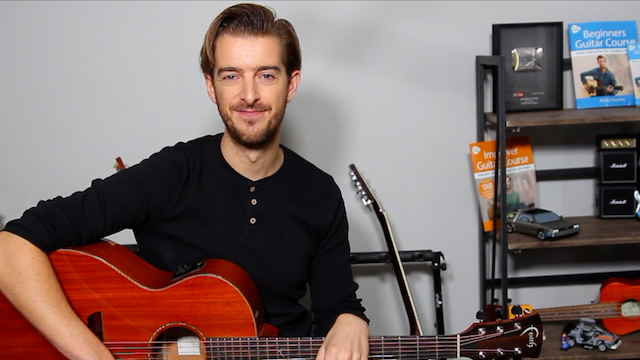
How's it going guys? In this intermediate guitar lesson, we're checking out the most essential piece of music theory that guitarists have to know, bar none. And that is the concept of diatonic chords, and put simply, that means chords in a key. Now we're gonna be primarily here in this video looking at the key of G. Which is a very guitar friendly key, but we're gonna be starting off with the absolute basics, presuming no prior knowledge of this, and then leading you on to a very high level and a complete explanation of what diatonic chords actually means, and this chords in a key actually means, how we get them, how to move over to other keys, and also some breadcrumbs to lead to what to expect from my more advanced lessons that are going to be coming, starting at the beginning of 2019. There is a precursor to this video that I would have you watch, which is this video just here from my beginner's course, which essentially explains the chords that are in the key of C major. These chords are C, D minor, E minor, F major, G major and A minor. And we also look in that video at how to hear what we call the one chord, so hear that in that context, the key is C. Now, again, we'll be covering a little bit more about what this means, but that is a video that I would watch and be aware of before we look at this concept. But G is a very guitar friendly key. The primary, well, the three major chords that go with the the G chord, including the G, are the G, C major, and then D major. And it's most likely, especially if you're an intermediate guitar player and you've been playing a few years, or a few, quite a few months, uh, you have, uh, covered many songs and have played G, C, and D many times and you've had many different examples of those chords in a chord progression. The complete list of chords that are in the key of G. R G major. And it wouldn't matter which way of playing the G that you used. A minor. B minor And in the previous video in this series, we looked at a few bar code sheets so that you wouldn't have to necessarily bar that chord. We have the C major, D major. E minor And then technically the last chord would be a diminished chord, but practically what tends to happen in that uh last chord is a a slash chord, and in this case, probably a uh what we call a G slash F. So this can be. When this sort of kind of thing happens. Sometimes we could think about that as a D slash F, so more like this. Or a um a D chord with the thumb over the top. But either way, we'll cover a little bit more about that chord and why it's a little bit more problematic, a a little bit more towards the end of this video. But what I want to make you aware of is what's happening there, we have that list of chords, which I like to teach this in a way that this is um like a painter's palette or a a painter's choice of colours. So when a painter is painting a painting. We, we don't have every colour available to us that's under a sun, there are a few colours that are gonna work together for any particular painting. And that is the case with a song also. So we have uh every chord ever available to us. Especially when we get into the er world of learning bar chords and what we know how to actually play most chords that exist in the world. And we have 24 major and minor chords to pick 1, 12 majors, 12 minors, but we don't have all those chords that happen in songs, songs actually stick to 345, or perhaps even a maximum of around 6 chords for most pop songs, most rock songs, and the theory that's happening underneath, is that for any um major song, and we're really thinking about pop songs here as our traditional, Um, sort of way of thinking. We have these chords that are our safe chords and our palette of chords, our, our main chords that we're going to use in a song, a palette of 6 or 7 chords that are an absolute maximum. And in this case, in the key of G, those are G, A minor, B minor, C that I've I've listed already. But the actual theory behind that is, all those chords are based off of notes from the major scale, and in this case it's the G major scale. And if I play that in position one. That's our major scale. It just sounds like do re mi fa so la ti do. However, each of those notes, the letter names of them are G, A, B, C, D, E, F, and G. So when we went up from the G, we've got G which is turned into major. The 2nd and 3rd notes, A and B are turned into minor chords. A minor, B minor. The C and the D are major. The E, the sixth note, is turned into a minor chord. The 7th is problematic and we practically do a few different things depending on the song context with this 7th chord. And then the 8th is the same as the 1 chord, so it's just typically, it, we just think of it as, as the 1 again. Um, cos the scale can go up multiple octaves, but here we're just thinking about the notes of the major scale within 1 octave. That's the important part of this. So the root notes. Of this major scale, however you play it, give us the root notes of all the chords in our key, G, A, B, C, G, A minor, B minor C. And it is always the 14, and the 5 that are major, and it's always 23, and 6 that are minor. To explain that again, what we've done is numbered the chords of the of the major scale, 12345678, treated each of those numbers as a chord, turned them the first one, always as a, in a major cos we're thinking in a major key. 2nd and 3rd, always minors. 4 and 5, always majors, and the 6 always a minor. The 7th changes per song context, but if you get that 1 to 6 in the key of G. In the key of C, which we've covered in the previous video that I mentioned, which is linked to in the tabs, and also, uh, in any future keys that you learn like the key of D, the key of A, any key that's possible on guitar, you know all the chords that will occur in any song that's in that key, or at least the primary ones. That is the biggest thing that I wanted to communicate in this video. The thing to go from here is to also know. That every note in every one of those chords, so every note in a G chord, which is G, uh, B, and D, A minor, which is A, C, and E, all those notes are just A, C, and E, and every note from there are only drawing from the notes of the G major scale. So every note that we play in the G major scale position one. Every one of those notes is only the notes that occur in the key of G. Now this is why, as a beginner or as someone who is new to this concept, we normally focus on the key of C first, because it's an easier concept to think about because it's also all just all the white notes on a piano. The key of C and all those uh naturals as we call them, so no sharps or flats, are just the white notes on a piano. And if we only play a song on a piano that's in the key of C, we'd only stick to those white notes and it always sounds good. And it's when we hit any of the black keys or those sharps or flats that it starts to sound a little bit odd, and those would be called accidentals because, not because they're an accident, but because they're out of, they're notes that are out of key. Here we're moving this into the key of G, cause hopefully you've had some experience playing in the key of C in that previous video. But more than that, G is such a guitar friendly key, we know so many practical song examples that are in the key of G, including Brown Eyed Girl by Van Morrison, Green Day Good Riddance Time of Your Life, Radiohead Creep. And also perhaps Live Forever by Oasis is a great example because that's got a fairly easy guitar solo which starts to stitch all of this together, the rhythm and the lead playing, just as an example. So there's 4 great song examples there if you just need something that's a bit by the book, and all of those song examples tend to stick to G. D, and perhaps E minor and A minor. All the easier chords in the key of C. They tend to stay away from, but sometimes can include that B minor, which we've got an easier alternative that we've looked at in the previous video here. And then any other chords that may occur, such as the chords we're touching on with the 7th chord, are kind of seen as some chord substitutions or little chord additions. So, uh, they're anomalies basically, and whenever we have any of those anomalies, common ones, for example, would be a C major chord going to a C minor chord. That's a really common thing that's done in the key of G, cause it sounds beautiful. C. D minor. Resolve into a G. Sounds beautiful, it's used in plenty of songs, but that C minor chord actually uses a note. Which is here, which is an E flat. Which is out of key. That 4th fret um on the B string is out of key, it's not part of the G major scale. Um, that's totally fine, but we wouldn't tend to use another chord that's out of key and a lot of chords that are out of key one after the other. We tend to use one easier anomaly and then going back to the safer options. That's a practical, uh, reason for, for why this, this happens. Another common thing that can happen. Is for that 7th chord that I mentioned earlier, rather than going to the major 7, which would be an F sharp, it goes to what's called the dominant seventh, which would be the F. In this case, that would make this an F bar chord or an F power chord. Um, so a common kind of chord sequence, which we did not long ago in a series of mine on YouTube called Songs That Sound the Same, and it was episode 2 based on the song Fortunate Son, was this. So that was G, F, C, and then back to G. So we've got the G playing it with open chords or with bar chords or power chords. We had the G and the C were the same, but the F chord was added, and it is essentially a substitution, um, born out of the, the fact that that dominant seventh note. Sounds really cool, and it's practically used in a lot of songs, and this is where with all my theory lessons, I need to communicate that it is never enough to just know the theory. We need real world song examples, and all of, all theory ever does is try and give an explanation to. Why certain songs work in the way that they do, but we need that song example, otherwise it is not, no, it's not practical knowledge, it's not knowledge that's gonna help us play anything, and I'm only ever gonna be communicating stuff with my YouTube lessons that I and my courses that I feel will really benefit your playing. So with that seventh chord, uh, what tends to happen, just to reiterate, we've got all that palliative chords, G, A minor, B minor, etc. but we've got the. The G Slash F sharp, which would just be played like this. Very similar chord to think of this as a um. Slash F sharp Very similar thing. So with the thumb over the top and hitting the F note. But also sometimes, and as a substitution for it, so these would not get used in the same song typically, we would have the, the F chord, which is used in an F root note where hey tuning. Which is using the F chord, or the, the F note, which is the dominant seventh. Of the, of the G scale, which would be essentially the uh well we get into the world of modes there, which I wanted to avoid in this lesson, but that's essentially the Malidian mode. Same as the major scale, but with a dominant 7th in there, a flattened 7th. So you can see how this can run away with you very quickly when we look at this, and the practical way to think about this is learn those song examples and also learn the G major scale. And start improvising with that major scale over songs that are in the key of G. And then learn to change key to the common major keys, which is something that we look at in depth in my intermediate guitar course which is available now, um, but the full course is only available at andyguitar.co.uk. It's a premium download and streaming, and it's also available on uh the Andy Guitar app. The app is free to download, but these course, this particular course. It's a real, it's a real body of work, it's a, it's a real, uh, there's like 448 lessons or 48 lesson videos in it, I believe, and it's a comprehensive look at not just the theory, but bags and bags of practical examples, and I really, really believe that if this has been something that has been of interest to you and has perked your interest, that course will definitely help you. I will link to another video that I feel may help you on the screen now that's on YouTube, but my course is also linked to on the screen now and you'll get more help from all of this kind of concept on the website at Andyguitar.co.uk and the Andy Guitar app. I've I've explained that twice now, but I'm gonna leave that in. Thank you so much for checking out this video. I hope it really helps you bring your plane forward.
In this video
This video is made in support of Andy's intermediate Guitar course. Click the button below for more info!
The key of G is probably the most guitar friendly key. This means that all the common chords are relatively easy to play and the G major scale can be played in open position if desired, making it also relatively easy to play.
A musical key tells us which notes and chords go together well to form chord progressions and melodies. Therefore, a musical key is the core building block of songs.
Learning about musical keys will help you learn more songs, learn them quicker and allow you to remember songs easier.
The technical name for the chords in a key is diatonic i.e. from the tonic. In this lesson, we'll be using the guitar friendly key of G as the example.
For the essential pre-curser to this lesson >> see this video on the key of C
G major scale
G – A – B – C – D – E - F#
1 2 3 4 5 6 7

Chords in the key of G
G - Am - Bm - C - D - Em (G/F#)
i ii iii IV V vi (vii)

Example chord progression
|G |Am |Bm |C

Song examples;
Relative Minor Key – E minor (Same chords as key of G)
Song examples in E minor;
Like this? Want more?
This video is made in support of Andy's intermediate Guitar course, including a clear breakdown of how to jam in every musical key! Click the button below for more info!