How to Tune a Guitar for Beginners

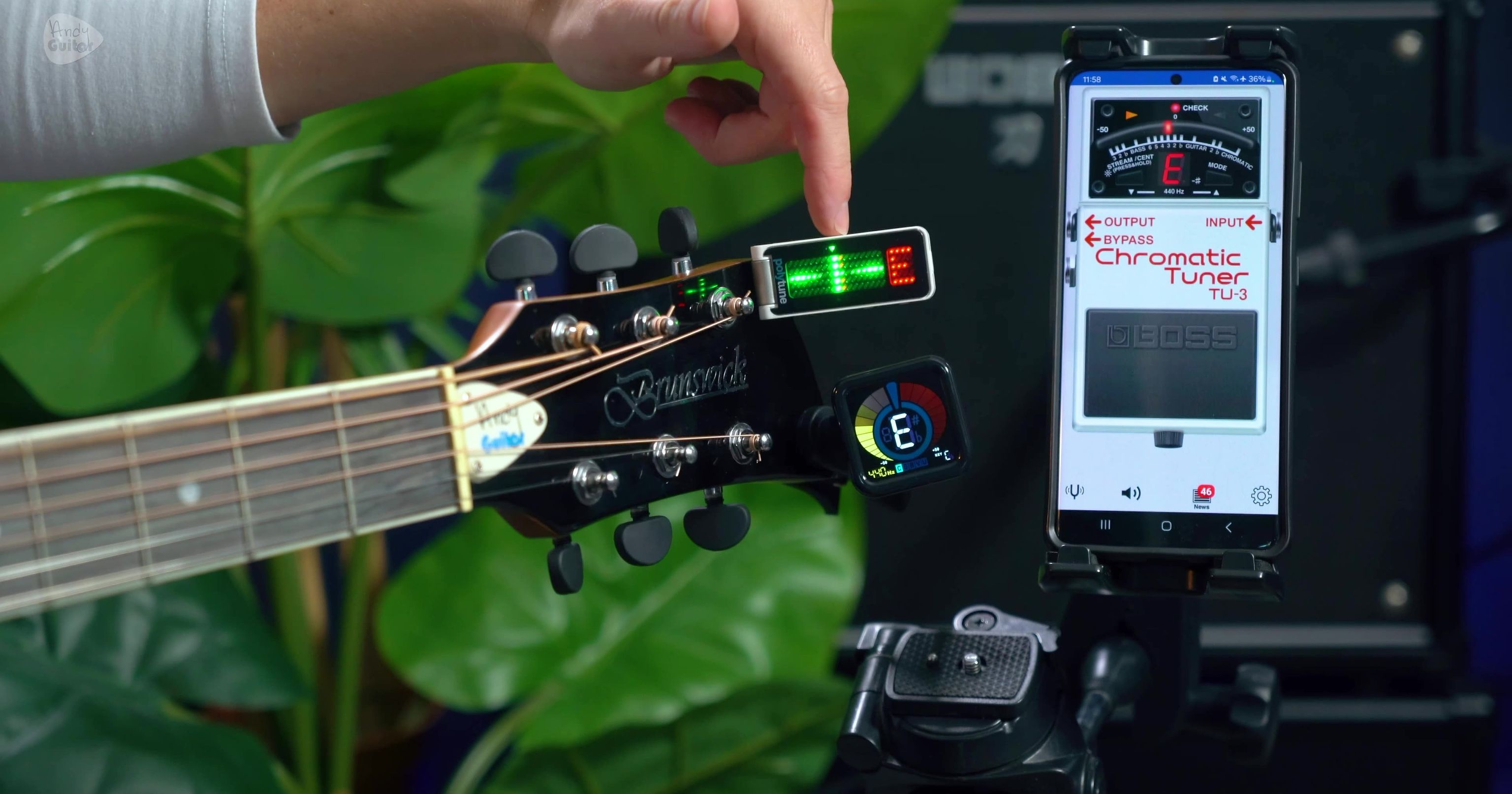
It's important to make sure your guitar is in tune before you play anything, but it can be the most frustrating thing when you can't quite get your guitar in tune and it's stopping you from playing. So let's jump straight into a close-up. I'll show you how to tune a guitar into standard tuning which all Andy guitar beginner acoustic song tutorials are in. Standard tuning, and then I'll talk more about the pros and cons of the different tuners I'm using, which might become obvious as we go. Most tuners work by us having to pick each individual string to see whether that string is in tune. However, this slightly more expensive polytune TC electronic tuner doesn't, we can strum. All 6 strings, and that, because you can see all 6 lights are pretty green. You can see this is close. To standard tuning, with any budget tuners or indeed a free app, this is the free boss app, we have to pick one at a time and I'm just gonna do that with my first finger. And this guitar is tuned to standard tuning, and we need to tune to the notes. E Eh? D. G B And E. You can remember those letters using a mnemonic, for example, elephants and donkeys grow big ears, or my favourite Eddie Dynamite, Goodbye Eddie. I'm demoing this on my entry level signature beginner acoustic guitar because all budget guitars are a little bit harder to get into tune. Whatever tuner we use, it's important to come from below pitch to pitch, so I'm gonna de-tune string six by turning it about a quarter turn clockwise. And pick it, so we can hear that, lowers the note slightly down to D and then coming up, it goes to D sharp, that little dot means sharp. We go above D and then we're in the range of E. We come gently up to that note, making sure we come from below. And when the note stays on green for a good amount of time. That's what we're wanting, that is now in tune. Very sensitive tuners will always show the note being a little higher when the note is picked, and then a little lower once the note rings out, but we're looking for as much green or as long on the note as possible on average. We're then do the same as that for all six strings, the next one is the A, and we should hopefully see, however, you let me know, that the more expensive tuner should be faster to each note, it should be. More accurate in pitch when we actually test it. The budget 1 may be a little bit slower to find the note and may not be as accurate when we test it afterwards, and the app is gonna jump all around the place anytime I'm talking because it's not attached to the guitar. Let's tune string 5 now, so I'm gonna pluck it. This is the A string, elephants and donkeys, A. We come from below the notes. To pitch. Now all tuners work best if we're close to the note already, but if we're way out of tune, say you've just picked the guitar out of the loft after a long time, or you've just changed your strings, these notes will be a long way lower than that, and we want to be careful not to keep turning, turning, turning, and not being aware of the pitch at all, because that can end up. Not ending well, so let's have a look at how we do that. I'm gonna go for the D-string elephants and donkeys, and I'm gonna really de-tune it. Crazy low, like I've just changed my strings low, this is really. This is super low now. So what I need to be aware of is it needs to be higher than the E and the A pitch wise. And it is lower. So I'm gonna come up to it. Turning anticlockwise as I visually look at the tuning peg. We're coming up through F and G, and what was I aiming for? I'm aiming for D. and we are also just a bit higher than that E string. A. This one wants to be higher than that so we can keep going, it is safe. See, now we know we're really close. Now we're at that D and I want to be careful now because this is really close. And there we get all green, and I'm now confident that this E. A And D Are in tune, when we go to string 3, string 123, it's this one. And we're gonna come from below the note again, that is now an anti-clockwise turn. And we turn it clockwise, so the same as the top actually, same way around. And there it is nice and quick. Next one, I'm gonna come below the note again, anti-clockwise turn. We're at A sharp there because of that little dot. Slow, slow, slow at this point, and sometimes you, you go past it and you have to come down. But there we are at B. Went a bit past it there, so let's go again. Just about there, more green is good. Finally, E, anti-clockwise turn to come from below. Now you will be able to see better than I. How the budget tuner is faring here, because I can't tell from here without turning this differently. Whether these notes are in tune or not on this tuner, it's just the, the angle isn't working for it, whereas this TC electronic tuner, whatever angle I'm at, I can see really clearly that that's all green and that's on an E. And the boss tune is also fared pretty well, but whenever I talk it goes crazy. And that's pretty good. And then if I strum all six strings. We get mostly green, but actually we can see that these thicker strings might still be out of tune and, it's a good idea to go 6 to 1, especially when you've de-tuned a lot. And just check one more time and maybe just come up to that string 6 again. And that's how we can tune a guitar using a clip-on tuner or a free app. The Boss app at the time of filming, the Boss tuner app is currently free, at least on Android. When this is a skill that you've practised, you can not only tune much quicker, hopefully, so I'm out of tune now. And there it is in tune. Go through each string like that, and then be pretty confident you're in tune. Oh no, I've de-tuned it. There you go. Shouldn't take more than a few seconds, and especially great that you can check everything's in tune or thereabouts, just by strumming all six strings, pretty cool. A worthy mention is the Boss TU 10. I've had this tuner for years and years, it's always worked really great for me. I can see. That that E string. Is looking pretty dead on tune to me, but that is not clear on camera at all, so that's not gonna look too good on. That's not gonna convince many of you guys. When I play my electric guitar and I have a pedal board, I tend to use my Boss TU2 tuner, which plugs in, even my acoustic guitars, many of them do have a jack lead that can go into this as well, and that's really, really accurate and super robust, great for gigging, and you can even use. The 5th fret tuning trick, in case you're perhaps at a guitar shop or at a friend's house, and you don't have access to a tuner right there and then. If you can get the E string or any one string in tune, and you can be pretty confident on that, I remember doing this with a keyboard or piano when I was a kid. The 5th fret on string 6 should be pretty in tune. With the open string directly below it, and that's the case for all strings, apart from G, which will be one fret down, it will be the 4th fret. But let's have a look at this, so fret 5 on string 6. Registers as an A note, and that's the same as the open A string. Or relatively close. And that is the same for every string. Fret 5, string 5 is the same as the open D string, that's a D note. Fret 5 on string 4 to the open 3rd string, a relatively the same note, and if this was low, oh no. They're out of tune. I can by ear think, OK, that's the pitch I'm going for. Around about there. A glance at the tuner obviously helps, but that's how you can also be checking your tuning yourself. You just need to remember that string 3 would be the 4th fret. To the open B string, B, B, and then E. Relatively in tune, intermediate players can even check their tuning with harmonics at the 5th fret and the 7th fret. Those should also be in tune, and it's the 5th rep, for example, on string 6, 7th ret on string 5, natural harmonic, touch the string. And those should be relatively in tune. Those are all the options you have available to get your guitar in tune, which is something you should check before every time you play, perhaps halfway through longer practise sessions, and every time you use. A capo, you may need to tweak the tuning. The tuner notes will be different, but if you're in tune for standard tuning, whichever note you're close to, you may just need to do fine tuning that is, which is now an F, it's just a little bit sharp, but it's pretty good. But especially with higher capos, you may need to retune there, but it's always a good idea to recheck the tuning whenever you use a capo, whichever notes you're closest to, that's the one that you'll be tuning to. And finally, why is it so hard to tune a guitar? Well, here's something to remember, guitars are tuned to the equal tempered scale, which is a mathematical scale that does not match the physical properties of the guitar strings, so even if you're in tune, your guitar. And every guitar is always a little bit out of tune because it's equal temperament. There's something to remember in case anyone says you're playing out of tune or your guitar's out of tune. All guitars are out of tune, but we just try and get as close as physically possible. A clip-on tuner is the best way to do that. There are free apps available and you can even do it by ear, but whatever you do, make sure you do it before every time you pick up your guitar to always sound best.
In this video
Here's how to TUNE your guitar to Standard Tuning: E - A - D - G - B - E.
All of the lessons in this Beginners Course are in standard tuning, so now we need to learn HOW to tune with the aid of guitar tuners.
We can remember the open notes of the standard tuning guitar by using a mnemonic, such as:
Elephants And Donkeys Grow Big Ears...or a personal favourite of mine; Eddie Ate Dynamite Good Bye Eddie.
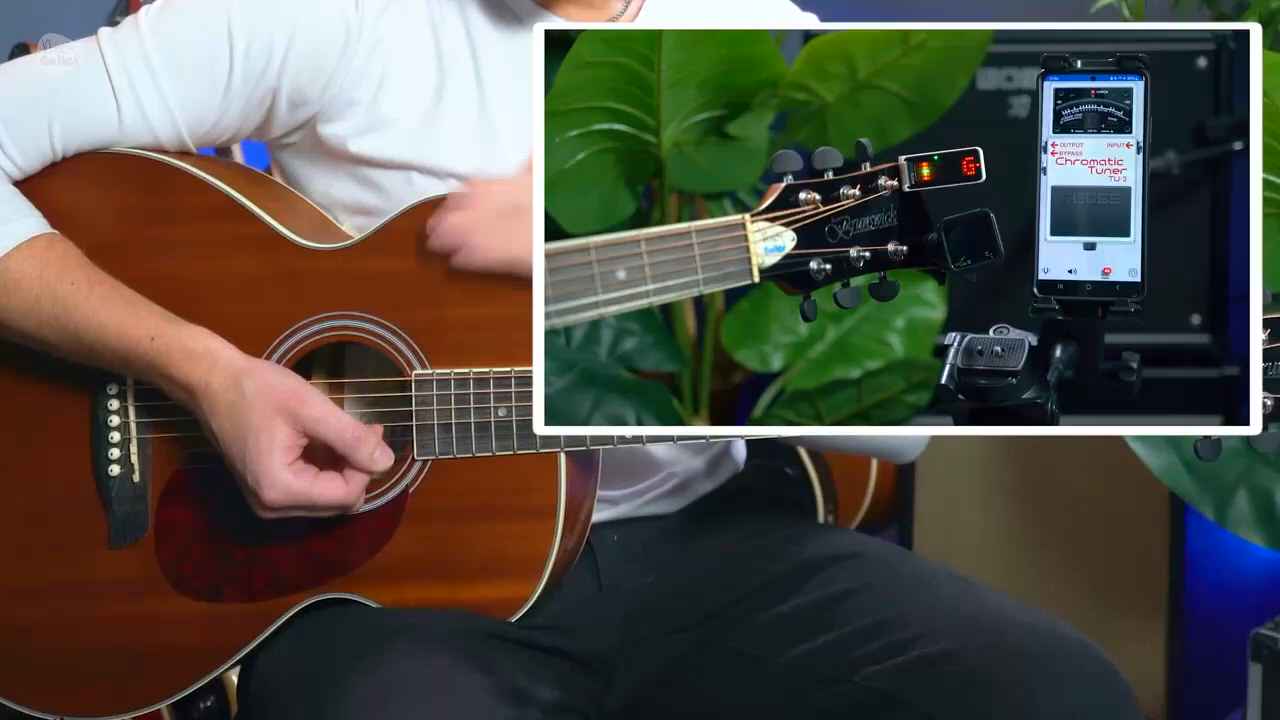
Engage the guitar tuner, play each string at a time while watching the tuner and simply turn the tuners in the direction that raises or lowers the pitch until it's on the correct note. A good method to follow is taking our time firstly but then always tuning up to pitch, meaning starting below/lower first and tuning up to the desired note.
Beginner Level 1
Recommended Songs
Enjoying this course? Want to test out your new skills? Find out my recommended song tutorials that accompany this course and get total access to the site by signing up today!