
Learn the Fretboard - Octaves 2
In this video
This lesson builds on the octave work from Level 3 by increasing the speed and range of your note finding. You already know the three octave shapes (E, A, and C shapes) — now we need to make them fast and reliable in any key, not just the comfortable ones. The focus is on finding six octaves of any note within 12 frets, and doing it quickly enough that it becomes a practical tool rather than a slow calculation.
What you will learn:
A speed-focused refresher of all four octave shapes
Finding all octaves of A and E across the entire fretboard
Challenging yourself with less familiar keys like F♯ and D
How octave knowledge connects to triads and the CAGED system
Why the SG-style double cutaway matters for upper fret access
A speed-focused refresher of all four octave shapes The four shapes come from chords you already know: the E shape (strings 6 to 4), the A shape (strings 5 to 3), the C shape (strings 5 to 2), and the relationship between strings 6/1 being tuned to the same note. At this level, the goal isn't learning the shapes — it's making them instant. When you see a note on any string, the octave locations should appear in your mind without having to think through the chord shape. That speed only comes from regular practice, which is why this is revisited here.
Finding all octaves of A and E across the entire fretboard A and E are the two most guitar-friendly keys, and you need these completely locked in before moving to less familiar territory. For A, you start with the power chord at the fifth fret, find the octave on string 4, then use the A shape to find string 3, and the C shape for string 2 — six notes within 12 frets, then repeating higher up. For E, you have the advantage of open strings on both strings 6 and 1, giving you the widest range of any note on the guitar — up to four full octaves if you include bending at the highest fret.
Challenging yourself with less familiar keys like F♯ and D Once A and E are solid, the real test is applying the same system to keys you don't encounter as often. F♯ is particularly important at this level because of the riffs and songs coming up in the F♯ module. D can catch people out because the obvious D chord shape on strings 4-3-2-1 doesn't immediately suggest where the octaves are on the lower strings. The exercise is simple: pick a random note, find all six within 12 frets, then check yourself. If you can't find all six, you know which shape is the gap in your knowledge.
How octave knowledge connects to triads and the CAGED system Octaves tell you where your root notes are, but triads tell you what's around them. When you play a G chord shape, for example, you know not only where the G notes are but also where the B and D notes sit. This is the bridge to the full CAGED system, where each chord shape (C, A, G, E, D) gives you a complete map of a key across the fretboard. We'll be covering this more fully later in the intermediate course, but the octave fluency you build now is what makes the CAGED system feel logical rather than overwhelming.
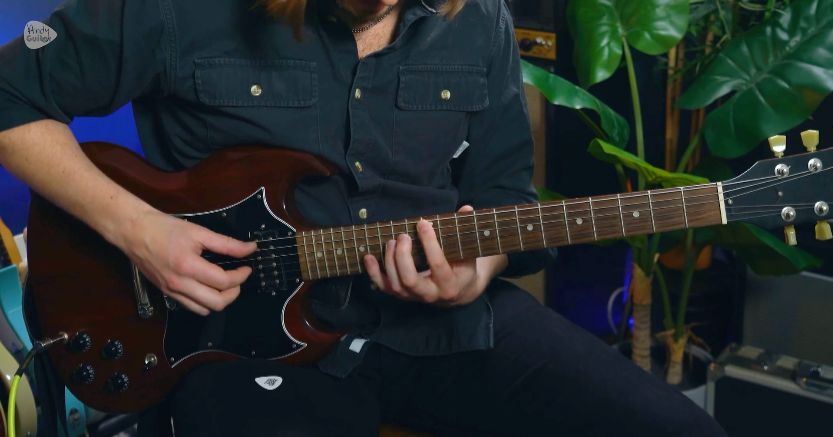
Why the SG-style double cutaway matters for upper fret access A practical point raised in this lesson: if you're working on note finding above the 12th fret, a guitar with a double cutaway (like a Gibson or Epiphone SG) gives you much better access to frets 17-22 than a single cutaway or an acoustic. This isn't about needing a specific guitar — it's about being aware that your instrument's design affects what's physically comfortable, and adjusting your practice accordingly. If your guitar makes the upper frets difficult, focus your speed practice in the lower and middle positions and use the upper frets when playing songs that specifically require them.
Intermediate Electric Level 4
Recommended Songs
Enjoying this course? Want to test out your new skills? Find out my recommended song tutorials that accompany this course and get total access to the site by signing up today!