
Introduction to Fast Punk Power Chords
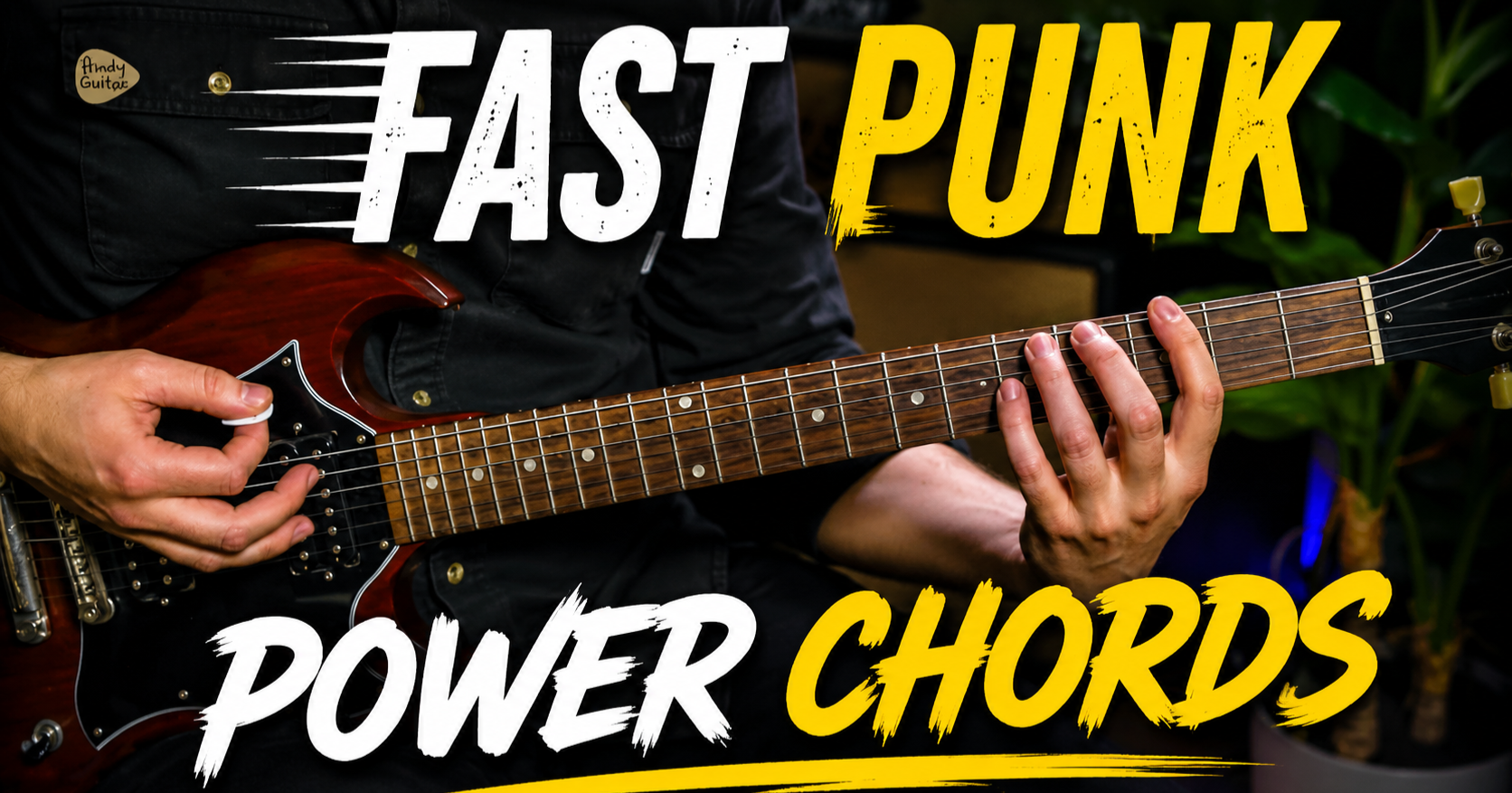
In this video
Speed with power chords isn't about moving your fingers faster — it's about moving them less. This lesson covers the floating technique, where your fingers stay on or very close to the strings at all times, sliding between chord positions rather than lifting off and replacing. If you've been practising the X's up the fretboard warm-up, this is where that minimum-movement discipline pays off in a real musical context.
What you will learn:
The floating technique — sliding between power chords without lifting off
Using anchor fingers to reduce unnecessary movement
The two-finger power chord shortcut for faster root 6 to root 5 changes
Power chord push-ups as a targeted practice method
Song examples: Arctic Monkeys, Green Day, The Hives, Ramones, and more
The floating technique — sliding between power chords without lifting off When you watch experienced players rip through fast power chord riffs, their fingers barely leave the strings. The movement comes from the arm shifting up and down the neck, with the fingers maintaining their shape and simply sliding to the new position. This is fundamentally different from the beginner approach of lifting fingers off, reshaping them in the air, and placing them back down. The X's up the fretboard exercise from the warm-up lesson trains exactly this kind of economy of motion, and here's where you apply it to real riffs.
Using anchor fingers to reduce unnecessary movement An anchor finger is one that stays on the same string while the others move around it. For root 6 power chords, the index finger often anchors on string 6 while the other fingers adjust. For root 5 chords, the little finger can anchor on string 4. Identifying which finger can stay still during any given chord change dramatically reduces the amount of movement required and makes fast changes feel much more manageable.
The two-finger power chord shortcut for faster root 6 to root 5 changes When moving between root 6 and root 5 power chords at speed, using three fingers on root 6 and dropping to two on root 5 (keeping the little finger on the same string) can make a big difference. The little finger essentially never moves — it just stays where it is while the index finger shifts strings. Combined with the two-fret slide technique from earlier in the course (pivoting around the thumb at the back of the neck), this approach makes riffs like American Idiot and Basket Case far more achievable at tempo.
Power chord push-ups as a targeted practice method If a specific two-chord change is giving you trouble, isolate it. Just change back and forth between those two chords as fast as you can — like doing push-ups. The key rule: never lift your fingers off the strings. Every change should be a slide. If you find yourself lifting, slow down until you can keep contact throughout. This targeted repetition is the fastest way to solve specific chord change problems, and it applies to any two chords that give you difficulty, not just power chords.
Intermediate Electric Level 4
Recommended Songs
Enjoying this course? Want to test out your new skills? Find out my recommended song tutorials that accompany this course and get total access to the site by signing up today!