
E Minor Pentatonic Superhighway Continued - The Hendrix Roadmap
In this video
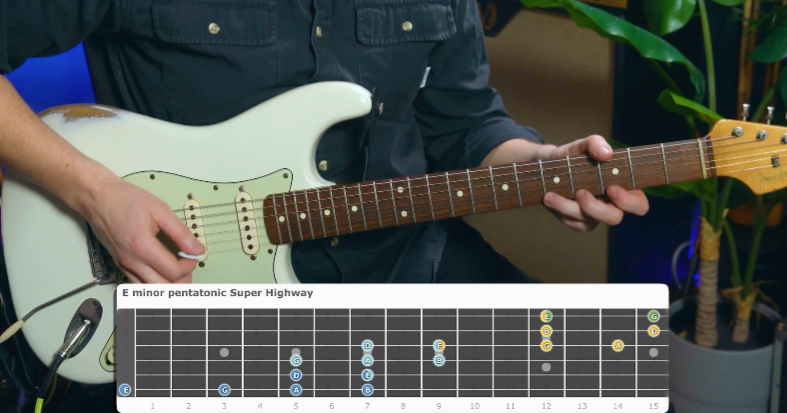
This lesson picks up the E minor pentatonic superhighway from where we left it in earlier levels and pushes it through the middle of the neck — the territory where Hendrix riffs live. By connecting shapes 1, 2, 3, and 4 with slides, you build a continuous pathway from the open position all the way to shape 1 at the 12th fret. This is the roadmap that makes riffs like Purple Haze, Voodoo Child, Cochise, and Mama Said possible.
What you will learn:
How shapes 3 and 4 of the minor pentatonic connect to the superhighway
The slide from fret 7 to fret 9 that unlocks the Hendrix territory
The E7♯9 (Hendrix chord) and where it fits on the neck
Riff examples: Purple Haze, Voodoo Child, Cochise, Mama Said
Applying pattern-of-three studies across the full superhighway
How shapes 3 and 4 of the minor pentatonic connect to the superhighway You already know shape 1 (the classic box at the 12th fret) and shape 2 (the "house shape" at frets 8-10). Shape 3 uses the lower part of the fret 7-9 area, and shape 4 sits at the top of it. The critical connection point is fret 7 on string 4, where a slide from 7 to 9 takes you from shape 3 territory into shape 4 — and from there it's a short step to the top of a power chord position. Once you can make that slide smoothly, you've connected the entire lower half of the neck to the upper half.
The slide from fret 7 to fret 9 that unlocks the Hendrix territory This single two-fret slide on string 4 is the gateway to the middle section of the superhighway. Before the slide, you're in familiar pentatonic territory from the open position. After the slide, you're in the zone where Hendrix, Slash, and Tom Morello build their riffs — frets 7 to 12, where the notes sit at the top of power chord shapes and connect naturally to shape 1 at the 12th fret. Practise the slide in isolation until it's automatic, then connect it to the notes either side.
The E7♯9 (Hendrix chord) and where it fits on the neck While exploring this part of the fretboard, we also cover the famous Hendrix chord — an E7 with a sharpened 9th. It's essentially an E minor shape with a major third added in the bass, creating that characteristically tense, bluesy sound. It sits right in the middle of the superhighway at the 7th fret area, and knowing its position helps you see how Hendrix riffs and chord work are all built from the same set of notes and shapes.
Riff examples: Purple Haze, Voodoo Child, Cochise, Mama Said Purple Haze starts on a blues scale note and moves into the superhighway from shape 3. Voodoo Child explores the same territory with a wah pedal. Cochise by Audioslave uses the slide from fret 5 to 7 and adds movement back down to fret 3, making it a slightly more advanced application. Mama Said by Lenny Kravitz forces horizontal movement across the neck using the same pentatonic notes. Each riff teaches a different way to navigate this central section of the fretboard.
Applying pattern-of-three studies across the full superhighway The three-note pattern study from earlier levels now applies across the entire superhighway, not just within one shape. Going 1-2-3, back one, 1-2-3 through the connected shapes builds fluency and helps you see the whole neck as one continuous scale rather than separate boxes. You can also try patterns of four and six for variety. This is how you develop the ability to improvise freely across the fretboard rather than getting trapped in one position.
Intermediate Electric Level 4
Recommended Songs
Enjoying this course? Want to test out your new skills? Find out my recommended song tutorials that accompany this course and get total access to the site by signing up today!