
In this video
The blues scale is the minor pentatonic with one extra note added — the augmented fourth (or sharp four), which sits between the fourth and fifth intervals. That single note transforms the scale's character and is responsible for some of the most iconic riffs in rock and metal history. If you've learned Sunshine of Your Love, Heartbreaker, or Enter Sandman, you already know the blues scale — you might just not have realised it.
What you will learn:
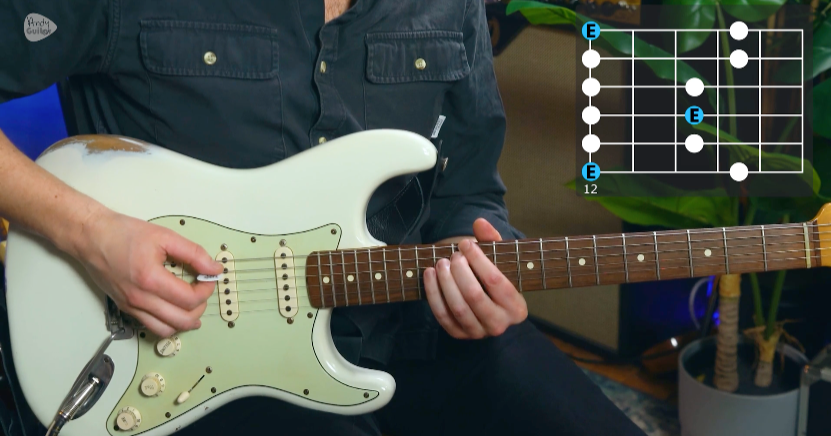
Where the blues note sits within minor pentatonic shape 1
The blues scale in both A minor and E minor positions
How to add the blues note to the E minor pentatonic superhighway
Why the blues scale works over minor and power chord progressions
Riff examples: Sunshine of Your Love, Enter Sandman, Heartbreaker, Sweet Child o' Mine, I Believe in a Thing Called Love
Where the blues note sits within minor pentatonic shape 1 In A minor pentatonic at the 5th fret, the blues note falls at the 8th fret on string 4 — played with the middle finger, slotting neatly between the notes you already know on frets 7 and 8. In the second octave, it appears on string 2, played with the third finger. Adding just this one note to the shape you already have memorised gives you a six-note scale with a completely different melodic flavour — darker, more tense, and instantly recognisable as "bluesy" even when used in metal and rock contexts.
The blues scale in both A minor and E minor positions The same principle applies in every key, but the two most important positions to learn are A minor (5th fret) and E minor (12th fret and open position). In E minor, the blues note falls in places that naturally lend themselves to hammer ons and flick offs — which is exactly how riffs like I Believe in a Thing Called Love and the descending run in Sunshine of Your Love are constructed. Having the blues scale in both positions means you can apply it across the full range of the neck.
How to add the blues note to the E minor pentatonic superhighway The blues note can be inserted at every point along the superhighway, giving you an extra colour wherever you are on the fretboard. The key is knowing it's always between the fourth and fifth — so once you can identify those two notes at any position, you know where the blues note sits. This is particularly effective in the shape 2 and shape 3 areas of the superhighway, where Hendrix and Clapton-style licks frequently use the blues note as a passing tone or a point of tension before resolving.
Why the blues scale works over minor and power chord progressions The blues scale shines over anything that's distinctly minor or built from power chords (which are tonally ambiguous). The ending section of Sweet Child o' Mine is a perfect example — the chords are E minor, G, C, and the blues scale sits naturally over all of them. Over major chord progressions, the blues note can sound jarring if overused, so it's best treated as a passing tone in those contexts. Knowing when to use it and when to leave it out is part of developing musical taste.
Riff examples: Sunshine of Your Love, Enter Sandman, Heartbreaker, Sweet Child o' Mine, I Believe in a Thing Called Love Each of these riffs uses the blues note differently. Sunshine of Your Love is built around it as a melodic feature. Enter Sandman uses it as the tension point in the opening riff — that one note is what makes the riff sound sinister rather than just pentatonic. Heartbreaker by Led Zeppelin weaves it through a longer phrase. Sweet Child o' Mine uses it in the outro solo section. And I Believe in a Thing Called Love deploys it with hammer ons and flick offs for speed. Learning even two or three of these riffs will embed the blues note in your playing vocabulary permanently.
Intermediate Electric Level 4
Recommended Songs
Enjoying this course? Want to test out your new skills? Find out my recommended song tutorials that accompany this course and get total access to the site by signing up today!