
How to hold (and choose) a pick
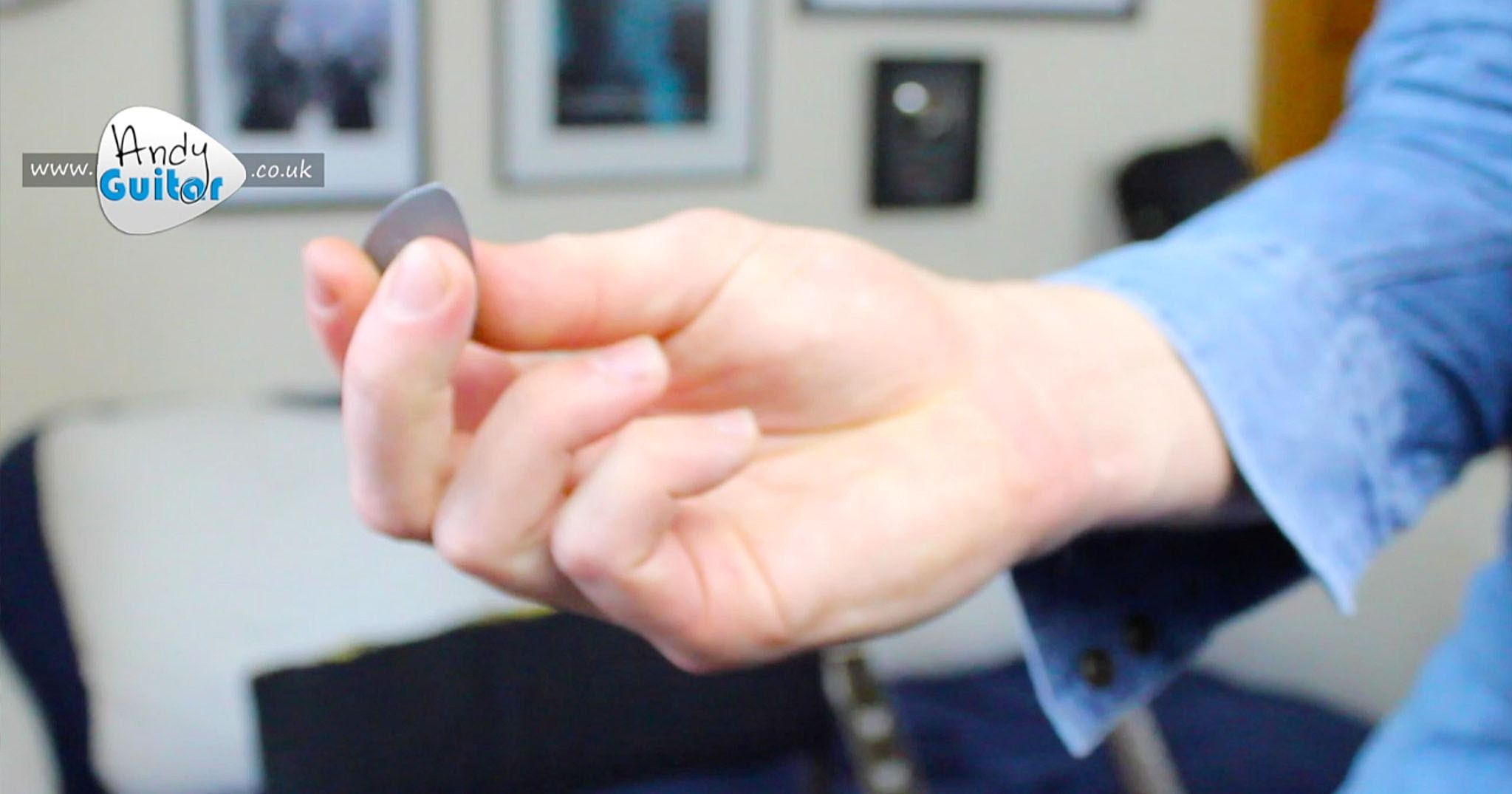
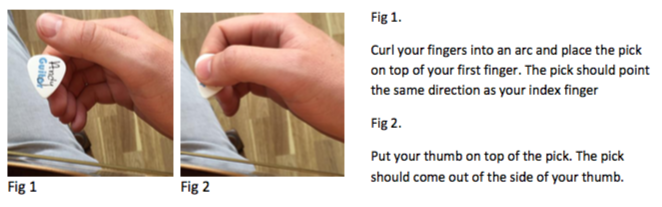
Hi guys, my name's Andy, and in this lesson I'm talking you through what a pick is. These things are also known as a plectrum, why I think you should get one, and my recommendations for doing so. So a pick is the best way to get the loudest and brightest sound from your guitar. Those two things are a real advantage, especially in the early days. So it's a worthy investment and they do cost just a few pence so it's really worth getting a pick. Now some beginners are really put off from using a guitar pick because they can move in their hands or generally. They just prefer to use their fingers, but it does give you a certain sound and I'd really recommend persevering with a pick. and it will become second nature to you, and you may even prefer it to using your fingers in the long run. So it's a very different sound we can get as well. This is my E major chord, the first chord we'll go for in the course, with a pick. Hopefully that sounds quite professional to you guys, that's the sound we're going for. We can just strum it with your thumb but. It gives a very different sound, a much more subtle sound, much more delicate. Now some people will prefer that sound and they may, those people may want to become fingerstyle guitarists. However, in my beginner's course, I'll be teaching you to use a pick and it's pretty essential to get used to using a pick to do the strumming patterns that we're going to be doing. And this course focuses on the basics of guitar and one of those basics really is learning how to use a pick. Now you can get a pick style of playing by using the outside of your nails, sort of in this fashion. And that will sound nice and loud and bright, and that style, including sometimes using the thumb has been popularised somewhat in these days by Ed Sheeran and other popular acoustic guitarists that are popular at the moment. However, if you do want to play that style of music, we have to begin by using a pick, otherwise what you'll find is you'll get blisters on your fingers and on your thumb. And you likely won't be able to recreate that sound in the early days, so we need to get used to using a pick first, er especially if you want to play that style of music that I've just mentioned. In regards to holding a pick, you'll want to place it between your thumb and your first finger. So if you hold your hand like you're giving the thumbs up sign, and then relax your hands slightly so your fingers aren't quite as tight as that, we place the pick on top of your first finger like this and then place your thumb on top of that, around in the middle of the pick, so there's only about 3 or 4 or 5 millimetres of the pick showing. You don't want to have this. amount of pick showing and you don't want to show too little so that the strings always catch your thumb and the skin here. So this is how I'd really recommend persevering with holding a pick and my hand kind of feels like now like I'm holding a microphone or like an ice cream cone and placing the pick on the side of your first finger creates a slight angle, which means that the pick runs across rather than rubbing against the strings. If you do get very frustrated and the pick keeps spinning in your hand or you keep dropping it. There's no problem in these early days of holding a pick with two fingers rather than one, where you would hold it like this. This is how I first started using a pick and it wasn't until I became a lead guitar player, so playing lots of single strings all the time, that I was encouraged to hold this pick on the side of my first finger, which is now the way that I play everything. But holding it like this if it makes you persevere with a pick, that's OK. So picks come in different materials and different thicknesses. My favourite is a Jim Dunlop Maxi Grip 0.73. I really think these are great, they don't move around your fingers quite as much as a standard pick does. And I've always been a fan of these nylon picks right back from when I was a beginner. That is just my personal preference. I'm not endorsing those pics more than just to say they're what I find most comfortable personally and I do recommend them to my students. Dunlop do also make these Tortec style pics and they are very cool and they're very popular among the professionals, but my preference is for the nylons. And then there is this plastic style pick that are very popular and you can get in. Lots more different designs and they can be a bit more flashy. Personally, I've never really been a fan of those plastic type picks. I've found I've broken strings with them. And because they don't have quite as much bend in them, they can be quite aggressive, especially for the early days. Again, those are just my personal choices. Because these picks are cheap, I do recommend that you get a variety and see which one works for you. Certainly for the absolute beginners that are likely watching this video, I don't advise you go any thicker than 0.73. And actually the thinner the better to be a bit more forgiving on the strumming hand so you can even go down to 0.38, which is one of the thinnest picks available. But somewhere between that and 0.73 you should find a pick that you're comfortable with. And it is worth spending just a few pounds or a few dollars, you know, getting a. Range of picks and seeing which one works best for you. So that's how to hold a pick and how to choose one. Do join me in the final lesson of these basic skills videos while I'll be briefly talking about how to read chord diagrams and how to read something called guitar tab, which is how single notes are written and displayed in guitar music. So I hope to see you in that next lesson before we get onto level one of my beginner's course. Take care of yourselves and I'll see you there.
In this video
Andy Guitar Beginners Course eBook 2016 - 2nd Edition
A pick (aka plectrum) is generally used to get the brightest and best sound from a guitar. I strongly recommend getting used to holding a pick and playing guitar using a pick.
Should I use a pick or just use my Thumb/ fingers?
Some beginners are very reluctant to use a pick. However, ESPECIALLY in the early days, I really recommend persisting no matter how many times it spins around in your hand or how often you drop it. It is simply the easiest way to get the best sound from your guitar for most pop and rock styles. Once you have a solid foundation of chords and rhythm, you can always learn folk ‘finger style’ playing at a later date (just like I did!)
Which size pick should I choose?
First you want to be aware of Gauges (thickness of pick in Millimetres 'mm'): .38, .46, .60, .73, .88, 1.0, etc.
Here's a break down of the most common pick gauges and what they are best for;
0.43mm Thin (light gauge) - ideally for beginners that are new to strumming
0.73mm Medium - suitable for everything
1mm Thick (Heavy Gauge) - Some people find these better for single note lead playing, particularly on electric