
Arpeggios in C major
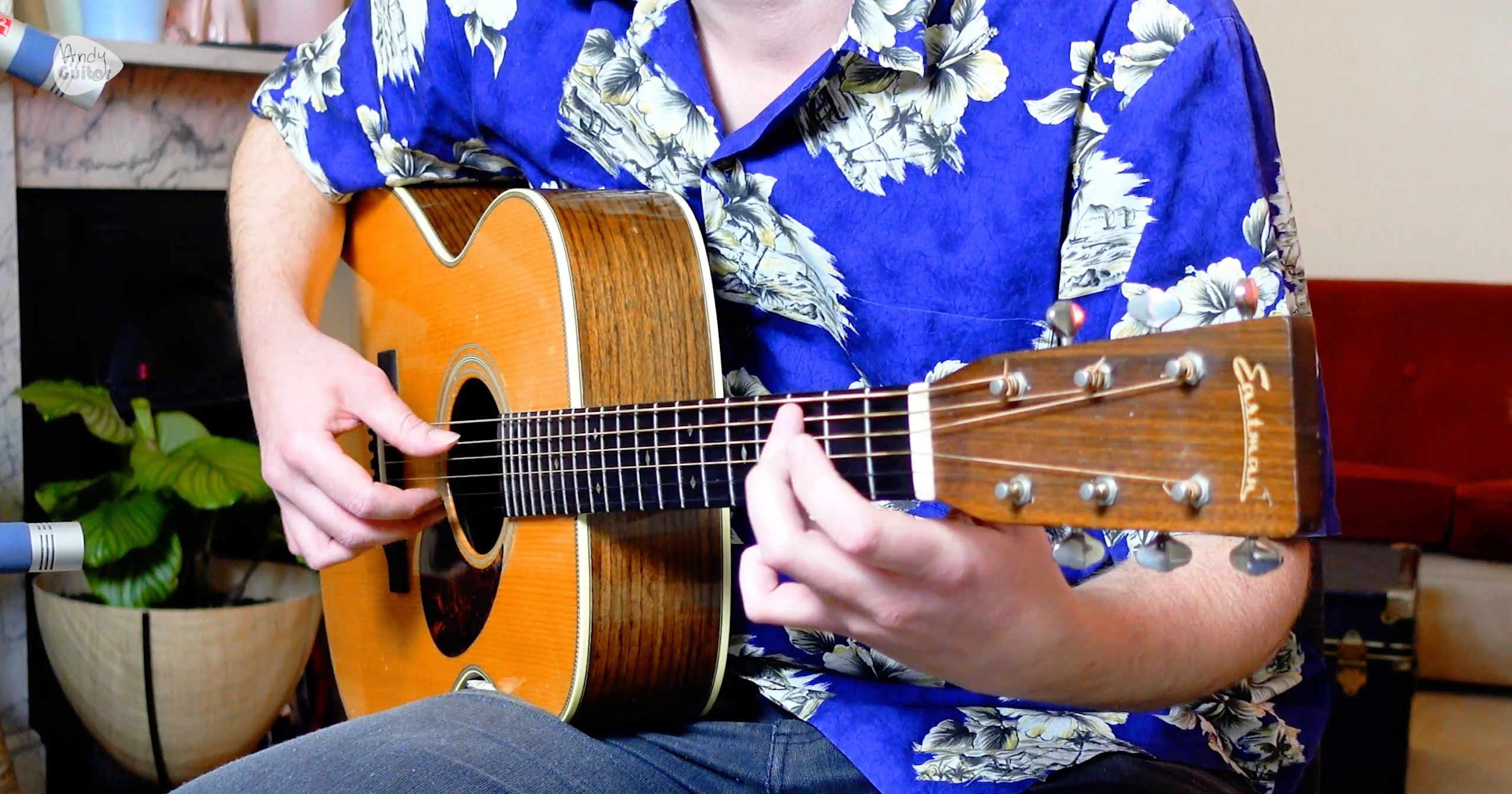
Hey guys, how's it going? So today we're gonna be looking at a study piece called Robin, which is a homage to a very famous sixties fingerpicking piece. So, we're gonna start with the first exercise or the first section of the song, I'm gonna go like this. So, let's break that down for you, so. The bass note, so let's look at the thumb first. So we're simply gonna go down the C scale, so C. C A G, OK? And then on the first C. We're gonna hit a topee with our middle finger. OK, so. Now, that's on the beat, so 12. Now, on the offbeat, we're gonna take our index finger. I'm gonna pluck the G string, the 3rd string. So we've got thumb on the 5th string. Middle on the top strain, the E strain. And then We're gonna play index finger on the 3rd string, OK, so. Then B, index. A, index, G index, and we get this little run. OK, so nice and simple. So be sure to try and keep it all nice and consistent with the tone. And nice and even, so then the next bar goes like this. So this is the other pattern, so there's a couple of patterns in the song, and this is the, the second pattern if you like, the slightly longer pattern. Thumb. Middle finger on the 2nd string, the B string. Index and the 3rd string again, so, so it starts the same, thumb and middle finger together. Then index like this, OK. Then we go thumb, middle, index, so 123. So together And So I'll play that pattern for you. OK, so we're gonna do that twice in a row, that pattern. So your thumb ends up playing 1234. 4 So that's your first cycle, OK, I'll put it into context for you. OK, so, Second exercise, so bars 3 and 4, we're gonna carry on with this theme and we're gonna develop it more in the second bar of the phrase, so we're gonna start the same. Now this time, we're gonna go like this. So we're gonna add some movement from the F chord, OK, so we're gonna go. And then So same pattern. You've got a couple of options here. So we're gonna use our middle finger for the base for the G. And we're gonna pluck. Uh, the E string, the low E string. And the B string at the same time. That'll be the same pattern, so together. 23. Let's put the second bar together for you, so this from F. So on the music it's the 4th bar of the music, but I meant the 2nd bar of the pattern, OK, just to be clear. Cool, so Let's stick it together. First time. Stay on the F 2nd time. To G Here's the next pattern, I'll play it for you. So you can see we've just continued to develop the idea even more, OK, so with this song we're gonna start and just add layers to the onion to try and develop the melody and the harmony as we go. So let's, I'll play that again for you. Very similar to the first two exercises, but this time we're gonna add a couple of high notes in the melody. OK, so let's break that down, so at this point. Now we're gonna get this high in the melody. So we're gonna probably wanna use middle and 3rd finger on the left hand, then. Basically the same pattern as before, how we started, but instead of having the E, we're now gonna put G on top, excuse my singing, it's terrible, you're gonna, you'll find that out pretty quick. OK, so G. And now when we get to the A. We're gonna play a top E string. OK. Play that again. So G. OK, let's try that one more time just to be clear what's happening, so. G on the top, and then we get to this one, E on the top. We've got that same movement. Next exercise, exercise 4. So the next section, we're basically gonna play down with the bass. OK, but this time we're gonna put a melody to match it. OK, so we're gonna get. Essentially, we're just getting thirds down the scale, so we're getting C and E, which is indicating a C major. And we're playing the B with a D on top, which indicates a B minor. And then we go to A in the base with a C on top, which indicates A minor. And then G in the base, B in the top. OK, so let me play that descending sequence. And we're gonna put the index on the 3rd string in between, so. B minor. A minor. Gee And then we finish with the sign, F. So let's try this section again. And again. So you can see all four of those exercises, very similar, so the first one we start with just the single note on top. Down the scale. Stay on that. Exercise 2, same. This time we had from the F. Gee. Next exercise, G on top. Then My singing is so bad. OK, so that's the 1st 4 exercises, they're kind of just. Building and building and building, OK, so exercise 5. We take it up another notch, so we're gonna, basically we're gonna start ascending, so generally we've kind of been ascending for the most part. So let's check out exercise 5 and we're gonna go like this. OK, so that's your ascending sequence, so this is. A in the base, C on top, so 0 and 1. 2 in the bass, B, 3 on top, D on top, so B minor, OK? Obviously between both of those we're putting our index finger, that's the continuous theme of the song, then. C in the base, E on top, there's 3 and 0, it's like a C major. And then a new shape. It's a bit like a D minor, we've got D in the bass, F on top, hit the G. So let's look at that ascending sequence. One more time. Then we're gonna jump right up, so let's quick shift this. So, 12 on the A string, 13 on the. B string. OK, so, and it's the longer pattern if you like. OK, and then from 12 and 13, we're gonna go to. 10. And 12, so 12 and 13 harmonically was is saying A minor, OK, so we've got A and a C which is like an A minor chord. Now we've got 10 and 12, which is like a G major. And again it's the long pattern, so let me play from here. OK. And then it carries on descending down the sequence, so the next shape. 8, so same strings, 8 and 10, this is like an F major chord, OK? Then we go back to 7 and 8, so that's like an E minor shape. So let's do that whole descendant sequence from Fret 12. 8 and 10. them. And again, 12 and 13. 10 and 12 8 and 12 And and So here we go back to the just one beat on each shape, so there we're spending 2 beats on each chord. 2, in the section we've just done, the descending section, we're spending 2 beats on each chord. OK, so at this point, we're gonna go back to spending 1 beat on each chord, so it's a quicker movement. So now we've got. OK, so 5 and 6. Minor. and 5, like a C major. And then we're gonna do a bigger interval here, so we've got B in the base and then we've got a G on top. OK, and then the next chord. Easiest chord in the song, 0, A E on top. So let's go through that bar, we've got 5 and 6. and 2 and 3, but 3's on the first string, the E string. 0 and 0, and then we're gonna finish with. called the G. So let's go through that whole. Ascending and descending sequence in example 5, so it starts here. OK, raising, then up to 1012 and 13. I'll carry on from here. Keep going. I'm gonna take you through that section again. So 01 3 and So 6. life on the high string. So I'm gonna play that whole section for you in context, so a little, a little faster. Quick jump. OK, basically you can kind of pick and choose which sections you kind of can play and then as you get more confident with each one, you can try and build it up, so let's try and give you a demonstration of all of the sections together. So first section Take it nice and steady for you. Stay there, now 2nd section. We're gonna add the G chord. Now top no To This time Now, ascending section. Pie, could be quick there. Keep descending Higher note So I hope she liked that little um that little ditty that I came up with, Robin, um, a tribute to a kind of very famous sixties fingerpicking song, and I will see you next time.
In this video
Welcome to this advanced fingerstyle course with guest teacher Jarvis!
In this lesson Jarvis shows us how to play a piece called "Robin", which was inspired by a certain popular fingerstyle song from the 60s. This piece has a steady and even bass line with a little bit of syncopation in the melody, which makes for a challenging (but with practice, achievable) introduction to fingerstyle guitar playing. The fretting hand work is fairly simple, which allows us to focus on the picking hand techniques.
Lesson aims
- Learn to control your picking hand, using your thumb and fingers separately
- Focus on the syncopation in the melody - this can be tricky!
- Learn to play the full piece
Study Piece 1 - "Robin"
Interactive Tab
Become a member to access this interactive tab section.
Who is Jarvis?
This course is taught by guest teacher Jarvis Daniel, who goes by JarvisGuitar on all socials. Jarvis is a fellow resident of Brighton and has become a good friend of Andy's. He has years of experience playing and teaching and is currently setting social media by storm with his phenomenal playing and super fun content. I first became aware of him from his excellent Instagram page and he also has a huge following on TikTok!