
Danse Macabre

Dance macabre, or as I know this, uh the theme tune to the Jonathan Creek TV series, which was shown in the UK in the late 90s and was a big favourite of mine. This is a really, really kind of magical um tune, very well recognised. And we've got uh we're going to. We learned this with the bass notes ringing out in this one also, but let's focus on the melody first of all, and we'll also sliding way up the neck, so again you're moving up the neck and using some triad shapes, which is a couple of principles of high-level fingerstar guitar. The key of this song is in the key of G minor. So G minor, we would really play as a bar chord, but there's no barring in this song, we're just starting off with 3 finger to little finger. And this works great if you can keep this third finger down. Bit more haunting if we, if we do that. So we play the thinnest string. And we're actually gonna play these uh the just the thinnest 3 strings in this song, and we're gonna change the principle that we've had so far, where we're gonna play uh string 2 with finger 1 and play string 1 with finger 2, so like this. Feels like the backwards, but it'll feel comfortable to do. So we go pluck, pluck. Play the thinnest er again. Then the first finger at the first fret, play it again. And then it's open. Open again. And the final bar, it's the little finger. At fret 4. So we've come down. Now we might need that thumb a little lower than you than you know you might have done before uh to make to keep right on the tips of your fingers. It's so crucial to be on the tips of your fingers for this one. but we can still be on an angle to make the stretch to the first fret easier. If you're like this, it is doable. But it's possibly harder and there's not really a need, we can have the thumb just sitting on top. Use whichever hand positioning is is feels more comfortable and is right for you. One more recap over that top line, one. 2 Again, keeping this 3rd finger down at all times if possible. If you can't do that, just play the melody and that will come. Uh, the second line, uh, goes like this. That was 3rd finger, and that's gonna stay down all the time. Thinnest string open. 3 is the little finger. 2 is the second finger. Open and back to second string. And then open. Open to. That line in total, that second line. And if we can just repeat that top line a couple of times, um, because it would be great if we could get the bass note added in on that top line. So let's make sure we've got the first two lines first. Which would go from the top? 1. 2. OK, and it would loop loop again if you want. OK, and this is in 34 again, 34 times, so a count of 1231231233 crotchet beats. And if we can, it will be fantastic if we could get the bass note added in here. And we're just gonna add it right at the top. It's actually a bar 2, but we'd go. And then try and keep that ringing out throughout. So that's exactly the same, but on the 2nd note, we hit the thumb on the open G as well, that's the only thing we're adding. One last time. OK. And then we we play the rest as normal. But when we get to bar 8, we're gonna hit the open D string. If possible. So that would be Thumb, string 4. That An optional extra. I can appreciate that that is tougher than most things that we've gone for in this course. And uh it, the next part is gonna slide up, so it's not, not gonna get easier from here. Apart from this, the, the third line, exactly the same as the as the first, as it as it normally is in this course. This would go. From here we have a slide. Up to 8th frets and 6th frets. How haunting, it's beautiful. And then we're down to a D major triad. But we've no choice than to play it up here. This was 3. Slide to 8. 6 on the first string. There's our D major barcode, D major triad. I'm choosing to play it with the 1st 3 fingers, there are other fingers you could use, but this is. My preference for you? And then easy way to finish. 7th threat, 5th threat. Third threat. Um, We could add in the bass notes from there. Here. That's the D bass note again at string 4. That was. What I did in the intro was add a little hammer on and flick off combo. Pluck, hammer, blick. And then pick that last note. In total. One last time, 34. When we're adding flick-offs and hammer-ons, that is a phrasing option, and it is a new technique or it could be a new technique for many of you. I have a few hammer on and flick offs exercises um in my improver course and a couple just on the website if you use the search box to do a search or even on YouTube. Um, but they are hammer-ons and flick-offs. There's a lot of that kind of thing in my lead guitar. Courses, both the acoustic and electric guitar rock ones, um but it just, they're just they're just different options basically to to make it sound cooler. Um I can't predict whether that will be something that all of you can do, some of you, you know, that will be too much. Get the bare bones down, try and finish it however you can. From there the easiest option is. That's the easiest option. Let's go from the top so you can see uh how all this will fit together. One last time, from the very top in. 1 2 And we're on the 2nd line. And 3rd line, same as the 1st. Lighting up. 8th fret and 6th fret. Easy option. With the flick offs. Hopefully that's something you enjoy. Such a cool sound to this one. And we're in a new key now which is G minor, so uh something a little bit different. And uh there's more of this kind of of lead line in my acoustic lead guitar course and uh also in my intermediate course we look at a lot of this kind of kind of study. Um, but let's get onto our final piece now in this course.
In this video
I love this song. I first heard it as the theme tune for the Jonathan Creek TV series here in the UK. Its dark and haunting but also beautiful. The end bit is really tricky for most, but is a great example of how we can move up the neck in fingerstyle guitar while also keeping bass notes and chord tones ringing out under the melody!
Song 11 - Danse Macabre

Lead Guitar Slides in TAB
There is a slide written in bar 14 with the / symbol, which makes the move up the fretboard much easier and sound better. It can be really tricky to do this and requires a ‘fee;’ for the slide, give it time and it will come and it will sound awesome!
Get the songbook!
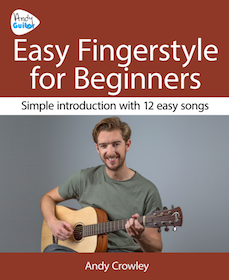
Get the TAB for every song in this course in a beautifully printed full colour songbook along with more help and guidance from Andy.
Ideal for those who like to have the TAB in a book open in front of them while watching the videos on full screen!
Available on Amazon.co.uk and Amazon.com only.
Fingerstyle Starter Course
Recommended Songs
Enjoying this course? Want to test out your new skills? Find out my recommended song tutorials that accompany this course and get total access to the site by signing up today!