
Happy Birthday - Fingerstyle
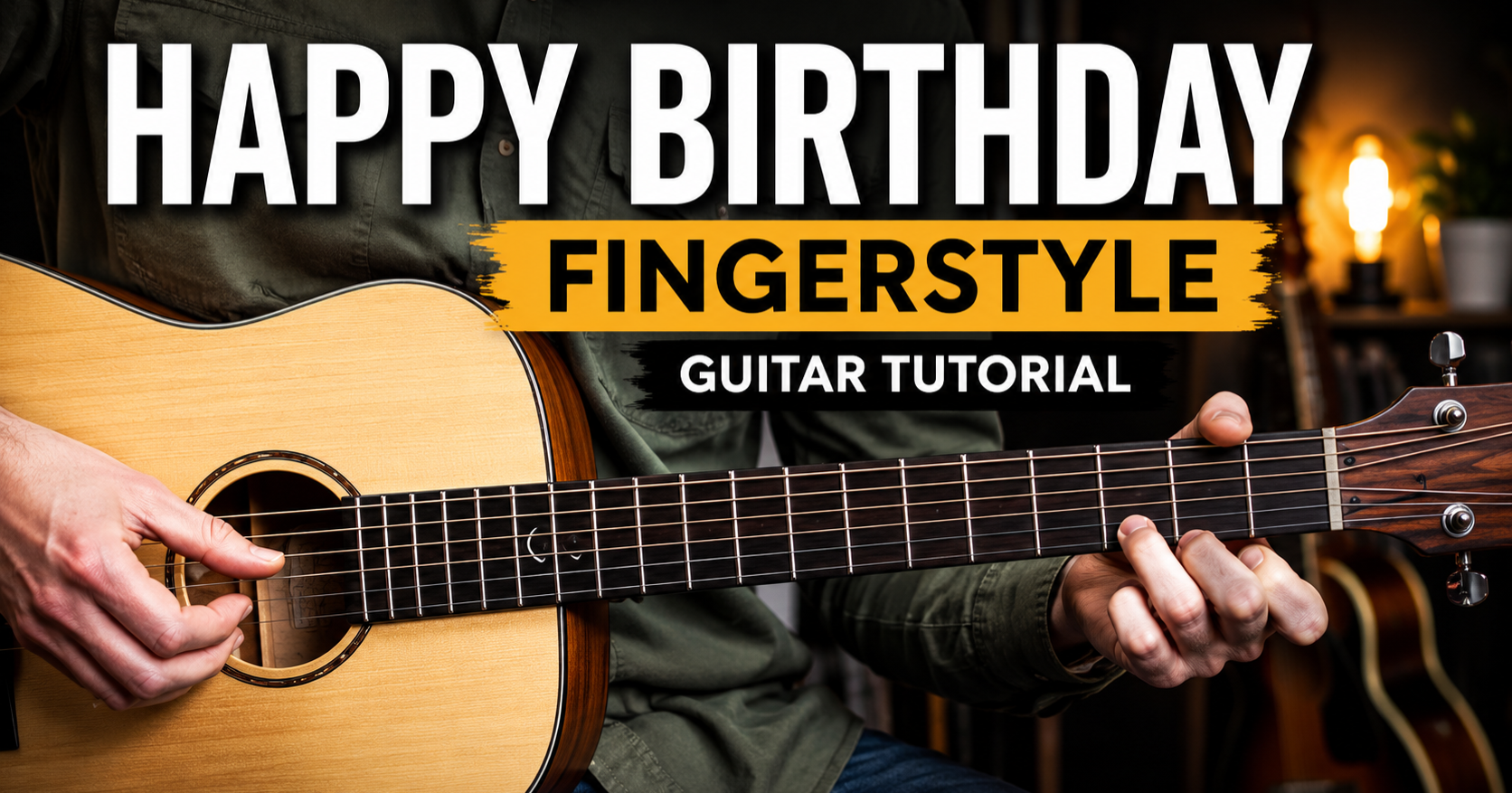
Happy Birthday, one of the most recognisable melodies um in the world of all time. And uh this one uses the C major scale. Uh, so if we play a C chord just now, we're using most of the notes from this C chord throughout this song, so we're gonna be using the first finger here an awful lot and things like that. Um, but we're actually going to begin. On the open G note, which is the 3rd string, and this is where I'd like to just cover the quick principle of finger style guitar, where we're going to assign a finger to each of the thinner 3 strings. So fingers 12 and 3 to strings 12 and 3, placed underneath them like this. This is how I'd like you to set up now. And I'd like to have that thumb ahead of the fingers in this fashion, OK, so we're kind of set up like this. And then whichever string we we need to pick, we're going to pick using that finger that is assigned to that string. Finger 3, finger 2, and finger 1. The thumb would then change between any of the thicker 3 strings whenever it's needed, but it's not going to be needed until much later in this course. We're focusing on those 3 fingers, OK? Now this isn't the first, this isn't imperative at this level, but by the end of this course, this is what I want you to have trained. So learn the notes first if you have to, maybe just pluck in with the first finger, it's totally fine. This is beginner stuff, it's cool. But by the end of this course, I'm gonna be forcing you to be a lot more vigilant with which fingers you use. So if you can at this point, I encourage you to do so. We're going to play that open 3rd string, 123, with the first finger. We then play it again. And then the middle finger here goes down at 2nd frets. Remember at this side of the fret, not this side. And then to the open string. And then we have the happy birthday. Another time. And to finish off that first section, we then play the the first finger at string 2 fret 1, which is the C note from a C chord. Pluck it with the middle finger. And then to the open string. And that would give us. The start of Happy Birthday, one more time. Now those first two notes have a little bit of what we call swing to them. It's to a rhythm of happy birth, you know, there's a bounce to it. 1 and 2 and 3. And that is shown in the tab via this symbol. We have um 2/8 notes together. So one and, but that is shown to be in a triplet rhythm which is a crotchet and then a quaver, so a whole beat and then a half a beat. All it means is basically play this like you know happy birthday goes. Nobody sings Happy birthday. You know, the, the rhythm. Make sure you play the rhythm how you know Happy Birthday goes, and you will be playing it correctly. It's just the technical way that would be written in tab and with rhythms is by showing that the eighth notes are to this rhythm, 1 and 2 and 3, and happy birthday. You OK, rather than a bit machine-like and rigid, happy birthday to you, OK? Just play it how you know it goes. Just want to explain that little bit there. Just as a recap, we have. Bar 3, after that we have open, open again. 2. 0 But finishing this time, the last two notes, 3 to 1. Which is on the B string. That was. Recap from that whole line. 12. The second line is a little bit trickier, but it begins in the same fashion with playing the open 3rd string, the G note. Twice as we've done already, and then we go to the thinnest string, 3rd fret, played by the 3rd finger here and the 3rd finger here. Now that is an octave, that distance between the G, an open string, and the G here, which is from a G chord. When we have that same note, but a different pitch, so same letter name, they're both G's, but it's at a higher pitch or a lower pitch, it's called an octave. They're they're a G apart basically, it goes G A B C D E F G. OK? And that G is higher than the lower one G A B C D E F. OK. Um, and there's 8 of those letters between each of the two. So that's why it's called an octave, cos oct means 8. We go to the 3, then to 0. And then to one. That was Open. 3. On the thinnest string. Open on the finished string. See note. Middle finger at this end. Open string. And then the first finger. Uh, that's 2nd fret note on the 3rd string. That's the tricky bit, we have a longer sequence of notes there. And then finally, from 1 and 1 in bar 7, we have. 11 to 0. And then finally, 131. That was 110. One 3 One And also, when we're in this key of C, um, every number of the fret, so fret 1, fret 2, fret 3, we would also use finger 1, finger 2, finger 3. So we're always using the middle finger at 2nd fret, first finger first fret, 3 finger at 3rd fret. A. This time. Not always, but it's a good principle throughout most of this course that that is the case. Now let's just go for that second line in total, which is really important, just to make sure we've got this part done when we're learning these longer finger style lines, OK, these longer melodies. That second line was. OK, so really slow and together from the open 3rd string. In 12. And when you have that second line on its own, very solid, we can go from the top. But until you've got that second line right on its own, I would not continue just going from the start of the melody and going through it. Because the thing is, you will have that first couple of bars down and therefore if you always go back to the start, you'll be practising those lots, and you won't be practising. As much the bit that you might be struggling with later on. So do the top line, get that sorted, and then move on. Don't play that top line again, go from bar 5 and just do the second line on its own, as I've just demoed there. But we're gonna have a go at putting it together now. Let's go from the top together if possible. And here we go from the open third string again. In 12. And we could choose to finish. With a strum, with the thumb. Just softly on a C major chord, because that is the key of this version, this way of playing Happy Birthday. Hope you enjoy that one, I hope you do play it for friends and family at some sort of birthday, um, when it is someone's birthday, and it's just one of those super recognisable melodies that I really hope you enjoy playing. Along with this second one, this this next one in this in this course. Such a great melody. The next one is Amazing Grace, and I hope you will join me for that one.
In this video
Happy Birthday is probably the most well known song on the planet, so it’s well worth learning!
Song 2 - Happy Birthday
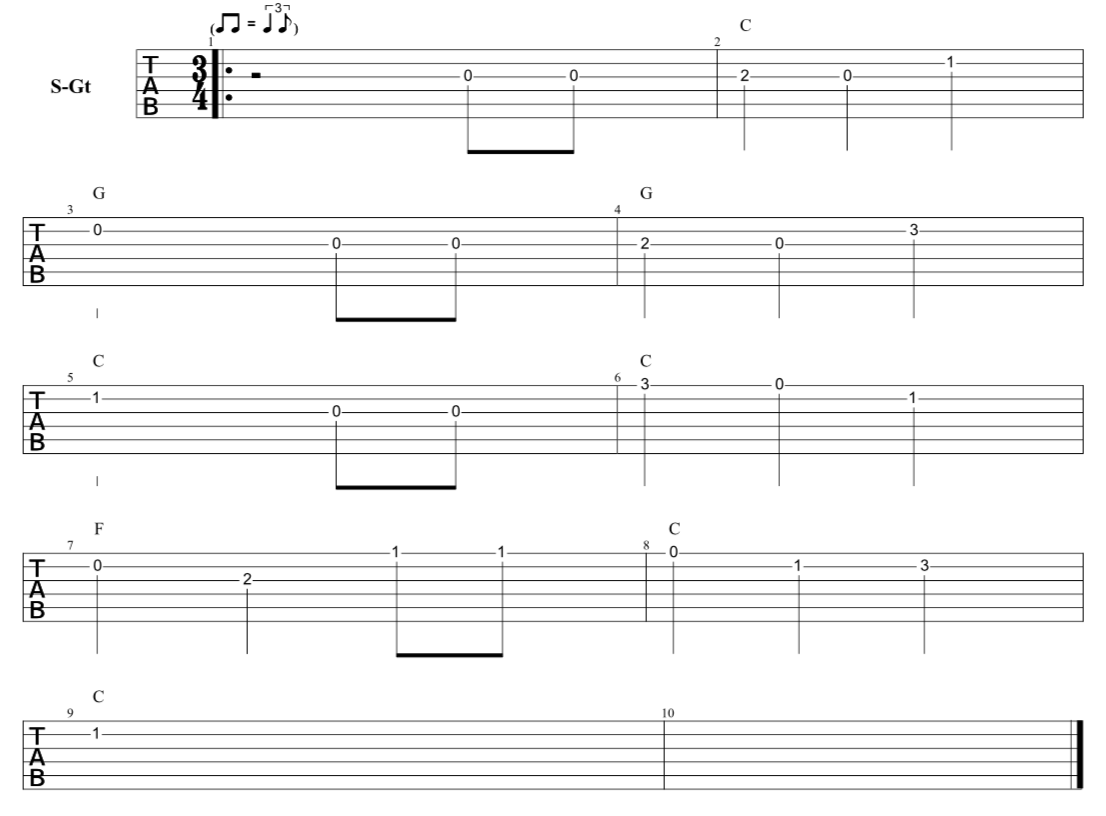
Getting the rhythm right
There is a jolly ‘bounce’ to this song, which is shown by the symbols in brackets just above the first bar. This shows that the 8th notes should all be played with a bounce aka swing rhythm. In basic terms, this means play it to the rhythm that you would sing it - singing along will help!
Get the songbook!
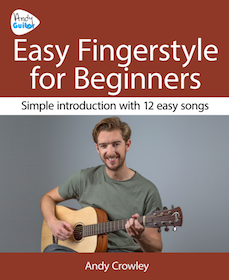
Get the TAB for every song in this course in a beautifully printed full colour songbook along with more help and guidance from Andy.
Ideal for those who like to have the TAB in a book open in front of them while watching the videos on full screen!
Available on Amazon.co.uk and Amazon.com only.
Fingerstyle Starter Course
Recommended Songs
Enjoying this course? Want to test out your new skills? Find out my recommended song tutorials that accompany this course and get total access to the site by signing up today!