
Amazing Grace
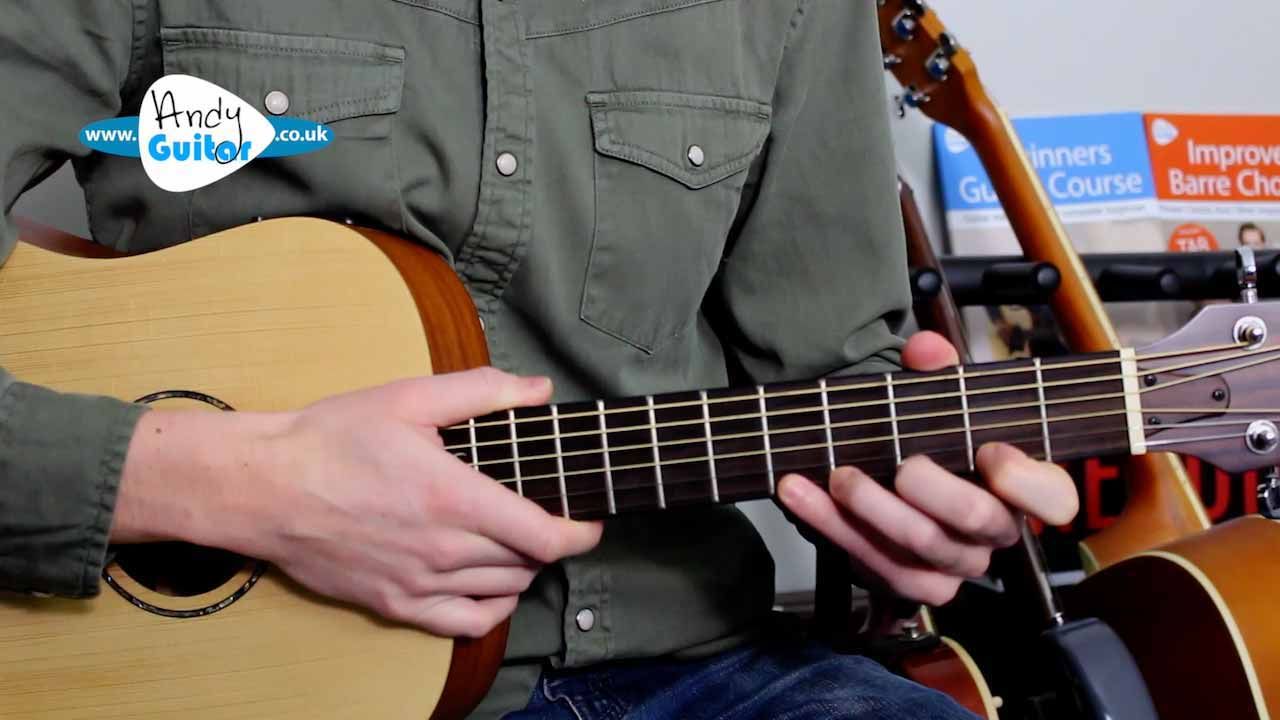
Amazing Grace, such a beautiful song. And in this video we're just learning how to play the single note melody. Now in the fingerstyle course that follows this one, we have uh the same melody notes but we put chords to it as well. So if we learn the melody here, we can add chords to it later and see how everything fits together. Uh but we're just gonna be working from the tab that's included with with this course. And we're going to start as we did with Happy Birthday, with the open 3rd string. This time just playing it once. And then playing the first finger, the C note, first fret of the 2nd string. And ideally we want to play that with the first finger and then 2 finger because we're assigning fingers 12 and 3 to 1 of those thinnest 3 strings in this fashion. So we play. Open one. And then the thinnest string with the 3rd finger. And we play that thinnest string twice. And there we're really just playing 3 notes out of a C major chord. This song does use the C major scale, but in that case, we're actually just playing the thinnest 3 strings. Of the C major chord, which is how so many melodies are actually written, and often people ask me how, how do we make scales sound like melodies, and part of the answer is to follow what chord's playing and to play what we call the chord tones. Play the notes that are of the chord that is happening, in this case a C. OK, that would get us up to bar 3. And then the 3rd finger plays the 3rd fret. Of string 2, so pluck with the middle finger and then back to the first finger. And then Middle finger at 2nd fret to open. And that would be our top line. 12. Finishing with another open to finish bar 5, but that's really the start of the next line. One thing I'd like to mention with the tab is this song along with Happy Birthday is in a time signature of 3/4, which is what actually is the first thing that's actually written on the tab. That means there are 3 beats, so there's a count of 3. But those beats are crotchet beats, so whole beats. Uh, so the number on top is how many beats, and the number on the bottom is, uh, what length of note are they? Are they crotchets, which is a whole beat? Are they half a beat, which would be eights, and we can have all sorts of permutations here. So essentially all it means is we're counting to 3123123, waltz time. Amazing grace. 123123. That's all that means, and it just means that every bar line uh means that inside those, within those bars are a count of 3 beats. So all the rhythms and everything have to add up to 3. So we're going to move on to the second line now, but every line is so reminiscent here of that first line. It has so much repetition through this song. So take your time and make sure you've got that first line right before we move on. If we're OK to do that, then we begin exactly the same. So the 0 there was from the end of bar 5, the end of the first line. And then the first is bar 6. The first finger in this hand. Open, open. And then 33. So that's the change. And you'll see that there's a G chord written above that, a G um symbol. And those two notes. Are from a way of playing the G-chord. you may be familiar with. That second line once again. 00. 33. OK. So that first line, let's go from the top again and get it to the end of the second line. 123. Start the same again for the 2nd line. And then 3. And then we use the little finger to play the other 3. The third line, most of it is the same as the 1st line, apart from the first two notes, which are open from bar 9, and then little finger again. On the 3rd fret of the thinnest string on bar 10. From there. the birds. Exactly the same as bars 234 and 5, as that top line. That one again this third line from the end, from bar 9 essentially. And the 4th line begins the same as the 2nd line. So exactly the same. All the same up to there which takes us to the end of bar 15. Bar 16, just place your fingers in the position of the C major chord and pluck. String 2 to string 5, you could do it all with your middle finger. But I'd especially really try and do that last note, that C note at the 5th string with your thumb. Because then we're moving towards the principle of playing the thinner strings with your fingers. And then that importantly that C note, that root note of the C. With with the thumb, and we covered what root notes were in my beginner's course, really from the top but from level 5 especially, so that shouldn't be uh too new to you. Let's go from halfway through, let's go from bar 10 and get the second half sewn up just as much as we got the first half sewn up, as I say, that is how to work through these songs, that is how to work through the tap. So we will go from bar 9, that first note, and 12. And the sea chords. One slow playthrough from the top now, but we're expecting this to be harder because every time we get each line or each little section um practise, it's always harder to then go from the start to the finish because it's the joins. The joins are always harder. Expect it to take a little bit longer to sew it all together than it does just to get a couple of bars or the one line. But there's nothing that you can't do if you've made it this far. Let's go from the top, from the open 3 string. And 123. Coming up to the last line, bar 14 there. And the sea god. Wonderful. So that was Amazing Grace. And this one and uh Happy Birthday both have chord melody arrangements in my full fingerstyle course which follows from this one. This one's just an introduction to melodies really. Uh but in my full fingerstyle course we cover fingerstyle patterns and doing chord melody arrangements. Of Happy Birthday and Amazing Grace and um pushing these single note melodies, the same ones we've learned here, but with chords. So if you like this, it's preparing you for that you know full syllabus there. But we're gonna move on now to our next easy melody.
In this video
If you can play this, you'll find a free lesson showing how to play a slightly more challenging arrangement of Amazing Grace in the follow on to this fingerstyle course.
In this lesson, we learn how to play a basic melody only version of Amazing Grace. In the follow on course to this, we look at how to play the chords at the same time as this melody, which is the gateway to higher level Fingerstyle guitar!
Song 3 - Amazing Grace

Chord symbols
The chords are written above each bar. This allows you to strum a simple version of this song and sing along if you wish. We’ll learn how to play these same chords with the melody at the same time in my Intermediate Fingerstyle Course, which is the follow on to this!
Get the songbook!
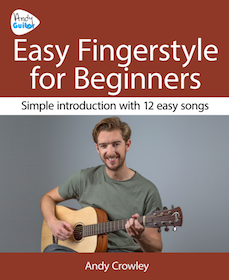
Get the TAB for every song in this course in a beautifully printed full colour songbook along with more help and guidance from Andy.
Ideal for those who like to have the TAB in a book open in front of them while watching the videos on full screen!
Available on Amazon.co.uk and Amazon.com only.
Fingerstyle Starter Course
Recommended Songs
Enjoying this course? Want to test out your new skills? Find out my recommended song tutorials that accompany this course and get total access to the site by signing up today!