
Heavy Rock Style Palm Muting [aka chugs!]
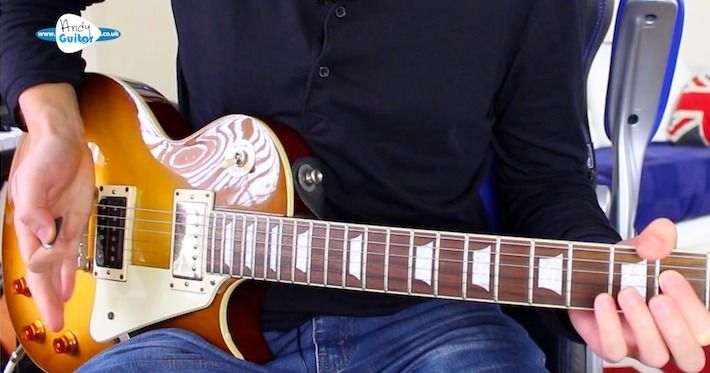
Hi guys, welcome to lesson 3 in this 10 lesson electric guitar starter course where we're checking out something awesome that's called palm muting, which is how to create this sound on electric guitar. Sounds great, sounds really rocking. If you're having problems with getting the sound of your guitar or the amplifier settings or anything like that, check out the first lesson in this playlist, um, where I'll be talking you through everything that you need to get your guitar sounding right and accessories and things like that. But let's get straight in for a close up on this classic lesson, how to play palm muted power chords. So in this lesson we're mainly focusing on palm muting, which is a way to get this kind of sound. Um, there's no other way to get that sound on guitar, and it is so synonymous with the rock genre. We're doing a little bit of a riff to play along to the backing track that we'll be playing along to after we've learnt the technique. But how do we get. This sound, well, if we just listen to my guitar sound without any sort of muting or other techniques, this is me playing an E major chord. So it doesn't sound particularly heavy but there is definitely enough fuzz or overdrive um on this to be able to get this kind of sound. The muting effect. This is done by placing the outside of the palm of the hand er kind of here. Just here on the guitar, so we're just inside on the strings from the bridge um and where the saddle kind of meets the strings here. Um, a way that I kind of like to teach it is usually at least on a Les Paul type guitar, which is this style of guitar. The hairs on the back of my hands are very much just catching or touching the er the saddle here, that kind of sits pretty pretty well where I'm doing this, if I let you see from here. And from here I'm very much on the just resting on the inside or on top of the saddle. I'm pressing down very lightly. But there is very much a sweet spot which you have to find on the guitar that you have. It is a little bit different for every model er of guitar, so Fender versus Gibson, all of that. There is a sweet spot you have to find because the bridge here is raised quite far from from the guitar, I think it's a little bit easier on um. Les Paul type guitars and Gibson style guitars than than Fender ones possibly, but you still, the same techniques kind of apply. So in essence, we lay our hand down here and I'm playing the A5 power chord. Just picking string 5 and 4 together. And my 1st finger is on the 4th string at 2nd fret. So we just pick string 5 and 4 together at the same time and without any muting technique at all. What I'm doing sounds like this. So my forearm is still and I'm just pivoting very slightly from the wrist, staying nice and small movements and nice and loose, no tension of the arm at all. Around the same amount of tension as if you're writing your name, nice and neat. And we lay down the palm of our hand, and if we're too far this way, it sounds like this. It doesn't sound any different. If I'm too far this away so I'm kind of near the neck pickup, it's totally muted. And if we move kind of backwards from there, you can get a bit of a note there, but that's possibly a bit too heavy. There's the sweet spot, and if I go past it. Then it doesn't sound any different to just playing normally. So let's have a look from this angle. That's without and with. That's too much. That's the sweet spot from this angle, which I guess is a bit closer to the angle that you'll have. That's what it looks like. Bosh, just there. Too much, so too far this way. If I move it back. That's the sweet spot. And then we move off. And we want to be at around this tempo, keeping everything totally even. And we're just going to keep that going, we're kind of building up the endurance in our picking hand with this. And making sure we keep the movement small. Shoulders down, nice and relaxed, loosey goosey but small. Controlled Movements with this A5. You can try it with an E power cord as well. The A5 And also move everything down the string again. This is actually the start of Now I'm Here by Queen. And it's also very similar to some of 69 when we play it on the D5 power cord. However, what we're going to do for the Riff itself is um we're gonna move this first finger up, not 2 frets but 3. So first finger was that second fret, which sounded like this. We're then gonna move it up to 5th fret. Then to 4. And to come back. Going for a bit of a Judas Priest kind of vibe. Uh, the track is a little heavier this one, but that's mainly due to, you know, the techniques we're using and the the rather than just more overdrive to make things sound heavier, you know what I mean? So we're gonna let these ones ring out. And then palm mute the ear. And we're gonna parm mute this ear for the first half of the track and then uh for two bars after that. So the track's going to start and we're just gonna try and get this palm muting up to kind of this sort of tempo. So let's try and do this together. Just the palm muting, staying on the ear and try and keep keep up Marty. Let's go in 234. 4, so 8 strumming. 2 and 34. And forehand and then pause there, halfway through the track, we move our first finger to 5th rep. And then 4th. For a bar of each and then we go back to 2 bars of this. Let me demo, 234. And again, And that would be the whole thing. Again, the challenge is not finger dexterity or kind of um, you know, any very complex skills. The complex skill we're working on is playing in time to this track and being able to coordinate the two hands together. So this hand moving and this hand doing one single strum and then parmuting. You know there's a lot of different things going on there and these things are not typically worked on enough for beginners in my opinion, so that's why I'm er focusing on them at this early stage of this course, it will get harder by the end. Uh let's have a listen to the track and see what we're going for here. So listen first of all. 21 to palmuting. So this is the tempo that we're aiming for with our palm muting. And then in a second we try those other chords that we did earlier. Palm mutiny again. That's what we're gonna go for in a second. Watch carefully. One last time and then we're going to go together. I think the biggest thing to take from the demo is how early I move up. 234. I moved early. Make sure my first finger made that jump up. OK. So uh let's have a play along together, just starting. With that first finger parmuting the A5 power cord. All this parmuting technique does work on a cleaner electric if I if I clean it right up. You know, as opposed to. It still applies, but it's synonymous with rock guitar. In, so we're going for the A 5 power cord. 12123. 1 and 2. and keep that timing good. Keep it going. Relax your shoulder. Forearm And just let that right hand do his job. Keep it going, this is endurance the first time we do it. Relax, small motions. OK. threat. And again, 34. Last time. And actually that's the end of the track. OK, so it is a bit of a quick one. you have total choice and total say whether for how long you stay on this part for. And for when you move to this bit. It matters which bit you prefer playing more and which one you have to and which one you have to work on for your own development. The choice is yours, the bass guitar is just hitting. note the entire way through the track, so it's entirely up to you, but that is how to play track 3 of this little rock guitar course.
In this video
EGSC Track 03 TABs Palm Muting
EGSC Audio Track 03 Palm Muting
Welcome to lesson 3 of my Electric Guitar starter course where we're taking a look at heavy rock style palm muting!
Ever wondered how rock and metal bands get that 'chug' sound? It is done with palm muting. It's relatively easy too, let's take a look!
Interactive Tab
Become a member to access this interactive tab section.
This lesson is based around an A5 power chord, played in open position. We use other chords too, which are shown in the complete TAB and in the video.
A5 Power Chord


Electric Guitar Starter
Recommended Songs
Enjoying this course? Want to test out your new skills? Find out my recommended song tutorials that accompany this course and get total access to the site by signing up today!