
Picking Root Notes Out of Chords
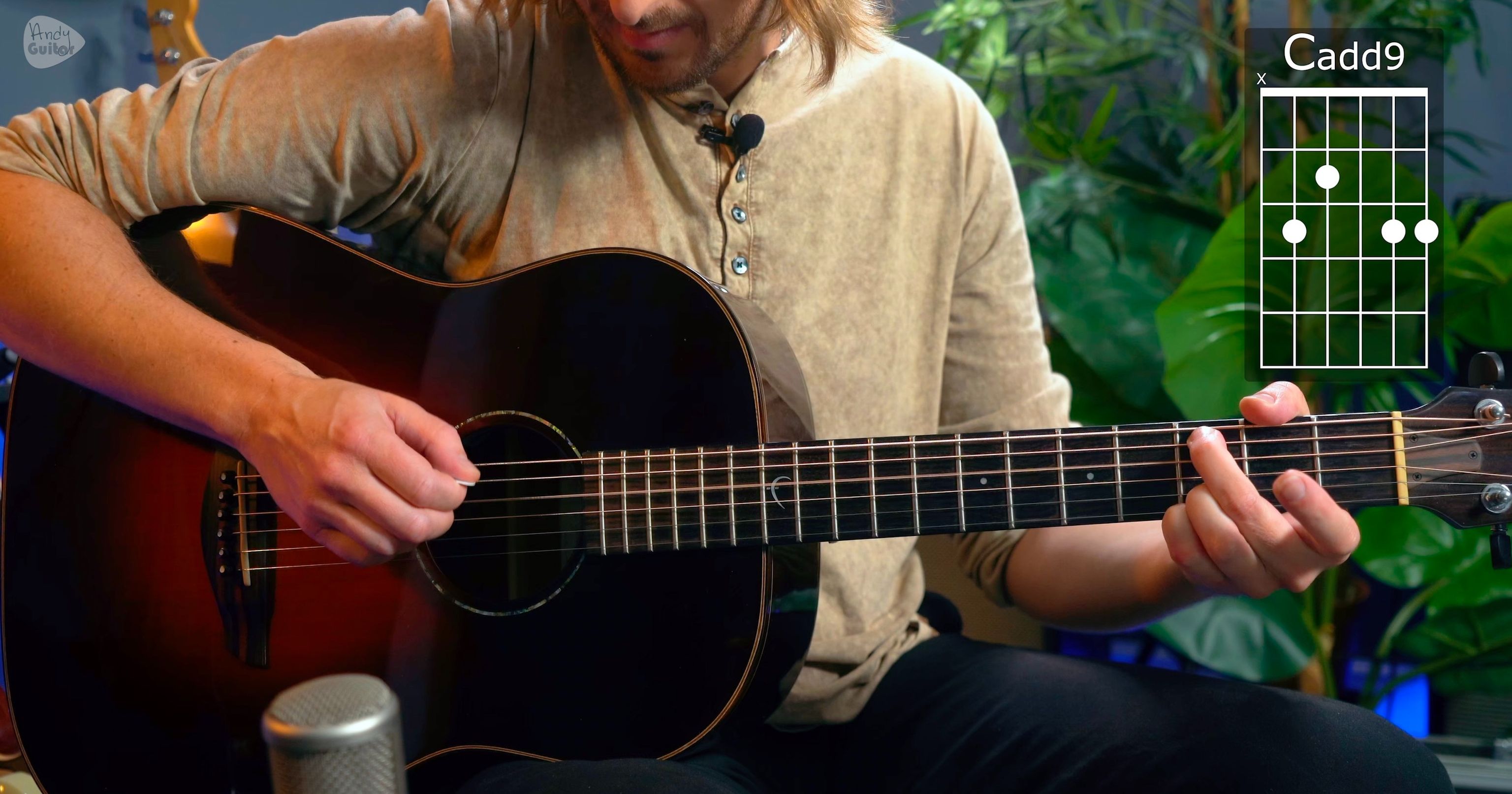
In this video, we're gonna take a look at how to pick root notes out of common chords, do that root note with strumming, and also look at something called combination picking, which is where we pick and hammer on or flick off with our fretting hand. That combination of the two hands fretting notes is. It's called combination picking. The difference here is that most beginner strumming songs are all strumming, most of the strings available in any particular chord. Perhaps you've started doing thicker strings on the down strum, thinner strings on the up strum and doing some embellishments. For example, that's where we left it kind of late on in beginner acoustic, but the way we can massively elevate that for different chord progressions and just make everything sound a lot better is have the ability to pick the root note of whatever chord we're playing. G major is here. And then strum. And have that pick, strum, pick, strum, which if I do up to tempo. I kind of nickname on this, Bob Dylan strumming, a very similar thing he's done in country, in many Johnny Cash type songs, and that single note pick. Can really bring a lot of basic strumming patterns to life because otherwise, I mean that's just strumming on the beat otherwise. So let's give that a go, use the same technique, the same small pick with the pick on the side of the first finger. You can do this with holding a pick like this. I just really want to try and do it with the pick on the side and we can even do the same pattern. Without a pick 2, I'll show you that in a second, but we're just gonna go for picks strong. Picks strong. Notice how the picking hand is very still or does a very small motion of the wrist on the pick and is more free flowing, still with a slight twist of the wrist on the strum, but it's all just a small twist of the wrist to do the single note pick. Very small motion and then we kind of just throw it down, just flick it away, flick it away. And that down, down, down, up, down is a nice thing to try and get used to. We can do that with finger style, with the thumb and then just the first finger. The up down can feel a little weird here cos we actually use the fleshy part of the first finger. And fingert will always sound more gentle than er strumming with a pick, cos a pick's how we can get the loudest, clearest sound. But you'd be surprised what kind of volume you can get out of. A strum with just the nail of the first finger. We can really get volume comparable to a pick. When we do that with other chords, we may have to change string for that root note, for example, on a C major chord, as we've covered already, that is the C note on string 5. And that's where we'd strum from, we can kind of safeguard. That we're gonna hit that and not accidentally hit, oops, string 6, by having the thumb just sat on top, not over, not like this, just sat on top. Of string 6, and that means that if we accidentally hit the thickest 2 strings. It's actually all right, that's saved our bacon there, and we can do. However, ideally, pick, strum, pick, strum like this. And we do want, I'm doing it slowly, but we do want just one sound, we're not doing a. We're not doing this, we wanna just one sound. And when we do that on, for example, a D major chord, that D root note is on string 4, which is quite a way from string 6, so we're a little bit further down, it can feel a little bit weird, this one can take a little bit longer to develop. And we can't rely on the. The kind of uh technique of muting string six, we need to just pick. But it is less of a strum down, we don't need to strum as far. Keep the motions as small as possible. Here's the trick For all of these intermediate level techniques. Finally, I promised we'd look at something called combination picking, big name, big fun, right? Hopefully this is gonna be something that you guys can do cos it's gonna be a new thing that we're just gonna drop in here. But we have something called hammer-ons and flick-offs that we can play on guitar. The hammeron is an easy motion and it's where we can pick and get a string kind of moving and vibrating, but then hammer on just with the fretting hand. And we get a note ringing out, and when we pick and then hit the notes. And we can even do a combination of hammer-ons and flick-offs, and do like the rock star thing, even on acoustic guitar. But when we. And hammer on or pick and flick off, that is technically known as combination picking, it uses a combination of both hands. And one thing that we can add to this, quite simply, but it is a step up from what we've done so far, is for example, on G major, pick string 6. Strum. Pick string 5 with an open string 5, so first finger off. Hammer and do a strum and we get this pattern. A wonderful folky, Bob Dylan-y style strumming pattern. So that is involving picking string 6, strum, pick string 5 with an open first finger. And have that middle finger placed so that that open string will ring out, it will be a little higher cos we're not pressing it down, so that's something to get used to. Pick that open string, hammer on with the first finger, and strum, and we get the rhythm of one. 3 and 4. We can of course do that same combination picking with the pluck of the thumb and the first finger, let me demo that. If we do that same thing on a CA 9, so the common CA 9 cord, we can even use the same technique. Picking string 5, strum, Pick string 4 with the first finger lifted off, but keep it close because it's going to pick, then hammer on, and then strum. And then we can do that same thing on a D major chord, pick the D root note. Pick string 3 this time. And then Strum, Lift off that first finger, pick, hammer on. We can do the same on that C chord. And G major chords. The other strange thing is that when we're learning that and when I'm teaching that, I'm leaning right over my fretboard to see what I'm doing and make sure that I'm teaching you guys really clearly. However, when I'm doing that in a song, or I'm performing or I'm teaching on these videos and demoing something, I'm sat right back into this chair which has good lower back support. This is just an Amazon Basics chair, but it's got um the cushion all the way down to the lower back. Guitar wedged right in at the hip. And that guitar is solid and held in place finally by the inside of the uh bicep I guess, kind of inside to the inner elbow. So that guitar is stable and going nowhere and my hands are free. Which means I can have a much more floating strumming hand and picking hand, and that my cord hand is just at a nice angle all the way up to the shoulder to the neck, everything's in a good spot. When we first look at the details of a lot of this, it's natural to lean over, but when you're. Repeating it, when you're practising it, when you're putting in the time, putting in the hours, please sit back. It's a strange contradiction of guitar that we're not supposed to actually see all the frets in the strings when we're picking and playing them. We have to try and get that picking and fretting and hammer ons without being able to see which string we're actually hitting. It's a strange contradiction, I know, but that's just the design of a guitar, and when I'm doing this. And then this with the hammer on I've got memorised with my hand motions, so I can even do this with my eyes shut, I promise I'm not cheating. And even if I make a small mistake. That is the level that you want to aim for. Even with the odd little mistake. But not right away, this is gonna develop over time. Again, that managing expectations is so important, but I don't want you repeating things like this too often in this position or even worse, kind of slouched on a sofa and like this. You're just memorising the wrong motions and you, you're gonna end up causing back pain, shoulder pain, things like that if you repeat that often. Sit back into your chair, sit upright, guitar right into the hip, resting on the inside of the bicep and the inner forearm. Keep that guitar stable with your hands totally free, that guitar's going nowhere. And then do have a go at consciously practising all the picking techniques that we've looked at so far. Without looking. And sat up straight, perhaps reading the tab that's in front of you. For example, Hopefully those exercises and techniques can really bring on your plane in a short space of time, and we're gonna look at demonstrating that in the first jam track which is coming up next. But please manage those expectations, this doesn't all fall together magically. Depending on your experience, this could have been super difficult or it might have been easier if we. Already holding a pick or fingerpicking, that might have been super easy for you. All we're trying to do is cover all the bases and give you the techniques that you need to get your picking hand or fingerpicking hand up to speed so that it's something like an intermediate level and can have a look at the jam tracks and songs at this level. I hope that really helps you.
In this video
I show the 2nd method we can use to massively improve picking technique on acoustic.
Exercise: Pick root note and strum (w/ pick or fingerpick)
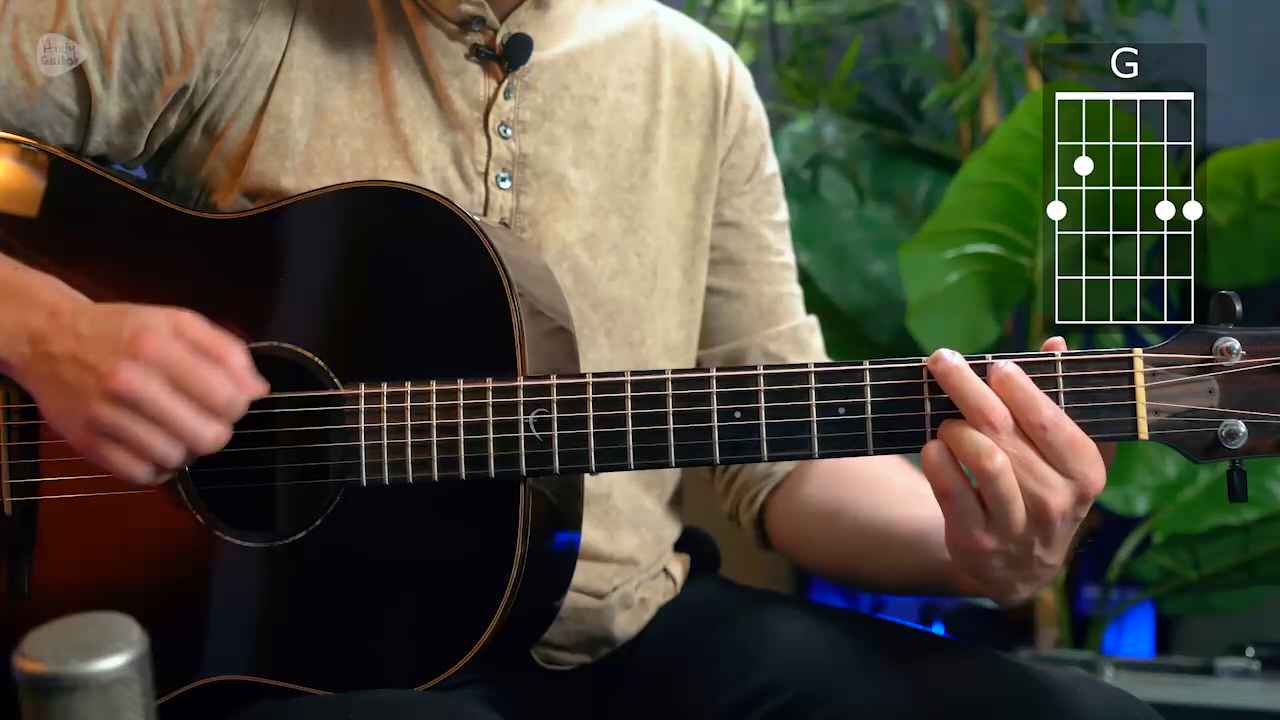
G major chord
G root then strum aka Dylan Strumming
Pick Down Pick Down - (Down = all strings)
Then, Pick string 6 - Down - Pick string 5 - Down
Finally, Pick6 - Down - Pick5 - Hammer on - Down
Combination picking explained

Whenever we pick then do a hammer on, we’re using combination picking. We’ll look at exercises to improve this further in the next module. But most people should be able to do this G chord hammer on, it’s picking the right string that’s the trouble.
Combination of picking and hammer ons is used for most guitar solos at an intermediate level, especially any that use speed or smooth aka legato playing.
We can do the same combination picking same on Cadd9 chord and same on D chord.
Level 1 Intermediate Acoustic
Recommended Songs
Enjoying this course? Want to test out your new skills? Find out my recommended song tutorials that accompany this course and get total access to the site by signing up today!