
Supercharge your lead playing with these rhythms
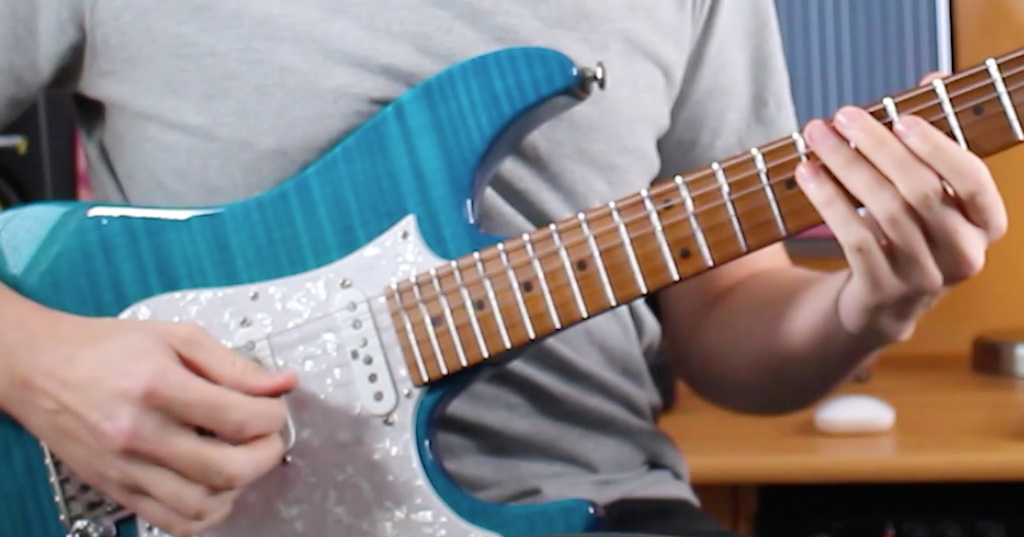
Welcome to lesson number one. This is the first of two of the workouts looking at different subdivisions and switching between them. This first one focuses on eighth notes and 16th notes. What does that mean? Well, basically, if we take a beat in a bar, 1234, the, the beat that we often tap or clap along to generally. If we split each of those beats in two, we end up with 1 and 2 and 3 and 4 and that's an eighth note. Then if we split that again and make make 4 notes per beat, we end up with 16th notes, which is 1 and a 2 and a 3 and a 40 and. So the 1st 4 bars of this example are really good to sort of demonstrate this. We're gonna start a phrase here on a 7 ft G string. And the melodic fragment we're using really outlines these notes. They fit around the cord and the backing track, which is an A 7th, and we have the 7th fret G, 6th fret G. And then a 7th threat on the D and 5th threat on the D. Now I'm using either finger, middle finger for the 7th frets or my 3rd finger for the 7th frets. It's up to you and something I'll discuss later on for this lesson is why it's important to be flexible in terms of what fingerings you use as well, so. That's the phrase, so the first two bars are 8 notes, so we're doubling each note, so we're playing a down and an upstroke on each note. Like so And then we, when we move to bars 3 and 4, we're now going from 8th notes to 16th notes, so we're doubling that. So we're thinking 1 E and a 2 E and a 3E and a 4 E, which is down, up, down, up on each note. In my head I'm I'm keeping my, my foot tapping on the main beats, the 1234, and I'm making sure that the pick attack is making a positive connection with the first of each of those groups of 4, or first beat of each 16th note chunk. So that's going to help me get an even right hand technique and it's something that's really worth looking at is not just the downstrokes but also making sure the upstrokes are even within that as well. So making sure that you're feeling the string contact with uh each pick stroke, that's not to say to pick really hard into the string, but just to make sure that you're actually knowing that you're really, you know, playing those notes and that's something you can feel as you play slowly. The last 4 bars of this exercise is the same idea, we're going from, we're doing 2 more bars of 8th notes and 2 more bars of 16th notes, but we're just adding some variations to the melody that we're playing, so bars 5 and 6 go like this. And on the tab you can see that is 7766 on the G-string. Then 7 on the D And then 9 on the G, and we do that twice. And then we finish off in bars 7 and 8 with a descending phrase which takes us to the lower strings, which goes like this. So that gives us the challenge of doing 16th note groupings over several strings, something we're going to add more to as we go through some of these workouts, but that will give you the whole exercise. Let me just play the whole exercise slowly. When I say free time, I mean in time, but to my foot tapping, OK, so. So there we have it, that's the exercise for lesson number 1, and that takes over the backing track, which is based around A 7 and G in the backing track. So be sure to listen out for the high hats and the kick drum and the snare in the backing track to really lock in with those downstrokes on each beat. That's going to help give you a checkpoint in your timing. And it's a really great warm up and even myself find that exercise still very beneficial after many years of playing, so it's worth spending time on the simple things, making sure that they sound and feel good. OK, I'll see you on the next lesson.
In this video
Sam Bell Bootcamp - Jam Track 1 - 80s Style
In this first lesson, Sam explains how to use different subdivisions of the beats in a bar to use for our picking technique. This includes switching from 8th note picking to 16th note picking.
Interactive Tab
Become a member to access this interactive tab section.
Lesson aims
Work around a melodic patterns using 8th and 16th note subdivision with alternate picking
Switch fluidly between two subdivisions
Exercise - A7 and G Backing Track
Over 8 bars in the backing track, learn the melodic pattern that fits with the track and focus on picking evenly. Especially with the 16th note picking, try to feel each stroke so notes are articulate in the intended way.
By tapping your foot on the main beats (1,2,3,4), try to make a positive connection on the first beat of each 16th note group. This helps with timing and keeping an evenly spaced gap between each picked note.
Listen out for and lock-in with the drums on this track. The kick drum, hi-hats and snare, will help most for keeping solid timing.
Lead Guitar Bootcamp with Sam Bell
Recommended Songs
Enjoying this course? Want to test out your new skills? Find out my recommended song tutorials that accompany this course and get total access to the site by signing up today!