
Strumming Basics, Spreads and the Beat
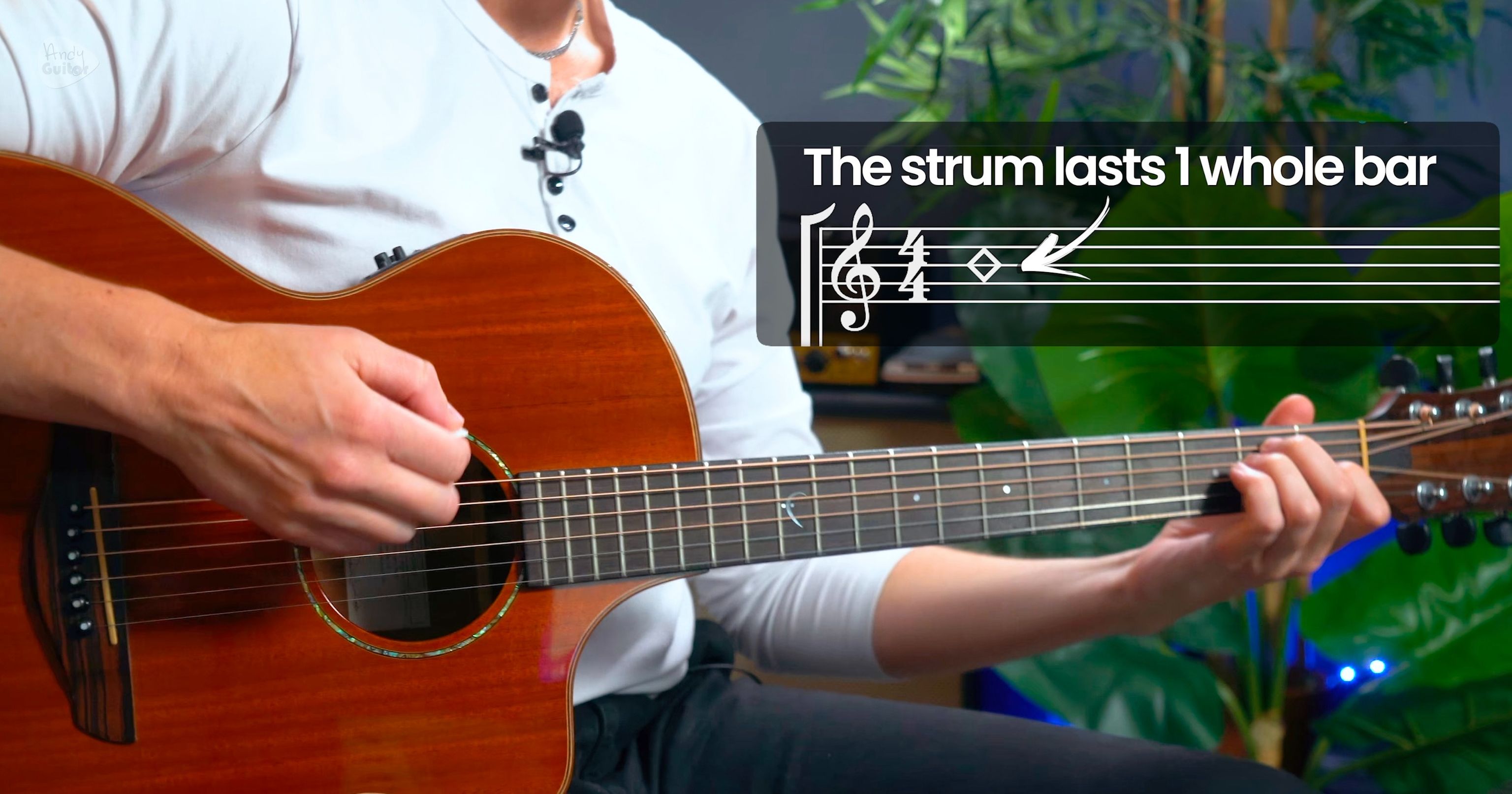
In this video we're gonna look at the rhythm and strumming basics you need to get playing real songs right away and be able to practise that by jamming along to the jam tracks that are coming up. To do this, we're gonna have to understand about bars and beats. You may remember some of this from any of the music lessons you may have had in the past, but for 95% of songs. We have something called a bar, which has a measure of 4 beats or 4 pulses. Those pulses have a count of 1234. And the simplest strumming patterns we can use are playing once per bar and then once per beat. The once per bar is called a spread. And the once per beat is just called fourth strumming because we're splitting the bar into four. Songs that do this are known to have a time signature of 4/4, which means 4 beats to the bar, and they are 4 quarter beats. For example, if I was just to pick the E major chord to a nice, even tempo. Or BPM, which is beats per minute. This is around about 80 BPM and I could go 1234. 234. That would be using the strumming pattern spreads. If I was to strum on the beat, it would sound like 12. 2. Which brings me on to the actual strumming motion, to enable you to move on to more advanced strumming pants as quickly as possible. We want to know a couple of things about strumming. First of all, it involves far more of a twist of the wrist rather than a big arm motion. When we're playing these early beginner level strumming patterns, a big motion is something that we can get away with, and it's not gonna hold you back. As a late beginner. And then hopefully an intermediate player. The more arm motion you use, the more that's gonna hold you back from taking on anything that's a little bit quicker or uses a little bit of embellishments or anything else that we happen to do. So how can we do that? It's all born out of this action of going, maybe. Or like, you know that thing that surfers do, that kind of, that kind of thing? That's the action that strumming should use, at least at a higher level. When we're doing this slowly, we can use a little bit of arm motion, as we always will anyway. But what we just want to get used to is a slight twist of the wrist because that's how we're gonna get you doing faster, looser, better sounding strumming patterns and not covering a big, huge amount of ground like this. So let's have a go at this first of all with spreads. If I was to count 1234, we strum on every one. Let's do that together. Ready in 12341234123, and encouraging a slight twist of the wrist to do that motion. 234. Keep strumming along with me, and whether I count or not, that pulse is still there and we still strum at the same time. And rest That was just a few seconds, straight away, there's lines on your fingers and it's, it's awkward. I know, but it's early days, it's all good. Even this twist of the wrist is gonna feel really awkward. It did for me demoing it in that sort of extreme fashion. Because we normally just do things how we regularly do them, right? We're gonna build these habits up from the ground up, and I just want that to be one of them, that slight twist of the wrist. Especially when we're strumming once per beat, this becomes really important. And that's all we're gonna do, we're gonna take that first chord E major. If you want to do this on an A major in your own time, that's absolutely great, but no chord changes just yet, stick on the same chord, and we just want that even tempo, which is around about 80 BPM. Which is a lower mid-table song, it's middle of the road as it gets, 80 BPM and BPMs always tend to be around between the range of the human heartbeat, from 60 BPM and 50, a resting heartbeat are really like nearly falling asleep. Or ballad tempo, up to around 140, 150 BPM, which is pretty up there, very danceable and like you're exercising. It's no coincidence that that is the same range of songs and the human heartbeat. So we're gonna form the E major chord, strum on the beat, and then when I say we're gonna then go for a spread as well. So let's start off on the beat, join in with me in 123412. 3, slight twist of the wrist, nice and soft. It's just one With a nice twist of the wrist. And then we go for spreads. 234. 2341 more, and then back to the beat, and 12. 12. Keep it going. 23. on a spread in 3. 234, outside of the palm of your hands, silences the guitar for a nice clean finish. Finishing like that makes it seem like you know what you're doing. That's the basics of strumming on the beat and doing spreads, which should be a default strumming pattern for really any song you ever learn, even at the more advanced levels, even at upper, intermediate and advanced. If I'm learning a new. So, it's once per chord and it's on the beat, especially if it has a lot of chord changes actually. The symbols used in tab or any other guitar kind of visual aider are very similar to those used in traditional notation, with a whole bar and for crotchet beats basically, so one beat per strum. It's written in a similar form but we call these slashers rather than. Uh, notes or crotchet or quaver, even though the time, if you're familiar with those terms, the times mean the same thing. If you're not, we'll cover them when we get around to them. That's all for now, let's crack on with your first jam track.
In this video
The first strumming patterns we will learn will have us firstly strumming once every bar and then once every beat. To do this well, we have to understand what bars and beats are. The video above covers this, the pattern itself and also my top tips for strumming with good technique!
What are bars and beats?
The beat is what you nod your head or tap your foot to when you hear a song you like. It is a pulse in music that everything lines up to. 95% of the time, a song will use a count of 4 beats, which we call a bar. Whatever strumming we do for 1 bar, we tend to repeat this throughout an entire song. So when you look at a song, only 1 bar of strumming may be shown, which you learn to repeat while playing whatever chord is written. How fast you count this 1, 2, 3, 4 is called the tempo, aka speed or bpm (beats per minute).
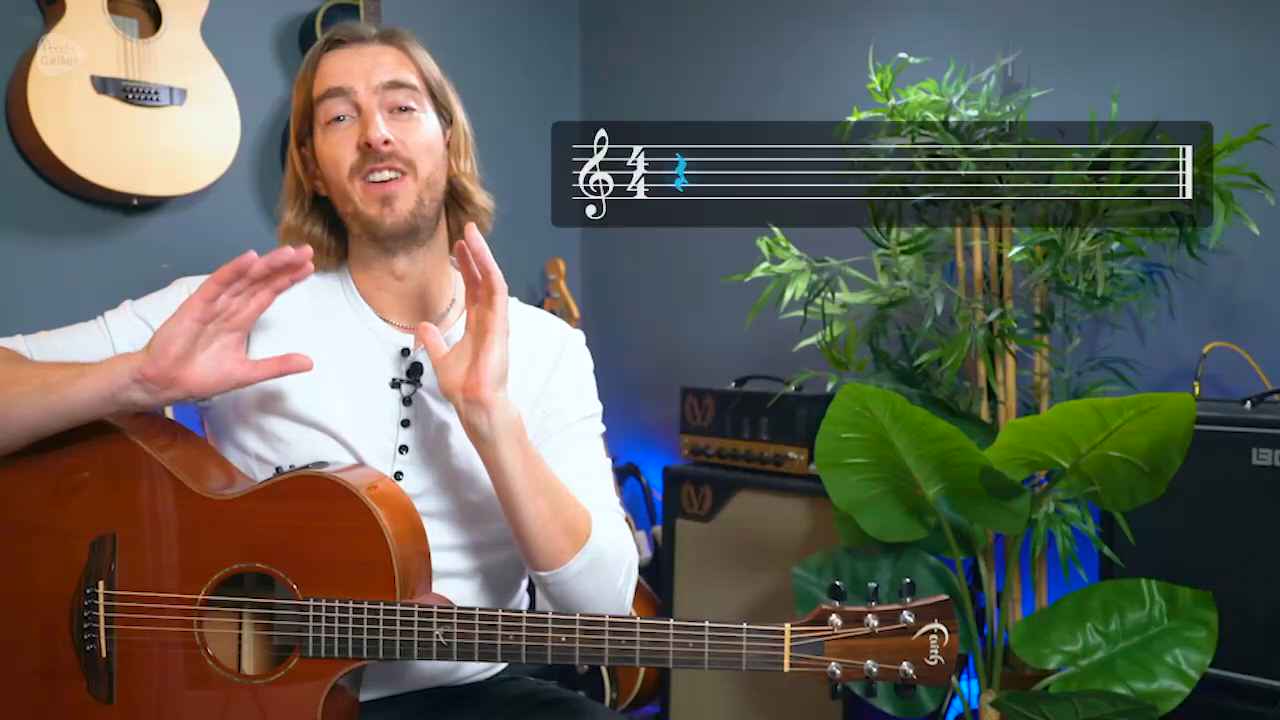
This is a great place to start when learning any new song as it gives you chance to learn the chord changes. Plus- many real songs actually start like this! Count 1, 2, 3, 4 at a slow, even pace (out loud if needs be) and strum an E chord every time you say beat 1.
Simple Strumming Pattern
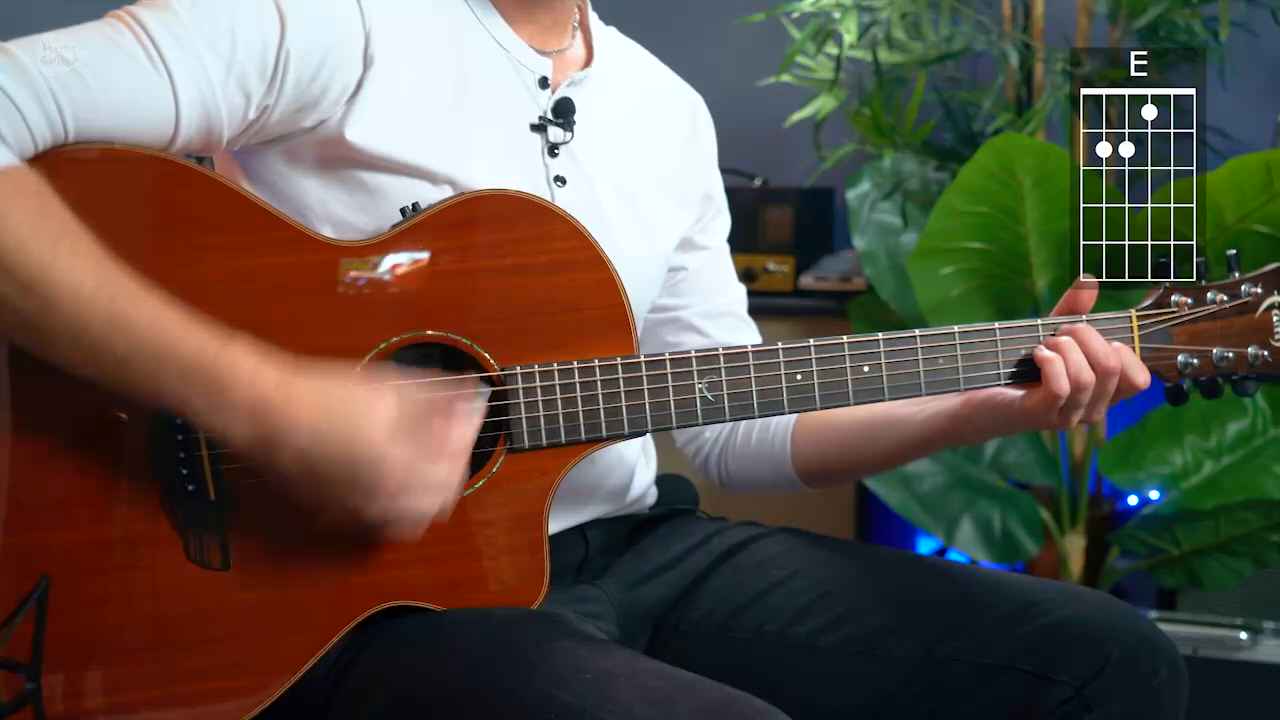
The strumming for any song is only shown as a 1 bar pattern. This is generally repeated for an entire song.
Beginner Level 1
Recommended Songs
Enjoying this course? Want to test out your new skills? Find out my recommended song tutorials that accompany this course and get total access to the site by signing up today!