
The Scratch - 2000 Trees Interview
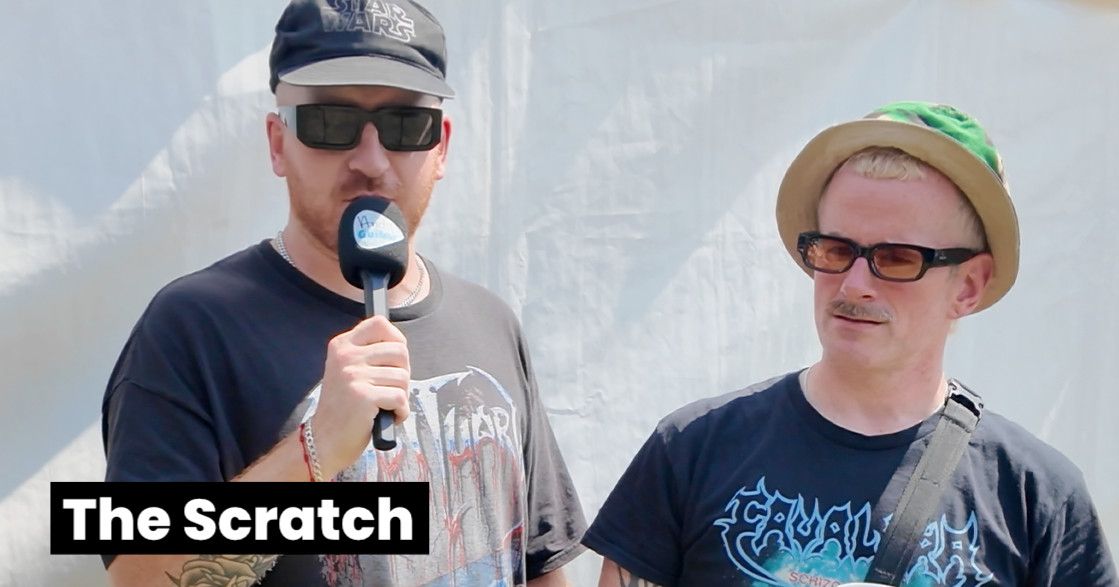
How's it going? Uh, I am Connor Dockery. I play guitar in the scratch. Hi, I'm Gary Regan and I play guitar in the scratch. Happy days and we're at 2000 Trees, and guys, it's very exciting to talk to you. You have a wonderful main stage mid-afternoon slot. Uh, and you know, most festivals, that's the legends slot, I'll be honest, and you guys are certainly 2000 Trees legends. What does this festival mean to you? Um. Yeah, it was probably one of the, the first UK festivals that booked us, I think, uh, if I, if I remember that correctly, but I'd say it was about 4 years ago now. We, uh, we came down and we did the forest stage, kind of an early slot, and then we came back maybe 2 years later did the forest stage again. So, yeah, maybe it's been like 5 years. Jesus, yeah. So, uh, yeah, like loads of loads of great memories, um. For some reason I don't remember it ever being this hot. Oh, this year is insane. Yeah, so, uh, but yeah, no, it's, it's a. Yeah, we were buzzing to come back and do a bigger gig here and on the main stage, so. I remember I saw you guys, it must have been 2023. I was actually dying with hay fever that year and I'd just taken all the antihistamines to get over it. And then you guys started, you know, the first chord, I think it was another round, the first song back then in the set, and literally I stood up, it was like Bruce Wayne seeing the bat signal. I was like. This is amazing, straight away, just it changed my state so much and I can't wait to see. How did you guys discover this sound, this mix of metal, acoustic, folk, Gaelic Irish, I guess you guys tell me. Um yeah, it was very, it was, it was it wasn't really planned, to be honest. I guess it was just a bunch of metal heads getting together and. We were jamming. We were just jamming on acoustic guitars and like a home, like we're trying to learn folk songs at the time. We were all discovering a lot of Irish music and, um, for the first time and we've done the metal thing for so many years and this was, it was like this whole new thing. But I just remember on the first day, our old guitar player and our drummer, like they just came up with this like instrumental piece of music. And they're like, here, check this out or whatever. And I was blown away. I was like, what is that? Like, you know, and then I think by the end of that day we were like, how do we, it's like, oh we need like, we should, you know, try put like get like get an ending on the song or whatever. And then we just took a part of our own metal band, uh, and we just like tacked it on the end. I was basically like a breakdown, kind of a chop thing, but we did it like kind of like just kind of rhythmically on the acoustic like scratching. So that was probably, and then we're like damn, this is like, this actually works really well. uh, and then it just from that moment on, it was always kind of a mix of like folk, folky stuff and then we would bring in a lot of rhythmics, rhythmic stuff and then once IMs came into the equation, it just started. I guess it really took on the form that it is now where you're going from like prop like, you know, riffs to like acoustic guitar. I don't know, you know, it's a cool mix of stuff. It wasn't planned man. It just, it kind of just evolved naturally, you know, as all the best things are. Was there any particular, you give a shout out to some of the songs you guys were actually learning like the old Irish folk songs or any folk songs? Yeah, well, early on it was like Interference, Gold, um, some Glenn Hansard of Damien Dempsey, um, learning some planksy stuff. I was learning Christy Moore. I was, I was learning Ben Howard, a lot of Ben Howard stuff at the time and. So we were all kind of like, we were all just like, yeah, I guess we just discovering all that for the first time and, and it was all new to us. We've pretty much been on a solely metal kind of thing for so many years until that point and then it was like, oh Jesus, there's this whole, especially in Ireland, like the, the history, the history of folk music and. And the songwriters and and and and the singers we have in Ireland, it was just discovering that all of that for the first time was like amazing, so. But this is really technical stuff as well, you know, you're saying you're basically metal heads doing this on, on folk as well. Uh, there's a real crossover with the technique that a lot of people wouldn't realise. What did you find challenging about playing this, playing metal riffs on acoustic, cos that, that's tough. It is, yeah, to be fair, it is, it's quite challenging. And a lot of people under uh underappreciate that. You know, people think I a big uh sometimes metal heads think oh the acoustics just for the strummers and stuff. But playing some of those riffs on on acoustic is physically brutal for sure, and we've we've kind of incorporated some of our favourite metal songs. Into the into the set as well like the other night we played a Ryan and then we played Blood and Thunder and stuff like that. So the riff side of things, it's quite hard and then we're chugging as well. We're doing breakdowns, so it took a bit of getting used to, but I think the guitars that we use now, I remember when I first joined the band, I was using Doc's old faith guitar, and we used to like Frankenstein the guitars you'd say. So Doc stuck a humbucker on it, so the action on the guitar was so high up because it just touched the humbucker, so I'm like. Learning these songs and the actions like miles, it was tricky, but now we have these guitars are built in home buckers and it's a little bit easier, but I, I, I literally find it, Like when I pick up the electric guitar now to play these rifts, I'm like it feels weird to me. I'm so used to doing it on the acoustic, so, but yeah, it was challenging it definitely was for me anyway. Yeah, yeah, I mean, it was more of a natural progression, but still, but yeah, still, it's like when I go back and play electric, I'm like, oh Jesus, yeah. So, we're making our lives so hard for literally thinner strings, lower option and the amber is doing a lot of the work for you. What I will, what I will say though is like there, once you, once you kind of like dial it in, playing riffs on an acoustic is like so satisfying. It's almost like because you can feel the resonance of the guitar as well and. It just, it has a lot. It has obviously more natural projection than than an electric. So there's something when you dial it, when you start in that tone and you and you write stuff on it, there's something full bodied and, and then you go back to an electric and it can sound a little bit tinny and or just feel a little bit, oh, OK, I'm not getting the same like response from the guitar. So it's kind of a, it's a weird thing. It's very satisfying to play riffs on an acoustic like like. Doing big chords on the electric, like it sounds great as Doc was saying when you dial it in and you do like a big chord on through the amp with the acoustic, there's just something about it that just like. It just gives you a little hug. Well yeah, it is like it's it's a big thing, it's a physical thing and it does vibrate against your body so it does, you do get more feedback from the guitar, from the instrument. Um, but come on, you've you've got to let me know a few secrets. So you've had a humbucker like. Frankenstein onto a FIF acoustic, which I still play FIFs to be fair. Um, but what's the trick to, are you going straight from the humbucker in straight from a pedal board into an amper or are you two signals the iron, what, what are some secrets to get this fantastic metal tone out of an acoustic? Yeah, I guess, I guess the key is it's, it's two separate signals. So the way our guitars are built and even the Frankenstein's, we always had 22 outputs or inputs or whatever and uh. So like, yeah, it's basically two signals come out. The acoustic is a totally separate signal that comes out into the quad cortex and then the humbleer is a totally separate signal again that comes out into the quad cortex. And once they both come into the quad, we basically just tell. We just kind of tell it what we want. We tell each signal what we want from it basically. So the, the acoustic goes through, it basically just goes straight to front of the house and then we have a couple of patches maybe in certain songs where we've added a bit of reverb or chorus or some compression. But generally it's just a, it's just a dry DI signal that goes through the quad and out front of house and then the humbleer comes in, the order input on the quad and then that goes through all your classic. Is Sims, IRS and then it's all we have it all and then that just goes straight stereo left right front of house and then it comes out into our cabinets as well, just classic, but it's very simple, really. And it's like. If you just think of it as two completely independent signals, but the amazing thing about the quad cortex and what we used to use, we used to have analogue peddle boards and we'd have like line switches and so we'd have, we basically do what the quad was doing, but with analogue pedals and it was, it was a mess. So many, so many issues and, and like patch cables and noise and everything and the quad is so clean and we can set up each scene for each song or we, we sometimes we just use the same scene for the whole set. And we just have our different patches and we can just mute the acoustic where we want. And I know, I guess the other trick we use is, is the, is the volume pedal, which we basically stole off John Butler. John Butler has a rig rundown from years back where he goes through like an, and if you watch that, that's pretty much our setup right? And uh learn from his is, his is analogue as well, but his, his acoustic, he's like humble or pickup. Comes out and go straight in like the first thing it hits is the volume pedal before anything else. So, so that allows you, like if you, if you're, if you have a patch where you're, you're hearing the acoustic and the electric, if I want to cut to the acoustic, I'll just bring the, bring the volume pedal back and then I just hear acoustic and then when you're playing acoustics so you can bring the slowly like that. That is a hell and it's it's, it's, it's just a really, it's a really clever, it's a really clever way of like controlling it. It's an extra layer of control on top of the cortex on salty when you wouldn't normally have that build in metal music, your mind do it dynamically on acoustic. You're able to do it a little, a lot more with a, with a full amp, right? Well, on the previous Mel the album before this, we had a lot of songs with like swells, so we, there was loads of parts of the set where we'd like to have a lot of delay and reverb and. And we would be swell the guitars in and sometimes you'd be swelling the guitars in over an acoustic chord, so you'd like strum the chord and you'd like. So it just gives you like, it just gives you all the options, but uh, but that's essentially it, yeah, 100%. And the only other people I've known do that kind of thing is who I call affectionately the slappy tappy guys, that John Garm, Andy McGee, and, and those guys, they always say as many outputs as possible from the guitar. Different little microphones. John Gonn, for example, 4 outputs, and he was, I remember seeing him years ago. He was able to get a better kick drum sound out of his blinking acoustic guitar than I could in the studio. Yeah, well, you know, we, we experimented with loads of different acoustic pickups over the years and then These, these called Clarks, they, they've they've an acoustic system called the PG-3, which is essentially 3 mics in one. So they have a contact mic, they have a condenser and a PieO and it comes into there. It's a, it's an amazing sound and pickup plugged in. It's like, it's like patented, like they, they, they don't sell it to anyone. It's just their own thing. But it sounds amazing through, you know, plugged in and that essentially like cause we were, we were looking at John Gom and John Butler and all these people like. What, how do we, how do we like, how do we fucking solve this issue of the acoustic sound? And then when I, when I found this, it's like, like they're right, the more, the more the better. And they, the Cole Clarks, they just do it all in one and, and you can kind of blend all the different mics and stuff and they've all this feedback technology that just, there's just never any feedback. It's amazing. So it's like the best sound and acoustic we've ever had on stage and then you've like a, you know, so I use it fucking, I use it. A Lundgren M6 in mine and he has a custom pickup from our our front of house engine, you know, so is there a trick with that so you're not fighting over the same frequencies, are you having to a little bit, you know, the equivalent of an Angus and Malcolm. Our tones are a little bit different. Yeah, we kind of, I like, I think our amp sounds can be similar enough. Like, I know Doc has the Lundgren, so his, his for a while, he, his guitar was quite hot and I was like, right, I need to try and match this, or not even match it, but just kind of suit his tone or what he's playing. But um, yeah, I got a, I have a pickup that was designed by our front of house rats. There the pickup is they're called wolfhound pickups in Dublin, so he, um, Steve McCarthy, I believe his name is. So they made the rat booker for me and it kind of matches the rat booker. What a name, the rat booker, yeah, uh, but yeah, that kind of matches doc's home, I think we're, but yeah, there's like. We've played around where where our town's a bit. I think, I think we have it fairly dialled in now. Like the last couple of gigs listening back was like, oh, I think it sounds class. The most recent time I've seen you guys was in Brighton in patterns downstairs, one with a big blinking pillar in the middle of the room, but such a vibe, such a great sound in a big stage or a small room. What's coming up for you guys? What do you want to give a shout out to anything later in the year? We have, yeah, we're kind of in festival season now. Um, we do have our next UK run is in January, so. I can't remember. You probably know the venue. I know we're doing like January. Give it a Google, you'll find Google them. It's, it's a, it's a big one for us. It's it's our biggest. Yeah, doing the, the, the January is the UK. We're back doing a headline tour in Europe in November, uh, festivals for the rest of the year. We're back in Bloodstock actually main stage bloodstock in August. Uh, and then like yeah, full European. We're doing a bunch of Irish states in September and then we're back to America at the end of October as well. So it's a few states in there as well. Yeah. Happy days and uh, you're one of those bands that. When people see you alive, they remember and they will come back again and again. I know I will. It's you don't forget it and you just want that feeling again cos it's so rare, it's it's a wonderful mix of stuff. Thank you very much. Thank you so much for talking with me guys. scratch, check them out.
In this video
Andy speaks to Conor and Gary from The Scratch at 2000 Trees. Topics include the band's history with the festival, how a group of metalheads accidentally invented their folk-metal acoustic sound by jamming on cajons and learning Christy Moore, Damien Dempsey and Planxty; the physical challenge of playing metal riffs on acoustic guitar; the technical breakdown of their dual-output guitar rig (acoustic signal and humbucker signal both running into a Quad Cortex separately); Cole Clark's PPG three-mic pickup system; and upcoming dates including Bloodstock main stage and a European headline tour.