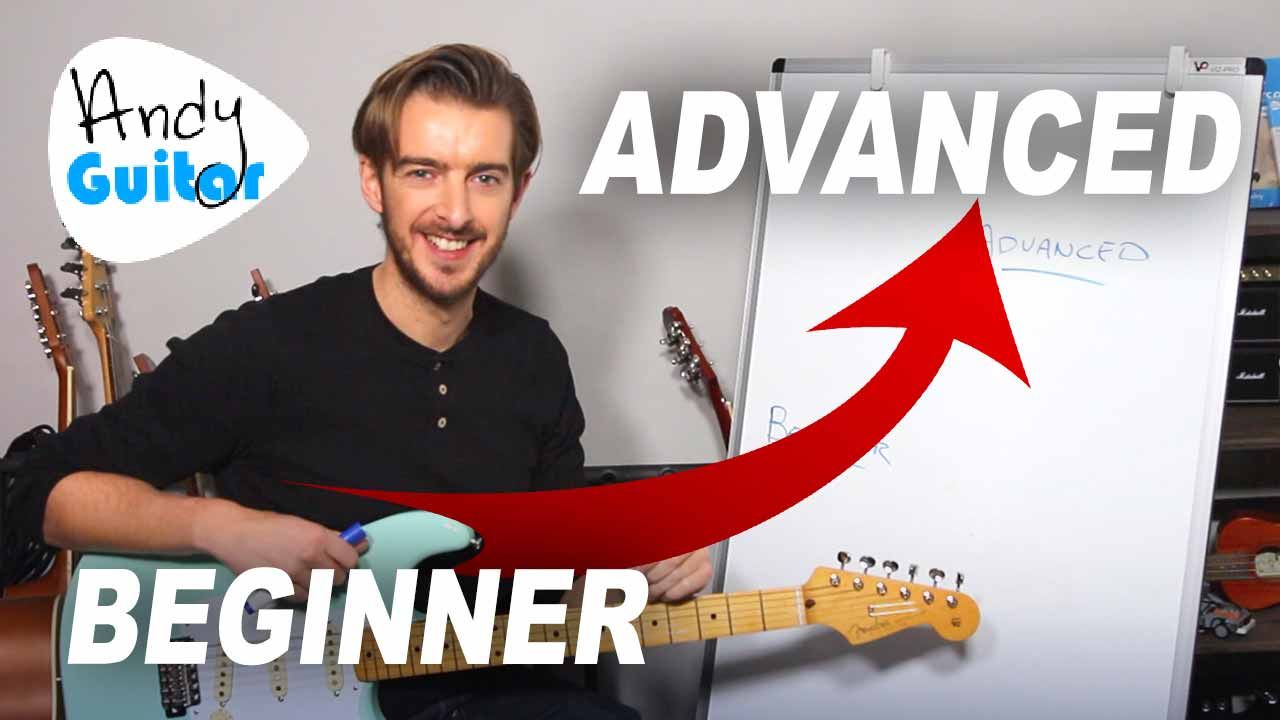
How's it going guys? Now, a couple of years ago, I made a video called The Timeline of your guitar Success. And in that video, I talk about the pros and cons of the traditional grading system, you know, from grade 1 to grade 8, and how that perhaps isn't the best structure to follow for guitar players that just want to play their. Favourite songs, and, you know, they're not studying music to degree level or anything, you just want to practically enjoy your instrument and make good progress at around a beginner to intermediate level. Now, to follow on from that video, I want to talk about how we can go from a total beginner to an advanced level, and what these different stages look like. So, at its most basic, I would suggest that a beginner level of guitar can be described as starting with open string chords, so chords that use open strings like the G chord and the C chord, and basic strumming. We have some perhaps song structure in there, but at its core, it's open chords and simple strumming. Two simple things, but putting them together and working towards competency when we put those together and playing real songs with them. And a simple description of an advanced. Level of guitar can be a mastery of whatever style of music that you're looking at, knowledge of the fretboard, and a certain level of guitar skill where whatever songs that we're looking to, looking to play, you can work towards mastering that song and having an ability to play it. And then of course in between those two, typically, we have an intermediate level, which some of the things at an intermediate level, I would consider the main things to be uh bar chords, so E and A shaped bar chords, confidence with 16th strumming, and that can be various 16th strumming patterns, but where we're essentially strumming 1 and a 2 e and a 3 eander, 4 eander, 16th strumming. And also building up a confidence with single note playing, riff playing, starting to learn early solos, and primarily the major scale and the minor pentatonic scale should be learned and covered at this level. So forgive my teacher writing, but there's a brief description of what is involved at each level. In my opinion, keeping this super simple so that everyone can understand and make a bit of a plan to take their playing forward and work out where you're at to get the most from your practise time. However, it's not as simple as this may seem, of course, and in practical real world terms, what commonly happens in my opinion and experience of teaching 1 to 1 privately over the last 10 years is that we have a beginner level, which essentially is easy chords and easy strumming, so two easy things done at the same time. And the tricky bit with this is doing them at the same time. And when we get up to an intermediate level, we've got harder chords, harder strumming, harder single note stuff, but still all having to be done at the same time when you're practising intermediate level songs. So rather than this happening, and the more we practise us just getting better and better and our knowledge just increasing, what happens is if we manage to get above a beginner level and we make some progress here. The combination of this, this, this and this all at the same time is just too much and people get overwhelmed and this becomes a mess, and our, we don't make the progress that we want, or it feels like we're a total beginner again. This is the trickiest stage for most people that do succeed in making it beyond a beginner level. But actually becoming a full intermediate guitar player in my opinion. Needs these certain items along with other things such as song structure, such as a study of harmony and ear training and things like this, these need to be done in the correct order, and in my experience we have more success if we just focus on, The barcodes or any other advanced chords or any cheats for barcodes, these are all totally fine, but we're looking at harder chords and what I've just added, which is song structure. And those are the two things that I have included in a course that I call my improver level. Now I've seen this level, sometimes called beginner plus, OK. Or it can be called early intermediate, but it is very much a level where we're bridging the gap between beginner and intermediate from just looking at a couple of the things from intermediate, uh, from an intermediate level, and not getting too overwhelmed with the mass of stuff that we practically have to do to, to look at songs that are actually at an intermediate level, it is general, and that is the downside of this beginner, intermediate and advanced. Methodology, which is, it's too simplistic and there's not enough steps, there's not enough baby steps in between it, it's not as incremental enough, and people can feel lost with their progress or everything just becomes overwhelming, particularly at this intermediate level. However, I still fully believe in this way of thinking for guitarists, um, as opposed to a more incremental system like the grading system or anything. Because it gives a lot more options at each level, especially considering that we have so much variety between the different genres of music and, and the differences between, um, electric and acoustic, for example. So even if we just look at intermediate playing. It's a very different syllabus for an intermediate guitar player to learn. If we want to play, for example, finger style, or if we want to be a rock guitarist in a rock cover band, or if you want to just strum and sing and play open mic nights and be a sort of guitar Joe knows all the chords kind of uh kind of player, each of those goals could have a. Very different practise routine if you were, for example, having private lessons and you were looking to get some 1 to 1 feedback in any of those particular genres. However, there are similarities, and those similarities can be brought back to the core things that you need to cover at this, at each of these levels to try and get your plane to do that. However, practically, this graph is never going to look like this for anyone in terms of your playing ability. It is not a linear process, and again that's the benefit of this. Learning guitar, and I think learning any instrument, but learning guitar in particular is not linear, it's not lesson 1 to lesson 50 or lesson 1 to lesson 100, song 1 to lesson 100, whatever it may be. It, it never feels like that, and that's not practically how the process happens for people. There's always struggles, and then it clicks and then you can get up to the next level, and then it feels like you're going backwards, but you're actually improving something like your rhythm, which can be harder for you to feel, and all these sorts of things. So there's a quick summary of what you might expect to be learning at each of these key levels, and then also. An explanation of what this improver level is, because I know it does confuse some people, but it's a level that I really believe in, and it's, it's part of my online syllabus at Andyguitar.co.uk and also on the Andy Guitar app. We've got a write-up of this and a bit more of a breakdown on the website. The link to that is in the description. I hope this helps you make a bit more of a plan and have a bit more clarity of how to take your Playing forward. Share your ideas of this in the description below. There is no right or wrong way to learn guitar. Everybody learns a bit differently. Everything clicks at different times for other people, you know, advanced guitar players, people that are far better than me have strengths and weaknesses, and it's making all those things gel to your guitar goals, which is the key to all this. Thank you. Thank you so much for checking out this video, we'll have more intermediate and advanced lessons coming for free on this Andy Guitar YouTube channel and uh can't wait to bring all this more advanced stuff to you, but we'll continue to keep the beginner content churning out as well. I hope that is helpful to you guys, and I wish you all the best with your guitar playing journey. Remember, if I can learn how to do this, you can learn how to do it too.