
5 barre chord CHEATS you should know
How's it going guys? Now if there's one thing that I'm known for with my YouTube guitar lessons, I feel it's probably offering an easier option or an easier solution to be able to play the songs or to be able to play the type of guitar that you want to play. And in this video, I just wanted to offer you guys every easier option that we have for all the common bar chords, and we're looking at 5 in particular. Including the B minor chord, the F chord, C minor chord, but every one of these, um, can either give a solution to not having to bar or just barring a couple of strings, which is far easier. Now this isn't just for those people that can't play bar chords yet and you're just struggling to wring it out. If you are, I do have some videos on that, um, which I'll link to in the description. This is also something that all professional guitars. Guitar players do, whether it's bringing the thumb higher up over the neck like this to play guitar more comfortably, or just choosing to use these chords because they prefer the sound of them. Guitarists such as Ed Sheeran use plenty of the suggestions that we're looking at here, but this video is in promotion and support of my new intermediate course, available only at Andyguitar.co.uk and available on the. New Andy guitar app, the app is free to download, but this is a premium course that I'm just showing a few of these taster videos here on YouTube, and uh let me get started with this lesson, but if you like this, you can find more similar content that will really help you to finally nail these songs that you're wanting to be able to play and bring on your guitar playing in that intermediate course. So the first chord that we're going for is an alternative. To this B minor chord. So this is a 2nd fret, a barcode using the A minor shape, and this will happen, this chord will typically occur in songs that are in the key of D. Or in the key of G, there's a crossover where we have this B minor chord that sort of goes well between those two chords. And with that in mind, I want to offer you this solution first of all, as an easier alternative to this B minor chord, where we have the first finger in the same location as it would be in a G major chord. Now this may look similar to a B7 chord, and a B7 chord is played like this. So you may be familiar with that B7 chord. That B7 chord is a major chord, and if we take off that first finger, this B minor chord is a B minus 7, technically, and we are keeping, the thickest string isn't ringing out, but the second string. And the 4th string are ringing out absolutely fine, and that will work great. As a solution between that G and D chord. I've also, or in any chord sequences that kind of in that fashion. So that's our number one option. We also have this option which I saw Ed Sheeran use in Castle on the Hill, or at least um an acoustic version that I saw him using it, and he uses this all the time in so many of his acoustic covers. It's a really great solution. Typically, he's only strumming the middle four strings, so not catching with the pick or with his fingers, the thinnest string or string 6. Not catching those two, just the middle 4 strings, and this would be. That would be the method that he goes for there. And the final method that I would show is just this partial B minor chord, which you could either play with uh the thinnest 3 strings or using the thinnest 4 strings. Which is a little bit more by the book method, guitar teachers really like teaching this cos students can do it, but also we're not needing to bar, we're we're just having the fingers just like this. So it's the same as the B minor chord, but the first finger is on the tip. And we're playing that A minor second fret chord shape just there. However, getting to and from the B minor chord to those other chords is tricky, so primary option for the B minor chord is definitely that one. Or just an alternative, if you can physically do this B minor chord, it can be very cool to go for a one finger A chord, if you're ever going from the B minor to the A chord. For example, in um Summer of '69. That does go from the B minor to the A chord, and that would be a primary example to play in that fashion. Moving on to the F chord. The big bad F chord, the one that everybody hates, um, the primary alternative to this first fret bar, which is very tricky. It's probably the trickiest, um, route six, as in root note on string 6, bar chord that we have. We have this sort of, uh, hybrid option, and then also just F like a C, which would be an F major 7, but whenever you use or play an F chord, that F will normally work. It is a really common thing to do. So from this, which is the easiest way to play an F, that's a real beginner friendly one, so just like a C chord but with your 2nd and 3rd finger just here. What we want to do is move that 3rd finger up a string and then add the little finger just here. So then if we play the middle 4 strings, and we don't strum string 1 or string 6, that's gonna sound exactly the same as a barred F. It's not going to sound any different, and it's great training to get these 2nd, 3rd and 4th fingers finally behaving and uh under a bit more control. The next step would be to flatten off that 1st finger just like this, and trying to get this, and I would suggest we do this with the thumb over the top as well, which would bring the wrist into the guitar. But that would be a great option for this F bar chord and very easy to change back to a C if you play this method as well. Much more comfortable for most people, and we're keeping a nice straight wrist as well so we're not ever having to do this, which we should avoid, you know, really kinking that wrist is something that we don't want. We've got all that good stuff happening here and even with the barcode, it shouldn't be too much of a change. If you ever do choose to play the F bar chord in a song, but with all our common chords that are in the key of C. Which is where the F will crop up, it will crop up in songs that have C, F and G. That's what we want to be going for. That brings me on to this F minor chord, which when we've just started to get some success with an F bar chord, the F minor chord, which sounds like this. Is a real sticking point for every guitar player, absolutely everyone, because that note, that third string, is just going to fail to ring out. Unless we've got a really solid, solid bar happening. And that would be the same as the F but without the middle finger, that's the F minor chord that we're going for, OK? So my alternative to this one is based on this method. Uh, which was the hybrid method I call it, cos it's kind of a hybrid between a bar cord and this, um, just some easier options where we've got a flat first finger bar in the thinnest two strings. We want that first finger to bar the thinnest 3. Like this OK, that's my number one method. One option is also just to buy the thinnest 3 strings and just focus on this. Which is just an F minor chord, that will work in a song, so if I have an F. It's really crucial, even with these sheets though, let's make sure that um elbow is right in, and we're barring at the side of our 1st finger, 2nd and 3rd and 4th fingers right on the tips, which will make all these chords sound so much better. Let's not forget our basics of more advanced chords here. Elbow in, fingers right on the tips apart from that 1st finger. Absolutely crucial, really curling over the 2nd, 3rd and 4th fingers on all these chords. Another option that can be easier for some people, but it won't seem to be easier for a lot of you, um, is going for a route 5 bar cord. This is all the way up the dusty end, this is an 8 fret. That's our F bar cord, that's our F minor bar cord. But that can ring out a lot easier, especially for electric guitar players. Electric guitar players should not have a problem with this chord, barring at the 8th fret and an A minor chord shape played with the 2nd, 3rd and 4th finger. That's a really great option. This shape leads me onto our 4th chord, which we're finding alternatives to, which is the C minor chord. Oh man, this, this is tough for so many people. And this would normally happen in some songs that are in the key of G, so chords in the key of G, G, A minor. That B minor chord that we looked at earlier, but we've got a solution to that now. See? And then Occasionally That's the minorcle, cause it sounds lovely. Generally it's that barcode where people start to suffer a little bit. Um, one sheet for this one though, it's not a, it's not a proper solution, but it is a solution, is just to think about the root note of the C chord, and then the, the note that makes it a minor chord, which is the minor third, that's the 4th fret on string two. So major and minor, and usually people come across this in Blackbird where we have this. Kind of thing happening. These two chords. I have a tutorial for Blackbird on YouTube. So if you're thinking, what's that about, you can check out that tutorial. But what that means is we can actually strum this. Which is Not too dissimilar sounding. Two, the full barcode actually. Things that we want to make sure we not do with this C minor chord is we can't let that thinnest string ring out, and we can't let the thickest string ring out. So again, we're focusing on the middle, uh 4 strings and really just 3, so I would have this first finger down, touching string 4. So that one won't ring out, we let the G ring out, and then we let that minor third ring out. So the only notes that are ringing out when we play Blackbird, basically, even if you can't fingerpick Blackbird, it's a really good song to learn these sorts of little cheats with, and a little bit more note knowledge, really. So if I'd played that chord sequence again, the G. A minor, B minor cheat, C. To see my That one more time, root note ringing out, G note ringing out, minor third played with the 3rd finger at the 4th fret of the B string, and don't let any notes ring out with a little bit of muting, primarily with your first finger, so we're muting the thickest string. And a couple of other notes, which is something that we'll look at super in-depth in my intermediate course, the premium one that's only available at Andy and a guitar, can't even say my own frigging brand name, and a guitar on the on the app and on the website basically. But finally. What I want to do now is show one trick that I learnt in a song called The Blower's Daughter, which is by Damien Rice, which I absolutely need to do a guitar tutorial for. But it's how to play every chord in the tricky key of E. Without playing any bar chords. Now there are two new shapes with with this cheat, so I'm combining two cheats into one bit here, which will be overwhelming for many people. And what you want to first be able to do is play the major scale all on the thickest string. Uh, so all on string 6, which is also what we look at in my intermediate course. That is not only the major scale or the E major scale, it is also the root note of every chord in the key of E. Which we would have to bar if you didn't know about this cheat. Which is that? We can play the E major with the 2nd, 3rd and 4th fingers. We can then play this. Lovely cheating way of playing this chord, which is how I would play high and dry uh by Radiohead. That's the F sharp minor chord, allowing the thickest, uh sorry, the thinnest two strings to ring out here, so I'm kind of like this. The first finger is at the 2nd fret of the um. Of string 3, thumb can press down for this root note or can choose not to. We can then slide that up two frets, exactly the same, to play a G minor chord, substitution for this. Then the A chord. Can be played like this, the B chord like this, so that is the major shape, so the middle finger is now down. And we have the option whether to have the first finger down here or down here. They're both notes from the barcode, so it doesn't matter. But also, it's kinda not needed either. Beautiful thing to experiment with, even if you were just going from the E. To the A to the B, and that thumb is at the 5th fret, middle finger at 6th fret, and then 7th fret for the 3rd and little finger. And then finally, that last little cheat is for the C minor, which rather than doing this. Which Doesn't sound that interesting on acoustic. does As I say, that was a trick that I learned from The Blower's Daughter by Damien Rice, that is how I saw him play it live 11 time. But it's how we can play any song which is in the key of E. We have some other tricks like that in my tutorial for High and Dry by Radiohead. But if you want a comprehensive look at how to do exactly what we've done here. With the lead guitar, with showing you how to improvise lead parts, work out songs by ear, know all the chords in every key, my intermediate course shows that from the ground up. If all of this, you know, the harder things that we've been looking at here has been overwhelming for you, that's cos I'm rushing through it, because this is a free teaser for YouTube, throwing it out there. And and seeing which of you are interested in really taking your guitar seriously and making sure that we've got all of this worked out so that when you're learning the songs you wanna learn. You're absolutely fine. Learn them quickly and you don't have any problems with them. I hope this has been of interest for you. Check out these other videos right now, some are for free on YouTube and then there's a link to my intermediate course available at Andyguitar.co.uk and on the Andy Guitar app. I hope to see you again and thank you so much for the support, it means the world, and I hope it really helps you to play guitar.
In this video
This video is made in support of Andy's intermediate Guitar course. Click the button below for more info!
Here's all the most common barre chord alternatives, used by the pros as well as beginners!
Don't let the word 'CHEATS' make you think this is a watered down lesson. Rest assured, all of these are well used techniques that all pros use - many just happen to be quite easy!
See full TAB and chord charts further down this page.
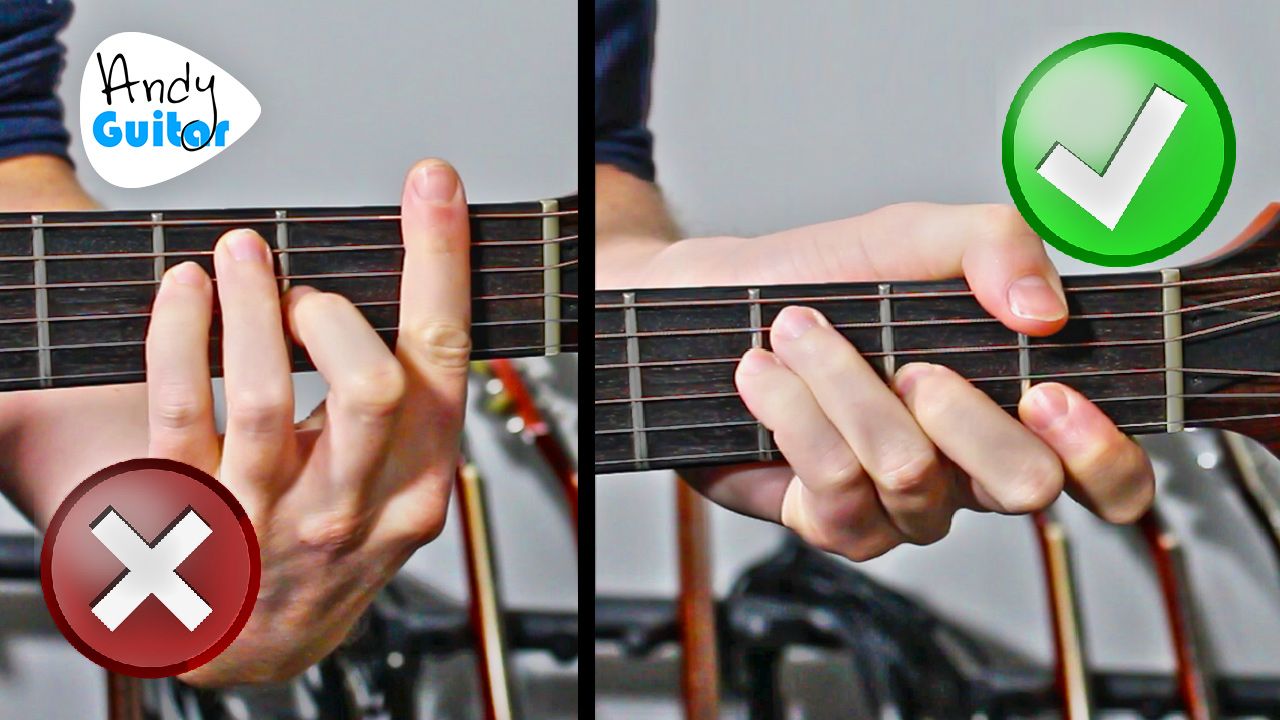
Before we get on to the video - don't forget your chord playing basics!
Keep the elbow of your chord playing hand into your body
Barre using the side of your first finger closest to the thumb
Keep the 2nd, 3rd and 4th fingers right on the tips, curling the finger tips to a 45 degree angle to the fretboard
B minor chord aka Bm (1:40 in the video)

Plus common chord progressions.
F chord (4:52 in the video)

F minor chord aka Fm (6:54 in the video)

C minor chord aka Cm (9:15 in the video)

All the chords in the key of E (12:07 in the video)
