C Major Chord Explorer

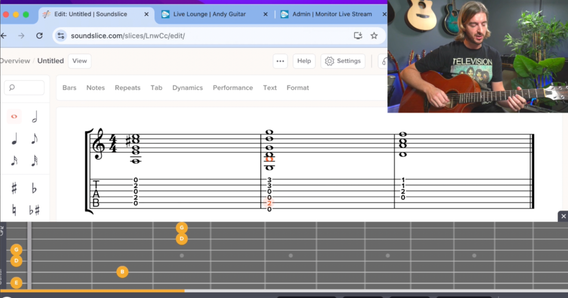
When I play a C chord, what happens in my mind is a whole bunch of options come to the fore and a lot of other options which could be overwhelming if I was thinking about those as well, just go to the one side, cos I can't do them, they don't apply cos I'm playing a C chord, or the thing I'm playing over is a C chord. And it massively simplifies stuff, so you just go, OK, all this stuff you know. Forget about 90% of it, we're in C. That could be C major, minor, that could be C diminished, that could be C mixalidian, that could be just pentatonic, minor pentatonic, major pentatonic, it could be a blues in C, it could be an alternate, every every. One of those options gets rid of most of what isn't useful in that musical context or theory context, and just highlights all the stuff that definitely works. For just a really quick example, if I play just a C chord like this. Like the BPM's been chosen there. The vibe's been chosen, so if I'm, if I'm accompanied by any other musicians and I just stay on a C chord. There's only so much they can kind of do over that. I mean there's a lot someone could do over it. But for all the obvious stuff, you're thinking in C major scale. You're thinking obvious major um embellishments? Thinking basic. Basic, um, stuff that's happening over the top, major pentatonic, because there's been a lot of decisions already made. If I change that first chord, it's still a C, but if I change it to like a C9 for example. Totally different context, all of a sudden that first C chord. It doesn't work over this, they actually clash. What's the next obvious chord? The 4 chord. And then Of course, the And the fore chords, or maybe we repeat it again. For example, how to put all of that stuff in sequential order. Really cool just to go, OK, C chord, what are our options? What are the obvious things we should be thinking about? And what are the embellishments you can do, cos everyone watching this call now or this video, should be able to play a C chord. But people that are more advanced than you can do some physically easy things. To really spice up that sea chord. Just like Chrissy Hine plays a C chord and she's thinking. Just as one song example. So how can we put this in some sort of sensible order? And just as a recap, we are starting off in C major. Those are the most obvious chords, C, F, G, A minor, E minor, D minor, and then you also have a nasty diminished chord, but also uh it just rarely gets played, so your, your B diminished would be the, the fancy one. We're gonna cover all that in a second. Alright, so C major open position. Some of you guys will be aware that we've got this barcode version at the 3rd fret and this one at the 8th fret as well. We'll be covering more of that in a second, but from a really rudimentary point of view. Beginner. Early intermediate. Late intermediate. But where can we go from there to make it sound cooler? Well, the most obvious thing is the C major 7 to the C dominant 7. And we have two song options with this, anyone name them? If I play. That's one of them, and then we also have. We got something and kiss me. What is the most common thing is not using both of these in one, the same song. The C7, which is adding. You can think about a C7 like adding a 7th, a bit like adding a 9, or add 13. Add 7, adds that um dominant 7. Which is here and it makes it kind of like a B 7, and it sounds very blues. The major 7. Sounds pop, it sounds relaxing, like the most classy thing you can do on both guitar, and on piano or any other song instrument, any chord instrument. He's just playing major 7. Just play major 7 to 7, you always sound fancy basically, especially on piano, but it does work on guitar as well. But that's the, they're the really obvious embellishments. The other one would be a sus 4. And this would be. This is a song called Laid by James. Like the whole song only exists. Because of a sus 4, SUS4s are so fantastic. For riffs, as are major sevens, cos that's what Chrissy Hind has done in Don't Get Me Wrong. Which uses C to C major 7. But then chooses other safe code options. They're safe cause they're all here. She went from C to A minor. D minor and then G, and that's all within this yellow line. So And I'm now Cause I'm doing 2 guitar parts or a whole song, yeah, 2 guitar parts, one playing the rhythm, one playing the riff. That is how we can add chord embellishments basically, it's one of the fanciest things we can do. Another really fancy thing we can do is take um I mean the really obvious chord progression with a C is to do C add 9. And this D, CA 9, and G is where so many hit songs live, and it doesn't happen, those hit songs don't happen without the CA 9, for example. Or What all those other embellishments are, we'll cover in a second, but that one is a C adnite. Now this is really important, why is this an ad 9? And this one Is a C 9. No ad. And the reason is this plays the full C major chord and then adds 1/9 interval. 123456789 on top. So it's C major, triad, add 9. When we just say C7 or C9 or C add 11, we have no full major third. We have the dominant seventh there, so that's C7. This is C9, they're the two obvious ones that we need to get now. Beyond that, we tend to play them in a different position, higher up the neck. I think about this as the John Mayer everyday I have the Blues chord. Any of you guys know where the Light Is, the John Mayer album from like 2008. When he played, it's where we get. It's where we get his version of er Free falling from. But then he, he not only supports himself though he does a full band show acoustically, he does it with the John Mayer Trio. And one of the songs he does is Everyday I have the Blues, everyday. Yeah. Every day I have. When you see me wearing, baby. It's you It's not my best John Mayer impression, but it's a John Mayer impression of that song. Trying to give it that vibe, and again the whole song is like. And the solo's insane. The whole song is based around this shape. Doesn't exist without this C9 chord, which, because it's not got an ad, is C7 with a 9 on top. No 5th, it's root, 3rd, dominant 7. 9. Where do those numbers come from? They come from the major scale. So we really have to know. The C major scale over an octave. And what are some songs we've got with that? Well, of course we've got. We got La Bamba, we got Baby It's a Wild World. What about these higher strings? Well, you know I'm a real fan of. Uh, falling slowly by Glenn Hansard. The other thing we should know is 23456, dominant 7, root. If we play that, we're actually playing something called the Malidium mode. And modes are something I really wanna dig into this year and we will cover them in intermediate Electric because on electric it really becomes like essential. And even in this chord explorer. It becomes really essential, particularly on D. Another really key one that I really love is this. This is a C chord. It looks like an E, doesn't it? It looks like I'm playing E major in the wrong place. Anyone named What chord is that? It's a C chord, but it's a C major. Over G C slash G. C major chord, G in the bass, Y. So that Scotty Moore could play a slightly heavier riff than anyone else playing a C chord. Give the record a bit more bass, a bit more punch, literally might not be a hit song without. Scotty Moore's guitar playing, because he is absolutely awesome. In C major, once we've got the major scale. This is what Bob's looking at now. We should learn to play that while keeping at least the root note down or any other fingers. Especially on acoustic, but this is. Cause that's how we can play. Oh, we're gonna see 9 God at the end there. But it all starts with. Keeping down that C chord while playing. A C major chord, and then for example, still playing C major as a scale. But playing all the other chords in your key, for example, G. Still C major scale cause we're still in the key of C. And that's the example, you'd need it on F as well. And even all these embellishments. They happen in so many. you want your free. Aren't. They happen in regular songs, that's technically like. An F and a G chord, um. And this is Fleetwood Mac, but it's in the key of C. Still all just the C major scale. Uh, we can play C minor in this position as well. You'd think when would I ever use that? Well, what if you can't play a C minor barcode. But also There Because it's the only way when I did that arrangement of Live and Let Die. That I could. Play the chord and the melody at the same time, it was the best solution, which brings on board. Uh, diminished chords. To do our diminished chords, we really want to think about C major chords using an A major shape. Major. Minor. 7. Dominant 7 So that's something in the way she moves. Attracts me like no other. Yeah. And then also, so major 7, minor 7. And then Diminished What does diminish mean? It's going up in minor thirds. There's 4 notes per octave and they're all 123 notes apart, so 1. And that is our C diminished shape. Uh, which in this case. We kind of want to resolve back to G, but um. That's also why we can move this shape up 3 frets and we're technically playing like the same chord, and it sounds a bit panto villain. And it does happen in songs, but I just wanted to give you all of the, what are the actual chords within within the octave that you need to know. You've got the major. The SAS 2's and SAS 4s. Major 7, dominant 7, minor 7. And diminished. And they're all the main ones within the octave, without taking apart 9s and stuff, and actually the A major bar chord is is the best place to do that. The last thing in my chord explorer for C is the E-shaped bar chord. Which is this one. It's mainly people like Jack Johnson play it like this as a full bar. Many other people do this kind of idea, not maybe in the key of C, but this is the Hendrix method, if you want to be able to play. All of that, that is basically all on the little finger and it's a root, 3rd, 5th, octave. It's basically the same notes as the bar chord, but it's not the bar you wanna practise, it's doing. Hammer on and flick off with the little finger. Which is how you get to. All of that kind of thing. And that is the John Prasanti kind of style of doing this. The Final thing I guess would be just the triads. See, see. And C, D, E shaped, and then we're getting towards cage system stuff. But we're not quite there. And all of that, I mean that is a good half an hour. Or at least 25 minutes. How long was that, something like 25 minutes? Just on C major. Just on C major alone. But it's really, really important.
In this video
The first lesson in the Chord Explorer series focuses on C major, showing you how professional guitarists think when they land on a C chord and what options immediately become available on the fretboard.
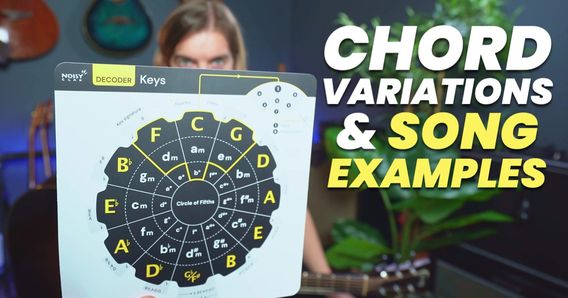
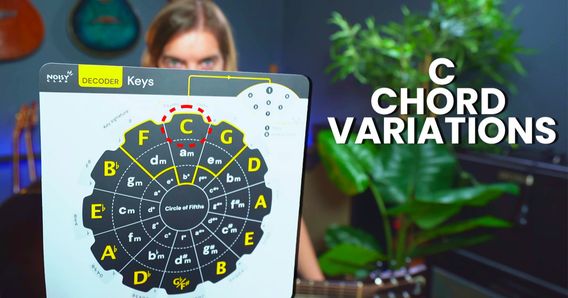
The lesson opens by mapping out all the diatonic chords in the key of C (C, F, G, A minor, E minor, D minor and B diminished), before working through all the essential chord embellishments: C major seven, C dominant seven, sus four and C add nine, with a clear explanation of the difference between add nine and C9 that trips a lot of players up.
From there the lesson moves through the CAGED positions in C, covers the Mixolydian mode and what a flat seventh does to the feel of a chord, and takes a look at diminished chords: what they are, how they're built in minor thirds and where they actually crop up in real songs.
Songs covered include:
Laid by James — the sus four embellishment as a full song concept
Falling Slowly - C major scale/ chord relations in action
Something by The Beatles — C > Cmaj7 > C7 in a real song context
La Bamba — the major scale over C in open position
Don’t Get Me Wrong by The Pretenders — how C major scale runs connect chords
Every Day I Have the Blues - John Mayer Trio version - C9 blue style
C chord variations - Beginner to intermediate
Interactive Tab
Become a member to access this interactive tab section.
Interactive Tab
Become a member to access this interactive tab section.