
Finger Gym 3: 2 Finger Flick Off / Pull Off Focus
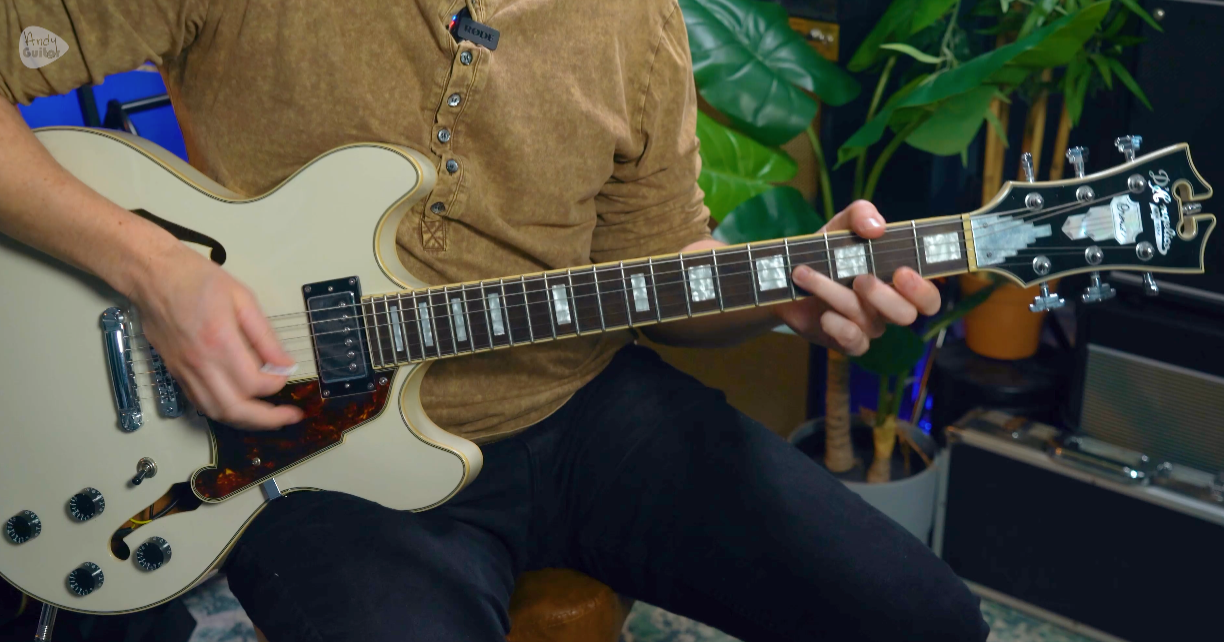
In this video
This is your main fretting hand workout for Level 3. Building on the warm-up exercises from the first two levels, we now introduce legato playing — specifically hammer ons and flick offs (pull offs). These are the techniques behind some of the most iconic guitar riffs ever recorded, from Thunderstruck to The Trooper to Over the Hills and Far Away, and developing them here will give your left hand the strength and independence it needs for everything that follows.
What you will learn:
• Two-finger hammer on and flick off combinations across all strings
• Correct flick off technique — flicking down rather than lifting off
• Muting control for clean legato playing with higher gain
• How to keep the index finger anchored and snaking along the strings
• Building toward three-finger legato combinations
Two-finger hammer on and flick off combinations across all strings
We start with the most essential combination: index and ring finger. The approach is to pick the higher fretted note, flick off to the index finger, then hammer back on — repeating this on every string. From there you’ll work through all two-finger pairings that include the index finger (index to middle, index to pinkie), and then the harder combinations that don’t use the index finger at all, like pinkie to middle. Practising these vertically across the strings rather than horizontally along them ensures the strength you build transfers to chord work and general playing, not just scale runs.
Correct flick off technique — flicking down rather than lifting off
The term “pull off” can be misleading because simply lifting your finger off the string often produces a weak, barely audible note. The key is to flick — a quick downward or sideways motion that catches the string on the way off, almost like a mini pick stroke from the fretting finger. This is where the term “flick off” is more helpful than “pull off.” Speed comes from how fast the finger moves, not how hard it presses. A quick, snappy flick will always sound better than a slow, heavy one.
Muting control for clean legato playing with higher gain
As soon as you add overdrive or distortion, any unmuted string will ring out sympathetically and create unwanted noise. To keep your legato playing clean, you’ll use the base of the thumb and the fleshy part of the picking hand to rest against the strings above the ones you’re playing. This is a habit to build now — it becomes non-negotiable as you progress into higher gain playing and faster legato passages.
How to keep the index finger anchored and snaking along the strings
One of the most common mistakes with flick offs is lifting the index finger before it’s needed. The index finger should already be down on the target fret before the flick off arrives at it. This means it needs to creep and snake along the strings, staying as close to the fretboard as possible. When the index finger is in place, everything is easier — and this principle applies well beyond legato work into barre chords, scale playing, and general fretting efficiency.
Building toward three-finger legato combinations
Once your two-finger combinations are solid — particularly the ones without the index finger — you can begin working on three-finger combinations like pinkie to ring to index. This is the foundation of licks used by players like Angus Young and appears across countless rock solos. We don’t drill these extensively at this level, but knowing they’re the next step helps you understand where all this foundational work is heading.
Intermediate Electric Level 3
Recommended Songs
Enjoying this course? Want to test out your new skills? Find out my recommended song tutorials that accompany this course and get total access to the site by signing up today!