
Chords consolidation - Beginner Electric
In this video
Congrats on your amazing progress and welcome to the consolidation modules where in this lesson we review all chords covered in this Beginner Electric course 🎸
This is a recap on all chords covered in this course and an explanation of how these chord get their names so you understand the theory, not just the shapes.
This is a BIG list - don’t panic if you don’t know half of these chords right away. The best way to learn chords is in context of a chord progression.
However, we do need one lowdown of the sheer amount of chords that have been covered in this course before moving onto trying to learn barre chords. Otherwise, the theory behind will never make sense.
This video explains that theory, plus is a recap on all the chords covered in this course.
Something not make sense? We’ll link back to the where those chords were first introduced where possible.
Main Points Covered:
Major chords: E, A, D (try E, A & D Jam Track!)
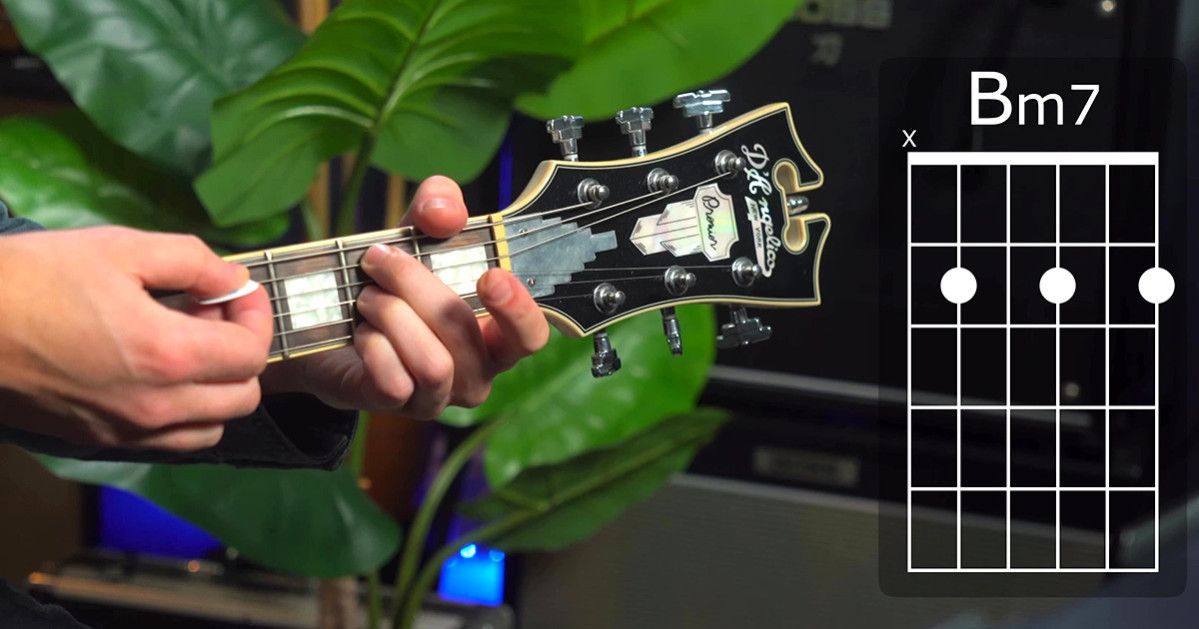
Minor chords: Em, Am, Dm, Bm7 (easier than full Bm)
Power chords: root 6 and root 5 shapes - Plus the G5 open position
The F chord and Fm7 (the chord that everyone learns)
Dominant seventh chords: E7, A7, D7, G7, C7 - often for blues
Sus2 and Sus4 embellishments on D, A, and E chord
Slash chords: G/F#, G/B, C/B, D/F# for 'walking' bass lines
Major seventh chords: Cmaj7, Dmaj7, Amaj7
Full list of all chords covered in this course;
Major chords
E, A, D, G, C
Root, major 3rd, 5th intervals of major scale
e.g. C major chord uses only C E and G notes
Not always in that order, but those are the only notes used
e.g. C major; C E G C E (strings 5 to 1)
Minor chords
Em, Am, Dm, Bm
Root, minor 3rd, 5th intervals
e.g. E minor is E G B notes only
E minor open chord; E B E G B E (strings 6-1)
E major open chord; E B E G# B E (strings 6-1)
Power chords
2 or 3 note chords but only ever Root and 5th!
Sus chords aka suspended chords (and Cadd9)
Major 3rd suspended (or omitted)
3rd replaced by perfect fourth or major 2nd
Open sound, wonderful for riffs and embellishments - they ALWAYS sound good
Dsus2/4 Asus2/4 Esus4
Cadd9, Dsus4 and G most common
Slash chords
Before the / is the actual chord being played, after the / is the root note of that chord
G/B is a G major chord
C/B and G/B, both functioning as a substitution of the diminished chord that makes up the final chord in a diatonic chord sequence; C Dm Em F G Am (Bdim replaced for C/B C
Makes most sense when descending from C, C/B to Am
G/Fsharp check workbook for notes
Dominant 7th chords B7 E7 A7 D7 G7 C7
Bluesy sound, or used in anticipation of a chord change
7th chords add a note on top of the tonic triad
7ths are the ONLY chord NOT referring to the major scale intervals
e.g. C7 is a C major chord with a flatted 7th
Useful to know for the future - Major 7th chords
Major 7ths sound relaxed, chilled and jazzy
Major 7th interval added on top of triad
Fmaj7 the one everyone learns
Cmaj7, Dmaj7, Gmaj7 useful to know
Beginner Electric Level 9
Recommended Songs
Enjoying this course? Want to test out your new skills? Find out my recommended song tutorials that accompany this course and get total access to the site by signing up today!