
The E chord

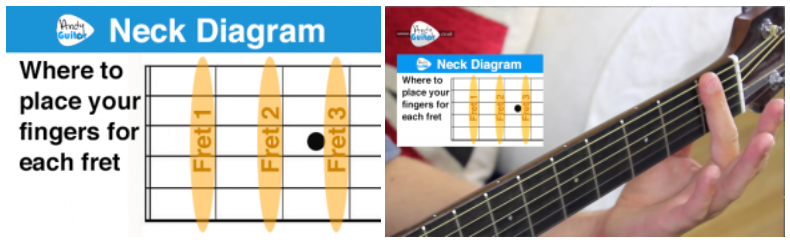
Hi guys, my name's Andy, and in this lesson I'm gonna be showing you how to play the E major chord. Now this is the first chord that I would teach any absolute beginner if they were to have a private lesson with me. So if you're an absolute beginner and you've never even held a guitar before, this is the ideal chord to first start with. So this is our E major code and this is what it sounds like. Now seeing as it's generally absolute beginners watching this lesson, I'm just gonna cover a couple of the basics for you. So these metal strips going down the neck here are our frets, but we consider this area to be fret 1, this area fret 2, and this area fret 3. And for each of our fingers we kind of have a coordination. Between the fret number and the string itself. And we're gonna to number the strings 1 to 6, so 123456. And for this E major chord, we need our first finger on the first fret of the third string. So 123. There's my first finger, it's right on the tip and it's arched over to this side of the fret, not over this side, so the side closest to you but it doesn't want to be on top of that metal fret going down, we wanna be in this area here and that's ideal. Your middle finger. Is on the 5th string at the 2nd fret, and again it's as far over this side of the fret as is comfortable for you and it's on the tip again. And then our 3rd finger is again on the 2nd fret just underneath on the 4th string. So one 23, and we wanna try and get this third finger as far underneath that middle finger as possible and staying on the tips of our fingers. And then if we strum all six strings. It sounds like that. Now you may be strumming this just with your thumb, but I'd really recommend getting yourself a pick, also known as a electrum, and if you click in the description below, there'll be help on how to choose a pick and and what pick I'd recommend you use, but it will sound a lot sweeter rather than using your thumb. Where it can sound a bit, a bit quiet and some people prefer that er but I'd definitely recommend for absolute beginners to try and get used to holding a pick, it just gives you more options. The main problem when people first start learning any guitar chords is that some of the strings don't ring out. And that is generally because their fingers are too flat or they're touching the bottom of the guitar like this and therefore that thinnest Estring has no chance of ringing out. So we want to give this area here underneath the guitar and around these thinner two strings that look like cheese wire as much room as possible. So that they ring out and don't sound kind of like, like this. As you try and get those strings to ring out, you may actually be pressing on too hard. It's way more common for people to be pressing on too hard than than not hard enough. And in my opinion, if we put it on a scale of 1 to 10, so 1 being not pressing down at all and 10 being like the pressure of making a fist really hard, we're pressing down around a 4, but if you need more help with that, there is help in a later lesson of how exactly how to press down. But this is our E code. And we just want to press down hard enough to get these strings ringing out. Now we can test whether they're ringing out or not by picking each individual string from 6 to 1. So we can tell that's ringing out and if at any point. One of them isn't ringing out, you can see which string that's on. In this case it's string 5 because I've lifted it off a little bit or I'm not pressing down hard enough. Press it down a little bit harder and there it is. But you can still see I've got plenty of room here by just keeping that thumb a little bit lower than I would be if I was just gripping the neck like this. It's just a little bit lower. And that is our first E major chord. Now when we look at the chord diagram for that E chord, it does seem a little bit upside down to some people, but the idea is from your angle looking down it's the right way up. So we can see that we've got the thicker line on the bottom and the thinnest line on the top, and that thinnest line is your strings. All those horizontal lines are the strings. We have the frets going down, and we have a double line at one side, and that's the nut of your guitar where the strings are held in place here. So that's how to play your E major chord. The next chord I would recommend you really go for is the A major chord. There's a couple of variations of that one, but that's shown in this next lesson. So if you want to stick with me and follow this beginner's course, I will see you in that next lesson where we show you how to play the A major chord.
In this video
Andy Guitar Beginners Course eBook 2016 - 2nd Edition
The E Major Chord
This is the E major chord. Each number tells you which finger to place down: 1 is index, 2 is middle and 3 is ring finger.
Chord Boxes
Chord boxes aka Chord Diagrams show us where to put our fingers for each chord. Here is the chord box for the E Major Chord (aka E maj for short).
The black dots show you where to put your fingers, the numbers show you which finger to use (1 is index, 2 is middle, 3 is ring finger). In this chord, we strum all six strings on the guitar.
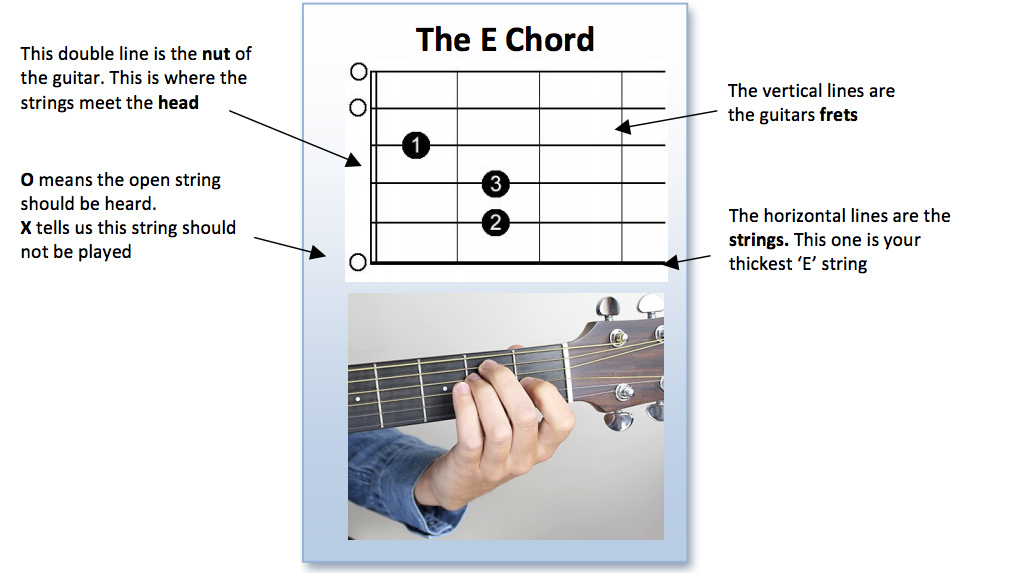
Many beginners feel that chord boxes and TAB can look 'upside down'. Many left handed beginner guitar players feel that chord boxes can appear 'back to front'.
In the video below video, I explain why this can be the case and hopefully help you to understand how to read chord boxes better.
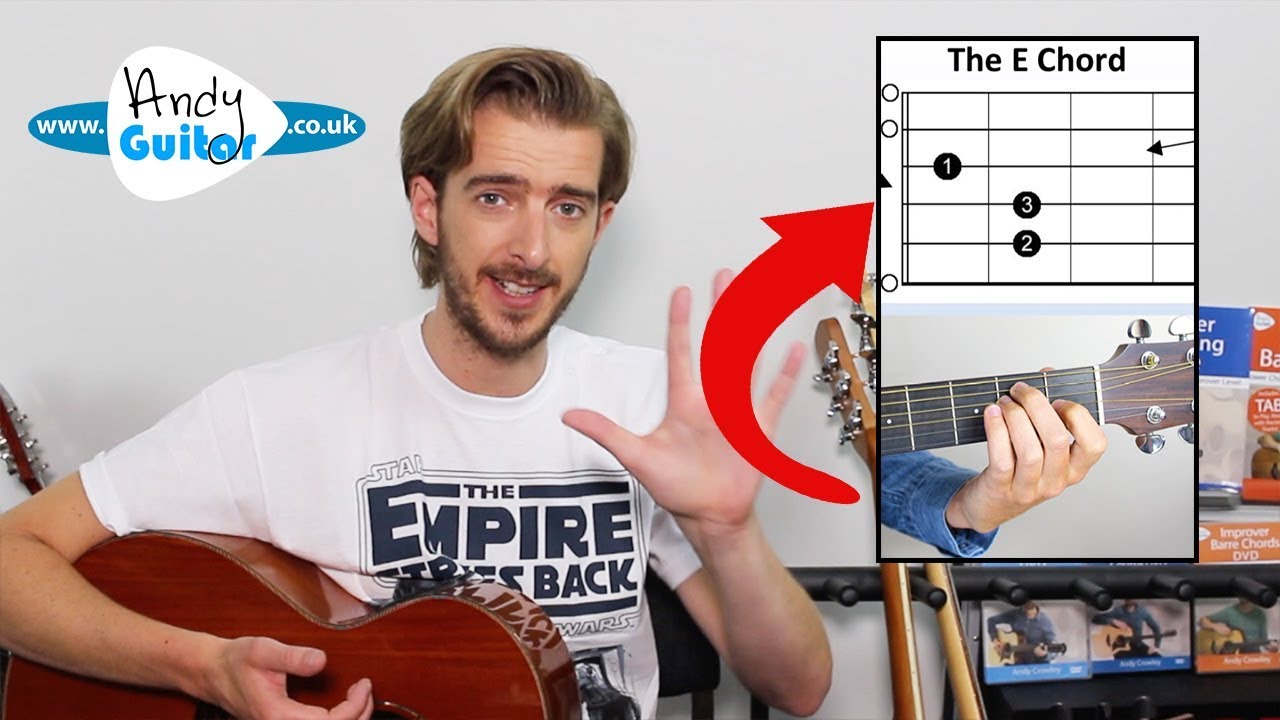
See my complete videos on How to Read Guitar Chord Boxes and How to Read Guitar TAB from my updated beginner course.
The Andy Guitar Beginners Course book is available on the Shop page and also on Amazon.
Finger placement/ buzzing etc
You must place your fingers at the near side of the frets. This is the most common cause of ‘fret buzz’, an unwanted sound where the strings don’t ring out and buzz.
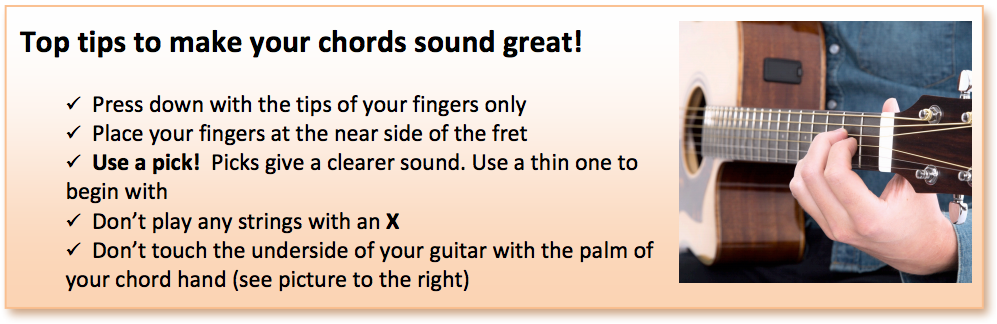
Hopefully this has enabled you to play the E chord and it's sounding great!
Next Lesson...
Check out how to play the next chord and change between chords correctly in the next lesson in this course!