
Picking Hand Warmup: Alternate Picking 1
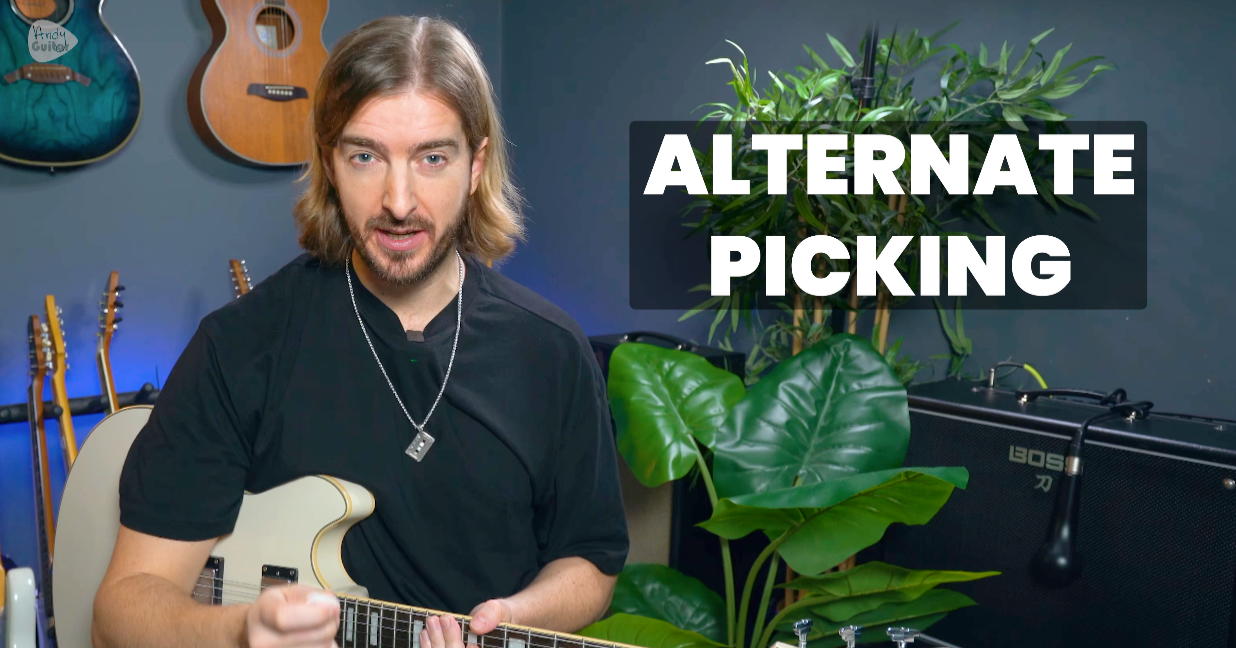
123 Now let's take a look at a picking hand warm-up slash exercise just to see what we've got with the picking hand. This is gonna use something called alternate picking, which is something we tend to default to, and it just means that whatever note you're playing, you pick the riff, the scale, the exercise with a down pick and then an upp, down, up, down, up, no matter what note you play. For example. However, there's an extra bit in this cos we're at intermediate level now. In this exercise and many single note exercises, we only want one string to ring out. And that takes a combination of both hands, especially with an open string. So to play the open A, once I start playing down, up, down, up. No problem, keep the motion small. I tend to pick a little closer to the um bridge pickup, especially for rhythm stuff. But this can be really cool because the string moves a lot more at this side uh near it, so if you pick kind of towards this side, a lot of the faster players, you'll notice they pick a lot more towards the treble pickup rather than the bridge pickup. Just cos the string vibrates and moves a lot less towards this side so you can get. Much faster at this side, much easier than you can at this side. However, when we move down a string. If we don't do something about it, They bleed into each other, which whether we're playing open strings or not, we don't want, and we wanna make sure we're fully in control of our guitar, especially when we have the Van Halen sound. Everything gets very noisy, and we wanna be fully in control of our guitar, even if we have a lot of overdrive on. There is a way that we can have only one string ringing out at a time with just the picking hand and it involves either the side of the thumb just here or sometimes the fingers themselves. And that is done if for example in this case, we're looking at string 5, the open A. Down, up, down, up, my fingers are either hooked underneath string 1 or sometimes touching string 12 and 3, especially when I have loads of overdrive on. Which I now do, fully in control of my guitar, and I can pick. String 5, nothing else rings out. If I wanna pick string 4. What I did just then, I touched string 5 with the base of my thumb or the side of my thumb just here as I picked string 4. And that mutes it, so if this string 5 is ringing out, I wanna pick string 4. I've just touched it and then I'm gonna pick it and that's enough, that's all it takes, just the lightest, quickest touch. But that is the perfect thing to look at as we look at this fairly basic exercise which is just going to be playing this riff. Which is kind of minor pentatonic based and then going minor to major. So 003, 05, 034. Kind of based on a famous beginner riff, something like the Peter Gunn theme or the Blues Brothers theme as it's otherwise known. But we're gonna change it between the thickest three strings, starting off on the A string. We're gonna play that twice. We're then gonna play it twice on the D string, same riff, we're gonna play it on the E string, same riff. And then move to the A. Just like a lot of famous riffs do, like something like Rock and Roll by Led Zeppelin. Plays a riff on A, starting at the open A string. Goes to D A goes to E and then finishes on A. Great song, we'll look at it later, but let's make sure we've got these basic building blocks first of all, with both our fretting hand, but in this case, mostly looking at the picking hand, can we be accurate enough at speed? To be able to do this, so we have. That's a demo of the full exercise, be extra careful to use the pick when you go between string 5. And string 4. That's all it takes. When I pick string 4, I'm touching string 5 and even string 6. I'm holding the pick on the side of the first finger, which you can do this same technique like this, holding it in kind of the strummer way, but it is harder. Highly recommend if you're not already hold the pick on the side of the first finger. Placing it like this and like this, and basically having your thumb and a pick on a 90 degree angle, because that's the trick to speed. There are people, and there's always gonna be many guitar players, countless guitar players that you can name, that don't do this, that hold it like this, but they tend to be the anomaly that proves the rule. They tend to be those outliers that just practised and practised and were absolutely gifted in that. That's what works for them. It doesn't mean it will work for everyone and it's not even the best way to play their parts if you haven't got that same technique down. So the one I recommend is having the pick and the thumb on a 90 degree angle, side of the first finger, thumb on top, 90 degree angle. That puts your pick on an angle here so that it's not colliding against the string. If it's colliding against the string like this, you're gonna get this sort of thing happening, which the closer you pick to this side. Happens a lot more cos the string moves a lot more. If we're on the side here and we're over the. At that slight, just kind of 10 degree angle, just like this. That's the angle the pick wants to be when it collides against the string and it moves over it in a really easy swift way. If you're getting this happening. That's an exaggerated version, but it does happen. That's what we don't want, we want it to glide over it. As an example, and that's something we'll build up to over time, but I do want to inspire you to make sure you're holding your pick like that. If you're following my lessons on electric lead guitar, that's what we're doing. Let's have a look at this exercise now and we're gonna have a jam track with this one as well. It will be down below, but it will be in the video now as well. Best of luck with it, and this is your picking hand warm up. One 2 12. 123. 123. 123. One. 123.
In this video
Alternate picking — down, up, down, up on every note — is the default picking approach at intermediate level. But this lesson goes a step further by introducing picking hand muting: the technique of using the side of the thumb or the fingers to stop unwanted strings from ringing out. This is especially important when playing with overdrive or high gain, where any uncontrolled string can get noisy fast.
What You'll Learn
• What alternate picking is and why it matters
• How to keep only one string ringing out at a time using the picking hand
• The correct way to hold a pick for speed and control
• A minor pentatonic-based warm-up riff across the three thickest strings
• How picking position near the bridge affects speed and tone
Jam Track

Audio Jam Track
Audio Jam Track - No Guitar
Alternate Picking
Alternate picking simply means alternating between a downstroke and an upstroke on every note you play, regardless of which string you're on. It's one of the fundamentals of efficient electric guitar playing and the default approach for single-note lines at intermediate level and beyond.
Picking Hand Muting
When moving between strings, unwanted notes can bleed through — especially with a driven or overdriven sound. The solution is using the side of the thumb or the underside of the picking fingers to lightly touch and mute the string you've just left. It only takes the lightest touch. Developing this early puts you fully in control of your guitar at all times.
How to Hold the Pick
Holding the pick on the side of the first finger with the thumb at a 90-degree angle is the recommended approach for speed and control. This angles the pick slightly so it glides over the string rather than colliding with it. It's one of those small technical details that makes a big difference as things get faster.
The Warm-Up Riff
The exercise uses a short minor pentatonic-based riff played across the A, D and E strings — move from A to D, then D to E, then back to A. It's inspired by famous riffs like the Peter Gunn theme and Rock and Roll by Led Zeppelin. The focus is on accuracy, clean string transitions and keeping the picking motion small and relaxed.
Intermediate Electric Level 1
Recommended Songs
Enjoying this course? Want to test out your new skills? Find out my recommended song tutorials that accompany this course and get total access to the site by signing up today!