
The Beat and 4th Strumming
Hi guys, in this lesson we're looking at how to play a couple of the easiest strumming patterns to play real songs with on guitar. These are appropriate for level one of my beginner's course and beyond. Before we get into the actual technique of strumming, we need a bit of background on what bars and beats are. So the beat is what you would naturally tap your foot to or nod your head to if you're listening to one of your favourite songs. But it is a pulse that is actually throughout every song that you've ever heard. But there's not necessarily something that has to play on the beat for it to still be there. Say it's a pulse that exists and you would naturally sort of feel when you get into having a natural rhythm through learning music. And that beat goes to a count of 4. So 1234, evenly spaced counts or pulses as I say. And uh it's that count of 4 that we call a bar. So rather than joining in a song that maybe, you know, beat 72 or 103. We would count, say come 2 bars in, which is 2 counts of 4 or 4 bars in, so on and so forth. So grouping things together in bars makes it easier to keep track of how many beats we actually play. But essentially all we want to be able to do is count to 4 at a slow, even pace, so 1234. And then to start off with, we're just gonna strum on beat one, which is actually how our first song actually starts. So if we just take this E major chord as an example and you can play along as soon as you feel comfortable at home with your guitar, uh, we're gonna play that first chord E major. And I'm gonna count 1234 evenly in a loop and just strum on beat 1, which is our first strumming pattern. So that goes like this. 123412341234. And that is our first strumming pattern, nice and easily, but we've got all the foundations there of what we'll use later on in real songs and chord sequences. So that strumming pattern is called a spread and it sounds best if we do the strum slightly delayed, so slightly slower, so kind of like a harp. Whenever we do one strung that rings out like these spreads do, it just sounds a bit more professional. If we do it nice, gentle, dragging the pick down. 12341234. 3. OK. So make sure you join in with this at home, nice and easy, we're just gonna go for it real quick. In 23412341234, strum, 234, strum, 234. OK, and if you have to count out loud to start off with, that's fine, but if we can make that count internal in your mind, then that's the perfect way to make sure that you're doing this right. The second strumming pattern and the one that is often the the foundation of so many of our songs, I'll always show you the chord sequence starting off with this strumming pattern. This is strumming on the beat. So that count of 1234, we're just gonna do down strums every time. And down strums are far more natural than up strums, so we're gonna. Start on on down strums for everything for now. So we're gonna take that E major chord one more time and just strum on the beat evenly but keeping the count in your mind so that you know how many you've done. So let's just have a go at that now. Join in at any point when you're ready. In 234, strum, 2341. one. And pause there. OK, so a couple of points just on that strumming now you've had a go. I'm using a pick, also known as a electrum. Um, these are really handy to get a nice clean sound. er and I really recommend getting used to having a pick if you're not using one already. Uh, you want to grip that pick between your thumb and your first. Finger, but if you do find that you keep dropping it and it's more comfortable, you can use two fingers as well. And strumming fundamentally needs to happen from the elbow, not the wrist, at least to begin with, OK. So it's a strum like this from the elbow and that elbow is hitting the guitar just here. And we strum using this action like this, OK? Just a demo of that one more time and if you want to join in you can. We wanna hit all six strings nice and evenly and just collide against them, you know, rather than. Down everyone, we want these strums to unlike the spread to sound like one sound rather than the harp sound we were going for earlier, OK? So one single strum. Yes, make it sound like a harp for this one. Just go straight for it, OK, a nice flick down almost. Ready, with your guitar on an E-chord in 23412. 4. And pause there. Now just so that we know how long you're playing for, let's change to the A chord now, which was the second chord that we looked at. And we're gonna strum for just 2 bars, OK, so just 2 bars of this count of 4. So this is gonna sound like 1. And this is because in songs we get given a chord sequence and your chord will last a certain amount of time. So this just checks that rather than just keeping even, we're gonna play for two bars, OK, which is again like a couple of songs that we're gonna be going for later. So on that ear chord, join into me on beat one after the count of 123, and strum. 4 and stop. That's the end, OK? So let's do that for 4 bars now just to get onto it. And then, as I say, you've got everything that you need really to be able to have a go at these songs a little later and and chord sequences. So, 1 more time, but 4 bars of A this time. Ready, in 234, strum. 41 one. Last And we stop there. So if you wanna get your timing a little better, you can run through those one more time, but I recommend we get straight onto some chord sequences which are, you can kind of see as pre-sons in this beginner's course. We've got chord sequences that are always gonna be really similar to certain songs, but they don't have the. Structure or they're a little bit simplified, so ideal to go for first. So that's in the next lesson, as I say, or you can get straight on and have a go at the songs themselves, which are on the website at Andyguitar.co.uk. And I hope to see you in one of those future lessons. Take care of yourselves and bye for now.
In this video
Andy Guitar Beginners Course eBook 2016 - 2nd Edition
The first strumming patterns we will learn will have us firstly strumming once every bar and then once every beat. To do this well, we have to understand what bars and beats are. The video above covers this, the pattern itself and also my top tips for strumming with good technique!
What are bars and beats?
The beat is what you nod your head or tap your foot to when you hear a song you like. It is a pulse in music that everything lines up to. 99% of the time, a song will use a count of 4 beats, which we call a bar. Whatever strumming we do for 1 bar, we tend to repeat this throughout an entire song. So when you look at a song, only 1 bar of strumming may be shown, which you learn to repeat while playing whatever chord is written. How fast you count this 1, 2, 3, 4 is called the tempo, aka speed or bpm (beats per minute).
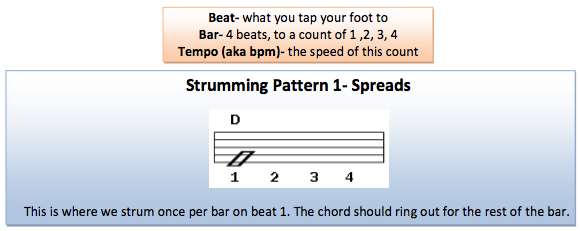
This is a great place to start when learning any new song as it gives you chance to learn the chord changes. Plus- many real songs actually start like this! Count 1, 2, 3, 4 at a slow, even pace (out loud if needs be) and strum an E chord every time you say beat 1.
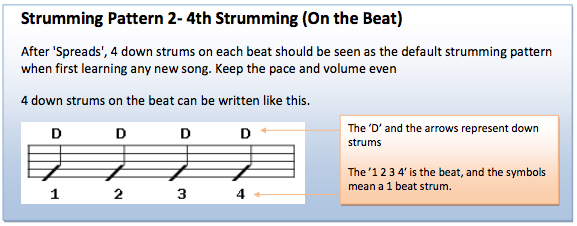
The strumming for any song is only shown as a 1 bar pattern. This is generally repeated for an entire song.