
Root 6 and Root 5 Barre Chords: Major and Minor
In this video
This lesson extends your chord vocabulary by adding root 5 (A shape) barre chords to the root 6 (E shape) chords covered at earlier levels. Being able to play major and minor barre chords from both root strings opens up the entire fretboard for chord work and is essential for playing the songs and progressions at this level. The key insight is that the challenge usually isn’t the barre finger — it’s getting fingers 2, 3, and 4 to work together quickly and accurately.
What you will learn:
• How root 5 barre chords are built from A major and A minor shapes
• Why fingers 2, 3, and 4 are the real challenge (not the barre)
• Hearing and playing the difference between major and minor shapes
• How guitar neck radius affects barre chord playability
• Three essential chord changes: E to C♯m, A to Bm, and D to Bm
• Why electric guitar doesn’t always require full barre chords
How root 5 barre chords are built from A major and A minor shapes
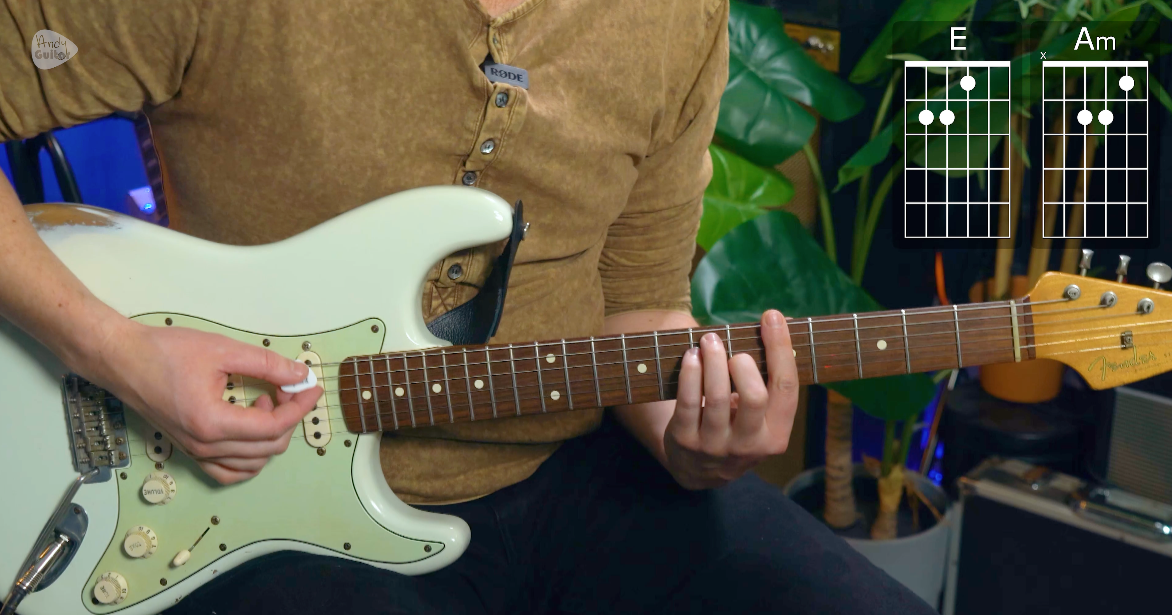
Just as root 6 barre chords come from moving the E major or E minor shape up the fretboard, root 5 barre chords come from moving the A major or A minor shape. You play the chord with fingers 2, 3, and 4, while the index finger barres across strings 5 and 1 (curling to avoid the middle strings). The root note sits on string 5, and you name the chord from there using the note circle — so at the third fret it’s C, at the fifth it’s D, at the seventh it’s E.
Why fingers 2, 3, and 4 are the real challenge (not the barre)
Most players focus too much on the barre finger when struggling with these chords, but the real bottleneck is almost always fingers 2, 3, and 4 — particularly the pinkie. A great way to isolate this is to practise open chord changes like E major to A major (or E major to A minor) using only fingers 2, 3, and 4. This builds the exact muscle memory and finger independence needed for barre chord changes, without the added complication of the barre. Get those three fingers moving as a unit first, then add the barre.
Interactive Tab
Become a member to access this interactive tab section.
Hearing and playing the difference between major and minor shapes
It’s essential to be able to hear whether you’re playing a major or minor chord — otherwise you’ll practise the wrong shape without realising. The potentially confusing part is that the major root 6 shape becomes a minor shape when moved down one string set to root 5, and vice versa. Thinking of these as “E shapes” and “A shapes” rather than just “root 6” and “root 5” helps, because you associate them with the open chords you already know. Regularly checking your chord against the open version keeps your ear calibrated.
How guitar neck radius affects barre chord playability
Not all guitars are equal when it comes to barre chords. A more curved fretboard radius (like on a Fender Stratocaster) can actually make certain root 5 chord voicings easier because the curve naturally fits the shape of a barring finger. A flatter radius (common on Epiphone and Gibson models) may make these same shapes harder. This isn’t about one guitar being better than another — it’s about understanding why the same chord might feel different on different instruments, so you can adjust your technique accordingly.
Three essential chord changes: E to C♯m, A to Bm, and D to Bm
These are the three chord changes that unlock the most songs at this level. E major to C♯ minor is arguably the hardest and appears in songs like Where Is My Mind. A major to B minor is more common and slightly easier. D major to B minor is the most accessible starting point. For each, the preparation is the same: drill the underlying open chord change with fingers 2, 3, and 4 until it’s automatic, then add the barre position. Making the shape in the air before placing it on the fretboard is a small habit that makes a big difference to accuracy.
Why electric guitar doesn’t always require full barre chords
An important perspective at this level: on electric guitar, you often don’t need all five or six strings ringing out. Many players — especially at Grades 4 and 5 — use smaller chord voicings with just two or three strings, particularly on the thinner strings. So if your barre chords aren’t perfectly clean yet, don’t let that hold you back from progressing. The shapes and the understanding of where chords live on the neck are what matter most. Clean full barres will come with time, but they’re not the barrier to moving forward that many players assume.
Intermediate Electric Level 3
Recommended Songs
Enjoying this course? Want to test out your new skills? Find out my recommended song tutorials that accompany this course and get total access to the site by signing up today!