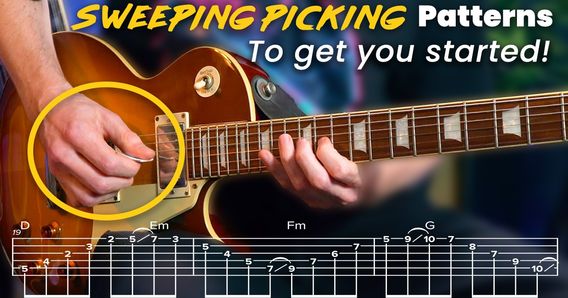
Metal Legato Pull-Offs
In this video
If hammer-ons are one half of legato playing, pull-offs are the other. In this lesson I introduce the pull-off technique using the same B minor shape from Lesson 5, showing how the descending motion mirrors what we've already learned. The same principle applies here as with hammer-ons, the more relaxed you keep your hand, the better it sounds and the faster you can go. Pulling off too hard is just as much of a trap as picking too hard, so I'll give you the key tips to keep everything smooth and tension-free.
What You'll Learn
• The pull-off technique applied to the B minor legato shape
• How economy picking still applies even within pull-off runs
• Why staying on your fingertips helps release tension in your hand
• The importance of locking in with strong beats to stay in time
• The full scale run using pull-offs, ready for the jam track
Interactive Tab
Become a member to access this interactive tab section.
In Detail
The pull-off technique applied to the B minor legato shape
Using the same shape as Lesson 5, I demonstrate the pull-off approach: start with the pinky on the 15th fret, pull off to the 14th, and then pull off again to the 12th. Each pull-off should sound just as clear as a picked note, the key is a controlled, slightly sideways flick of the fretting finger rather than just lifting it straight off the string.
How economy picking still applies even within pull-off runs
Between strings, the picking direction still follows the economy picking principle. Even though most of the notes are generated by pull-offs, when you do pick to move to the next string upwards, that pick should be travelling in the direction you're heading. This keeps the flow consistent and your pick hand in the right position for the next move.
Why staying on your fingertips helps release tension in your hand
When the fingers lie flat on the strings, the wrist kinks and the hand tightens up, exactly what you don't want when trying to pull off quickly and cleanly. I find that keeping the fretting fingers curved and on their tips naturally tucks the elbow in and releases tension throughout the whole arm. It doesn't have to be exaggerated, just enough to keep the hand open and free.
The importance of locking in with strong beats to stay in time
With fast legato runs it's easy to drift rhythmically. I highlight the importance of anchoring your playing to the pulse, feeling the strong beats of the bar and making sure your phrases line up with them. This is what separates a musical legato run from one that just sounds fast and slightly vague.
The full scale run using pull-offs, ready for the jam track
I run through the complete scale using the pull-off pattern, descending through each string pair and finishing on the 10th fret, which resolves perfectly in B minor. We then take it straight into the jam track, so you can hear immediately how it sounds against a real groove.
NWOBHM Style Jam Track - No Guitar
NWOBHM Style Jam Track
Recommended Songs
Enjoying this course? Want to test out your new skills? Find out my recommended song tutorials that accompany this course and get total access to the site by signing up today!