Learn the Fretboard: Octaves 1
In this video
At Grade 3, we need to make serious headway with learning the fretboard, and octaves are the smartest way to start. Rather than trying to memorise every note on every string individually — which is overwhelming and inefficient — we use shapes you already know from chords and power chords to find the same note at multiple positions across the neck. This is the essential first step that everything else builds on: triads, the CAGED system, and confident improvisation all depend on knowing where your notes are.
What you will learn:
• Three octave shapes derived from E, A, and C chord shapes
• How to find six instances of any note within 12 frets
• How octave knowledge connects to riffs and real songs
• A practice method for systematically mapping notes across the fretboard
• How this sets up triads and the CAGED system at later levels
Three octave shapes derived from E, A, and C chord shapes
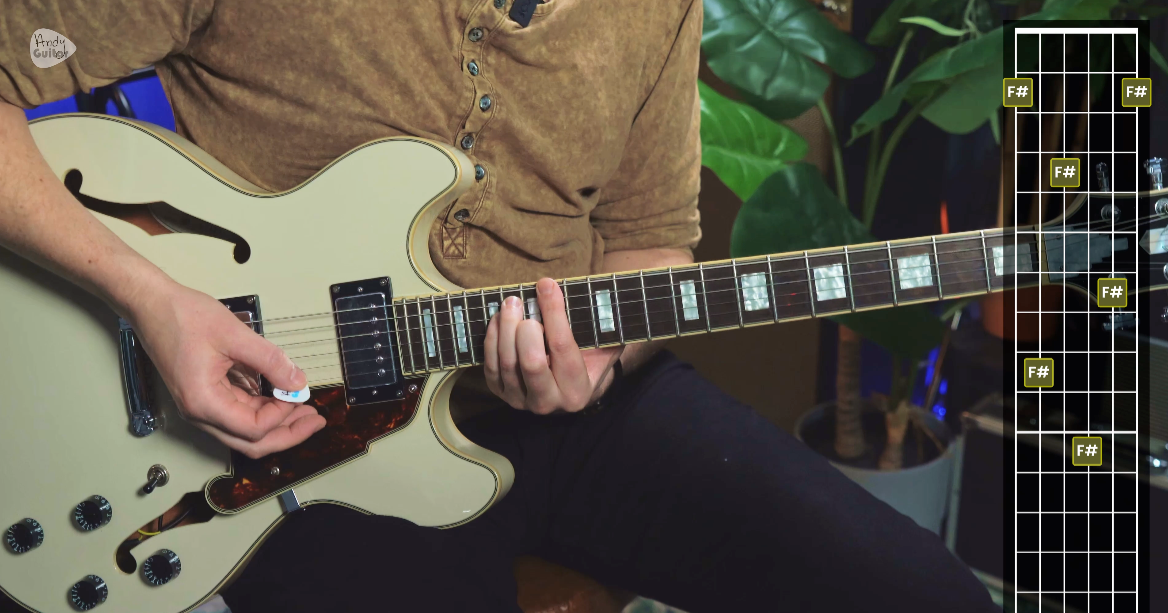
The three shapes you need all come from chords you already play. The E shape gives you octaves between strings 6 and 4 (the same relationship as the root and top of a power chord). The A shape connects strings 5 and 3 (the root of an A-shaped barre chord to its octave). The C shape links strings 5 and 2 — this is the trickiest one to remember, but it’s based on the open C major chord with just the index and ring finger. With these three shapes, you have everything you need to navigate the entire neck.
Interactive Tab
Become a member to access this interactive tab section.
How octave knowledge connects to riffs and real songs
This isn’t just abstract theory — octaves are used directly as a playing technique in a huge number of riffs. Bulls on Parade uses an F octave, Immigrant Song uses F♯, My Sharona uses G, and songs like Cherub Rock and High and Dry use root 5 octaves moving along the strings. Knowing your octave shapes means you can learn these riffs faster, understand what notes they’re built on, and transpose them to different keys if needed.
How this sets up triads and the CAGED system at later levels
Octaves are the foundation, but they’re not the end point. At Grades 4 and 5, we build triads on top of these shapes — adding the G and D shapes to complete the full CAGED system. You’ll never get there comfortably without first being confident with octaves. Think of this as learning where the anchor points are on the fretboard; everything else gets built around them. The small investment of time now pays off enormously as the course progresses.
Intermediate Electric Level 3
Recommended Songs
Enjoying this course? Want to test out your new skills? Find out my recommended song tutorials that accompany this course and get total access to the site by signing up today!