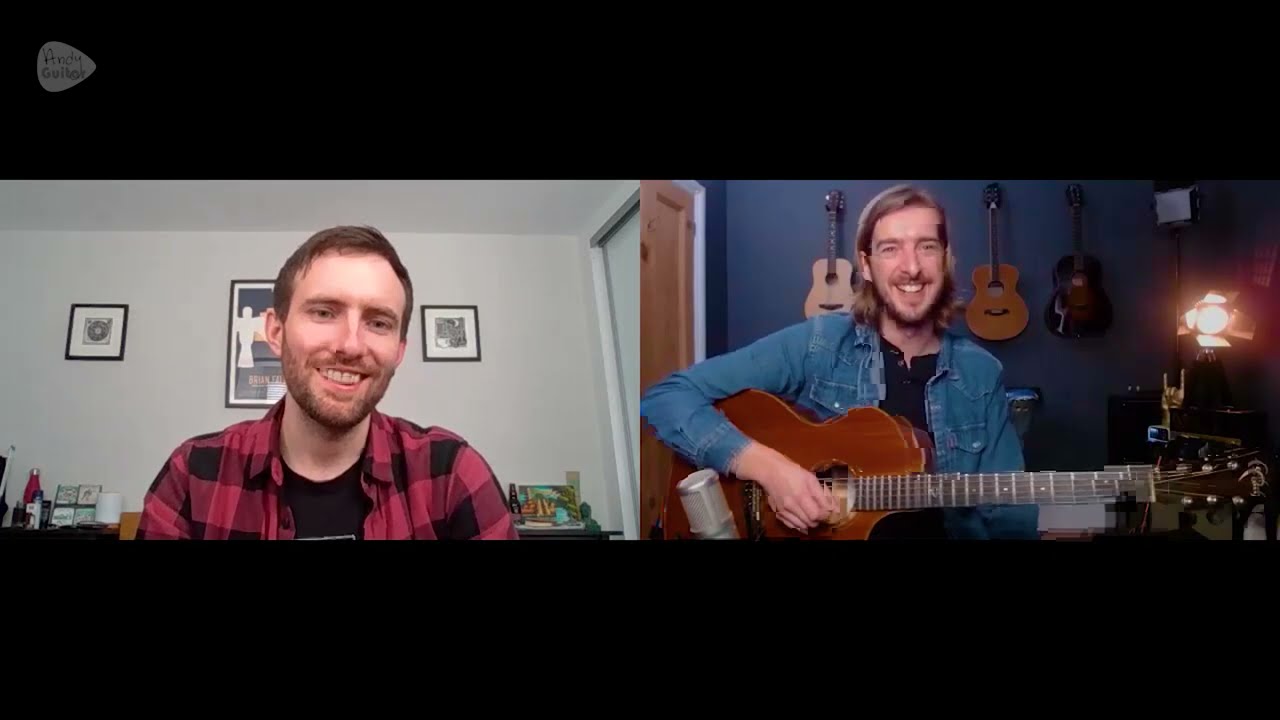
1 Year Adult Beginner Guitar Progress With Online Lessons
Mate, how are you? good to finally meet you. Yeah, yeah, and you, yeah, I'm all good, how are you? Very well, thank you. I suspect we might have been to er the same gig once upon a time. Yeah. Did you go and see Brian Fallon in Kemp Town? Uh, I did, yes, at the church. At the church, at the church. Oh, amazing, yeah. There, there you go, we've, we've been to the same gig then, it was fantastic, wasn't it? Oh mate, it was amazing. Which one did you go to? The, cause he, he did two, like he, he did 2, and I, I went to both of them. It was like he did a the same day. Yeah, that's it, mate, yeah, he did, he did the matinee one in the afternoon and then, uh, evening. I suspect it, it was light outside, so I suspect it was the matinee. Yeah, oh, it's so good. Um, yeah, it's fantastic. They're, they're weird ones, because you're literally in a church. We, I think we started off upstairs to try and get a better view and then came downstairs or something. Yeah. But no, really cool. I've also seen him at uh Coco in London. Yeah. Were you at that one as well? Probably, yeah, Amazing. Like 2, 2.5 years ago, maybe. Yeah, uh, probably when the, his last album just came out, um, when he toured that, um, yeah, we'd have gone there. And the last time I saw him was, uh, just before, well, just before the world went all weird. Uh, he played the 100 Club. Uh, London, yeah, it's absolutely tiny, so it was the first time I've been there, and, uh, yeah, that was great. Amazing. I did meet him very briefly afterwards at Coco as well, but only because we, we got talking to some fans. Um, just who we were stood near with at the gig. They were going for a pint round the corner. So we went, yeah, fine, we, the tube's late, so we can have a pint after the gig. And then the um support band came in. Oh yeah. Who was, ah, who were they? They, they were like, they've, they've they, was it Dave Hawes? Yes, it was. Yeah, like one of my girlfriend's favourite acts. We've seen him loads at 2000 Trees Festival and that kind of thing. Yeah, yeah. And um, yeah, when, when we saw them, we were like, OK, let's hang around. And then he came in after the gig. And I did get to say hello, but nothing more than that. Yeah, I find you were fantastic tonight. Oh cheers. You know, that's all that happened, but still, amazing. Um, that's one thing I've not managed to do yet is, uh, is just shake the man's hand. It's it's luck of the draw sometimes, and you'd hope that something like those acoustic gigs you can, but there's still 1000 people, isn't there, or something? Yeah, that's it. But, um, really quality, really quality. I do remember um. Uh, from back in the day when they were touring the '59 sound and all that kind of thing, but that's, that's a foggy memory. Yeah, yeah, yeah, again, saw gaslight so many times and uh. Yeah, it's sad times they're not together, but still. No, indeed, indeed, it's um it happens, doesn't it? I don't particularly know why they broke up or anything, but uh it's one of those. Um, anyway, mate, it's wicked to finally, um, you know, speak to you cos I've, I've been following your progress on your Instagram, um, loads, cos I do think it's a really inspiring thing and also. You know, you've, you've made a decision to make that Instagram like public, so there's, there's something about it that um I wanted to ask you, like, why, what wanted to, what made you want to start learning guitar in the first place, cos you started totally at the start of lockdown, didn't you? And then also why, what was the decision to like start basically daily videos on Instagram as to your progress. It's pretty intense. Yeah, I mean, it's something I've wanted to do for a while, um, good, good couple of years, and I kind of said to myself in the start of 2019 that I'd do it, um, that year. And then as the, as it, as it kind of, as the weeks went on, my year just got really busy, work was crazy busy, um, I had loads of plans to be like going away and, and various things. So for one reason or another, lots of excuses, it, I, I didn't, didn't end up doing it and. Came round to last year and I was like, right, I really, really want to, really wanna learn this year and I guess why I wanted to learn, I've, I've always been into music since like, you know, school and uh coming out of high school and stuff, listening to bands like Blink and stuff. um but more recently, you know, I've got a, I've got a um, a group of mates that um most of them live around Portsmouth, and all of them. Um, uh, you know, play instruments, some of them are in, um, really good punk band, um, and, yeah, just being around those guys for so long, um, going to festivals with them, gigs, you know, seeing their own gigs, and, um, them writing music, talking about music, it just, you know, constantly being around that when I see those guys, it just kind of roped me in, and one of my best mates, you know, is constantly kind of niggling at me, come on, you should learn, learn, learn, and, um. Yeah, you know, the, the, we, there was one, thinking back, it was a couple of years ago, two of them, uh, got married, Will and Laura, and, uh, the wedding, um, the whole entertainment in the evening was all of, all of these guys just in different groups getting up and, and performing sets that they'd rehearsed and stuff, and it was, it was quality, and again, just being around that, um, just really kind of pushed me to actually go ahead and do it, and. So I decided 2020 was gonna be when I was gonna do it, before lockdown and COVID and all that sort of stuff, and it, um, I had. I had a trip to South Africa, um, that I was going to for a mate's wedding, and, you know, I was kind of saving up money for that, and I said, right, as soon as I'm back, now I'm gonna do it, and then it just so, so happened, it coincided with COVID and everything and going into lockdown, so it was kind of perfect timing really for learning, uh learning guitar. Um, So that's kind of why and and how it kicked on, and in terms of the Instagram page, you I, I, I just, I don't know really, I, um, I remember actually talking to a couple of mates when I was in South Africa, saying that I am actually going to do it, you know, I'm gonna do this when I get back, um, and just saying, I wanted to document it because I wanted to, you know, keep a track of progress, see how I was doing, and, um, yeah, we were just chatting about you could just start an Instagram page, so. I did. There you go, and it's coming up to one year later, isn't it? Yeah, it is, it's this weekend. That's, that's really incredible, and it, it literally every post has the day number on it as well. Yeah. The only thing is, I, I'm sure somewhere along the line I've balled it up somewhere, I wouldn't, I wouldn't be surprised at all. But the main thing that you do know when you started, you know when you posted those videos as well. And um, no, it's, it's an incredible thing. One thing I want to um just pick out of that. Is er how much that kind of one support group and and also just inspiration from friends and inspiration around you, it's, I think um, the, the luckiest thing for me was having an older brother that played guitar. Um, without that I wouldn't have known about this world at all, cos you're just, you're only. Aware of what's immediately put in front of you when you're growing up and when you're a kid, and even later in life you can see certain, you can see movies and one thing or another, but, um, unless you've got friends or people you know that do something that play at all, you just never get to have those conversations that can be very inspiring. And then with the wedding thing, when you're seeing all these people come together and obviously it's a group where people come together anyway, an event where people come together, but then they're able to do something with that, more than just talk about it. Yeah. And yeah, I imagine that had a very direct impact, did it not? Yeah, absolutely, as you say, like, you know, bringing, bringing the guys together, seeing something that they've spent a lot of time, um, you know, rehearsing songs that they, you know, wouldn't normally play in some instances, and, you know, what that brings then to the, you know, the, the, everyone, everyone that was there. And as I say, you know, going around and seeing, seeing the guys, um, in, you know, a couple of them that are in this band, going around and seeing them play, um, you know, various gigs around the country, or actually going to, they, they played a festival, um. In Slovenia, I don't know if you've ever heard of it, uh, punk rock holiday. Right, OK, I've not heard of that 10 my God, it's, it's like the best, best place in the world ever. Um, they, they, they got on the bill for that, and, uh, you know, we all went over there and watched them, um, you know, hundreds of people watching them at a festival in Slovenia, it was quality, and it's, yeah, it's just being around the, around those guys and. And yeah, one Rich in particular just constantly kind of niggling at me, just do it, do it, do it, and yeah, I mean he was, he was a massive help in terms of uh literally I had no idea, you know, I didn't know what to buy in terms of like, you know, guitar and stuff, and yeah, he, he, you know, he massively helped me out in terms of picking, picking one out and the various bits and bobs that you need. Um it is so handy to ask someone because as much as there's so much on the internet. Um, that is helpful. The fact that there's so much means it's gonna be difficult, cause you, you don't know what to search for as a beginner, other than what guitar to buy, and then you have 10 people telling you 100 different options. Yeah. So, there's a weird thing as well, cause you're really into like heavy music, but also acoustic, and that is so common with the style of music that you're into, the punk rock, the alternative rock. It lends itself to both. Um, what was the reason you went for acoustic rather than electric? Um, I don't actually know, I I've just always, I've really, as you say, I really enjoy um. You know, heavier, faster, um, louder music, um, but there's always just been something about those songs being like stripped back to, um, you know, simple acoustic, kind of, again. You've been with mates and stuff at festivals or whatever, or parties around people's houses and just stripped back, kind of, it sounds a bit cheesy, but you know, campfire, all sitting around and someone playing guitar, there's just something being about that, all these, these fast, loud songs just stripped back to simple, simple guitar and vocals that I've always, always really liked and um. And I, so I guess that that er that probably contributed. The song kind of shines through when you can take a heavy song and then make it acoustic, you do realise there's, there's only, you can only really do that with good songs, I guess. Yeah. um, no, it's really cool, I did the same thing and I think it's really common that a lot of people try and start on acoustic cos you have to get one thing. And then when you, as soon as you get an electric, you have to have an amplifier, lead, there's pedals. Suddenly there's all these other stuff that can be distracting, um. Oh, fun but daunting. Yeah. Um, one thing certainly to compare the two, there's an awful lot of stuff that is easier on electric. OK. Literally physically easier on your fingertips. Um, so even just pressing down one string, the strings on electric guitar are thinner. Typically, but they, but they're pretty much consistently across the board thinner. Um, this has got gauge 12 strings on it. Most acoustic guitars have 12 or 13, which is, um, the 0.something of an inch, um, for the thinnest string. So that's how the gauges kind of work. And, uh, on electric guitar, it's either 9s or 10s normally. They all come with 10s, so that it is literally easier to press down electric guitar strings. That only gets compounded when you look at things like bar chords, which I know you're in and around now with your playing. Um, yeah, bar chords are easier on electric guitar. Add to that the fact that you can have an amplifier and these pedals that have loads of effects on, oh, I think I've just lost you there. Wouldn't be a Zoom call without technical issues. There we are, mate. Flipping heck, sorry, it's totally fine. Suddenly my internet just er said it disconnected on my laptop. It, it happens to us all, it's, it's ours still drops out a little bit, but it's been pretty good recently, but yeah, I mean, thank God all this pandemic happened when we'd all got broadband, right? I mean, honestly, if it had have happened 20 years ago, people would have gone mental. Yeah, yeah, can you imagine more so, cos they'd have just, it'd just been boredom, wouldn't it? But yeah, anyway, yeah, um. There's so, there's so much stuff that can be easier on electric, and for the reasons I mentioned before, but also you have like this world of effects where you can literally play one note and it sounds like a crazy big synthesiser or anything that you want. Um, but of course all that stuff's daunting, so therefore, um, starting off an acoustic, it does make logical sense. But be aware, especially as you get higher up. Everything is harder to play on acoustic guitar, it is a more physical instrument. It'll hurt your fingers more. It literally, when you get these, you know, punk bands screaming for two hours, and then they do the acoustic set, I bet so many say that the acoustic set's harder. Yeah, I, I guaranteed, because when, when people are Most people that are doing those kind of gigs, their voice can take it and they can do the screaming bit, but when they're used to, you get used to whatever you're used to. When you're used to just strumming an electric and then you strumming acoustic for a while, it, it is just more, more physical. It takes a little bit. But what is it about it, cos I, I think I cut off just as you were about to go into what, what's easier about, or what can be. Thinner, thinner strings on electric. So it's literally easier to press down strings to hold them down to the fretboard. Both for pressing down one string, but also things like bar chords, bar chords down at this side of the neck especially, are much, much tougher on acoustic than they are at electric. Um, the, the fact that we can add overdrive and effects to the sound of electric guitar can mask a lot of things as well and make it. I mean, I know the first time I was trying to do lead guitar, like playing one note. I coated my sound in something called reverb, which is a big echo sound, it sounds like you're playing in a hall, and that just covered everything up. And it sounded bad, don't get me wrong, it's not, it's not wrong, but to me playing, it covered up, it masked everything so that I was happy just to do this. Just to get picking. And it made me do it, whereas on acoustic. It's kind of um it's not the, the one thing that has come out recently which is pretty phenomenal for this, is when you have acoustic guitars that plug in, so this has a pickup in it. Um, not only could you have, you know, a lead into an acoustic guitar amp and add some effects to that, which will, it does make you play differently, it is a consideration. But there's now a what's called a toneward amp, where you can plug it in, it attaches to the back of your guitar, and the effects actually come out of the sound hole. Oh wow. You can, you can like play once and have reverb on that, and it comes, and it kind of sounds um like the guitar's like all around you or behind you or something. Ah cool. Um, and then, yeah, there, there's a little expense to that, but for acoustic guitar stuff, there's not too much of that stuff we can, we can buy. There's not a lot available. So little things like that, and I do think with acoustic guitar, they're loud enough, aren't they? So we don't want it louder, we don't really want an amplifier, but having the effect when you play, makes you play differently, cos when you listen to recordings, or when you listen to YouTube, that sound is processed. That sound has effects and processors on it, which make it sound better than it did in the room. Yeah, yeah. I think acoustic guitarists are often have a, a lot more of an uphill battle than electric guitarists do. For those reasons, but it's just daunting to start with electric guitar cos you've got so many options. Um, so, but, so yeah, it's certainly like. Do, do what you're gonna do, whichever one makes you wanna play it, go for that one, and there was clearly something about acoustic guitar, um, that you were drawn to and and made you, made you go for it. But be aware there are things that are easier on electric. And it, it can be an option later on. Literally just for variety, you know, so that every time you strum a sea corn, it doesn't just sound like that, you can make it sound like anything. Um, and it also brings out this world of like the Palmuti. All that kind of thing, on electric guitar comes kind of, it, it, it's a different world to what, what is there on acoustic. Yeah, yeah. Um, cool, so, just going back to your, like, Instagram, um, has there been like. I know this, this is a bit of a loaded question, but what has been the best and the worst thing about doing this for one year? And I know some of that's just like, what's the best and worst thing of social media, which I don't wanna get like loads into, but it, it, it's certainly something that I'm sure a lot of people would wish they had done, but would find it very difficult to do. So after you have done it for one year, what has been the best thing that has come from sharing your progress and perhaps being part of this online community, particularly on Instagram, where just normal people are just recording themselves and documenting, documenting the progress, but just sharing what they're doing, and they're adding other people that are doing the same thing with, with guitar. Yeah, I think that that's it, the the best thing about it has been um just finding other, you know, people and pages, like-minded people and pages that are doing the same kind of thing. um, and, you know, there's a couple of a couple of guys and girls on there that um. You know, all doing the similar kind of thing every day, or every, every couple of days posting, and um, yeah, it's great, you know, the people commenting to um for advice, and actually, you know, picking up on little bits that you're doing and making suggestions about actually it'd be easier if you tried um this and that, and that's been so helpful. Um, it's just, yeah, there's just been, just a lot of support in this, that, that kind of, as you say, community of people doing the same kind of thing. Um, that's definitely been the, the. The best thing about it, the worst, I say just on that though, that's, that's kind of the same as the thing that got you started, which was this having friends and other people that you can talk to and message, you know, they say they live an hour down the road, so you're gonna be messaging them, in many ways you can get that support online, but you're in control of who you add as well. So the bad thing about that happens to people like me is we add all, a lot of the other people that are doing our jobs. And a lot of our other favourite guitar players and stuff, but when they share an Instagram post, suddenly everyone on your Instagram's a better guitar player than you. And it it can be really do, it's like, literally I've been playing guitar 20 years and I'm, there's no way I'm ever gonna be good at this guy, and then again and again. I know a lot of people, I, I know Ross Campbell shared about it a lot, and uh he's a fantastic um YouTube and Instagram guitar teacher and player, um, and a few other people I've had as, as well, and I know I go through periods where, like, I follow a load of people, and then I have to unfollow them, otherwise I'd never make another guitar video ever. Yeah, you know, when you, when it comes to um posting online and, um, like the negatives of sharing your guitar playing online, I don't think one of the negatives is particularly like. Negative comments or anything because you can just block people, it's your page, you're doing this for fun, just, just block people, like when you don't, you're in charge of your friend group even when it's online, but when it comes to who you follow, that's just as dangerous. If you're, if you're following loads of people who are literally and shredding or, or, or playing something that. Leads you not to feel good about your plane, that can be dangerous, so having this support group of people who are at the same level as you, is really important and you're in charge of that. Yeah, and, and to be honest, you know, I follow um people as well that have, you know, further along in a journey um as well, and, you know, it's inspiring to see like, ah, watching some videos, I, I cannot get my head around how people do it, and it, it's just kind of, It's there as a, I, I mean I don't look at it as a thing like, oh God, they're much better than me, I've got no hope, it's kind of like, well look, they, they've obviously started somewhere, this is, if I, if I actually carry on, and you know, if I keep working at this, there could be one day that I'm able to do something remotely close to that, and I'd certainly take that. So that's another great thing as well, again, is, is seeing kind of how far people have got to with it, um. Yeah, uh, as I say, some, some, some of the videos are just absolutely mental. I don't know how people do it. And I think, I think it's in their own ways I always had like an appreciation of how hard, um, people have to work to be good at, uh, good at it, but I don't think I quite realised. How difficult it, how difficult it actually is. It's, it's always really difficult, and, and again when you're starting off, you don't know what you don't know. So every time you learn a new thing and your skills improve, the amount that you don't know, but that you become aware of grows bigger, and this is the thing where it can get very daunting learning something like guitar, which when you see someone do it, looks so easy. You know, my favourite, one of my lyrics that always comes to mind with this is play guitar like ringing a bell from Johnny B. Good. And I always remember that, thinking, I, I, I've played guitar before, it's really hard, how can it be just like ringing a bell? But when it's all happening and when it's, when it's under the fingers, it looks like that. But there's that whole process that you don't see, and I think more of that is being shared now online, um, which brings me nicely to, um, your page is called Gaff's Guitar Daily, right? Something like that? Yeah. So, you have a bit of a running gag. Which is at the end of most of your videos, you mess up, and then you go, oh damn, oh shucks, right? Is there any reason you decided to do that, cos you do do it in most of, it has become a bit of your thing, right? Yeah, I, I didn't ever intend, intend to, and, and I think some unconsciously, um, it was happening quite a bit in certainly some of the earlier videos, cos I was cocking up so much. Uh, and mess it up so, so many times that, uh, it was, it was happening, and, um, I would then just at that point, kind of pause the video, um, and then stop. Start again, start a new video, and um yeah, some of the posts early on, um, contain those, those mess ups where, yeah, like you say, I'd say, occasionally swear or whatever. Um, then, I think, I think it was you actually, um, kind of mentioned that, you know, that you've noticed that this is happening quite a bit and actually pushed through. Don't stop, just keep, keep, if you, if you mess up, just push through, keep going and keep going. So it's it's something I've tried to not do as much, um, but, and, and I think I went through a big spell of um not really doing it for a period, but I think now where I'm er I was spending a period of time just kind of trying to refine what I knew and just get a bit better at what I knew, and now I'm starting to consolidate a little bit. Yeah, and now I'm starting to just push a little further. I'm finding I'm making those making those mistakes again, and the, the videos that I'm taking seem to, every single one of them contain a er a mess up that er that gets caught on there, so. Well, I like, let's cover those different stages that you've kind of gone through. So you were certainly, like, from looking at my lessons and just doing what you wanted to do, you were sticking to learning strumming chords, and that's what you were posting for maybe kind of 8 months or something like that. Yeah, about that, yeah. And then there was that period where, as you say, you were learning more songs, but they weren't necessarily more difficult. They were within your ability, but you were. Refining, you were consolidating those skills and just strumming songs that you wanted to play, and crikey, enjoying it because you've worked hard to get to that level, right, so reward yourself a little bit. And now you're getting to that point where you're taking on, I suggested um taking on some single string picking. So I've seen that you've done that both with a pick and without, you've looked at some of my basic fingertyle melody lessons, Happy Birthday and stuff like that. Yeah. Um, and then starting, which then leads on to, by the way, playing, picking single strings at all, does lead towards, you know, rather than all your strumming sounding like. For every song, we can start to get some songs. Literally with one pick and then some strumming, and suddenly elevates it, it means it's not on. Literally one level. Yeah, um, so that, that's kind of where we're at now, and of course you're trying to do that. Some picking with playing more difficult chords, and at the same time that, that can be very difficult. So we've, we, it's a point where you've gotta be careful. There's gonna be challenges, but you, you're pushing through, and that, that's, that's the way forward. Um, so that's kind of early intermediate level, I would say. Back to the kind of making a mistake and going, ah damn, and that being the video you post, there's just a thing where it's, it's the fact that whatever we practise, um, is, is the way that is the way that we're gonna play it. I've, I've heard, uh this is a Justin guitar thing, but he says practise makes permanent. And it's so true, practising something does not just automatically get you better. However you practise, however you play something regular. So that's all prac, even when you're just playing a song, when you're playing it that same way regular, that is just gonna solidify and be the way that you do it. And when it becomes a habit to play for 20 seconds, mess up, say oh damn, but then stop altogether. That can become the way that you're solidifying what you're doing. And it's certainly that, you know, mistakes are going to happen, but when they do happen, I'd encourage a pause. So say literally, I don't know, say, say it's between 3 bar chords or something, so maybe. You know, like that. Rather than going, ah damn, freeze and just look at exactly what happened and go, ah, I was just a, a couple of millimetres out and just continue. Yeah, and cos literally the action of going, ah damn it, taking your fingers away, you didn't learn anything from making the mistake. And it's literally when that mistake happens. It's, I mean, I don't even like calling them them mistakes. I like, I like the Bob Ross thing of we make happy accidents. But it's a learning opportunity. It's an opportunity to get better, but it isn't if you take your hands away and you stop altogether. If in the moment you just freeze and, and then do the right thing and continue while the momentum's there, you can get a lot better a lot quicker. Which, which sounds, that's something that most people want to do. But when it becomes a habit to do on your channel and you become comfortable posting that, it can be something that you don't notice. Um, there's also another tip that I'll give you that whenever you play one note. And it's a bum note Like, Like just sounds bad. You're only ever one fret away from playing a right note. If I literally do this. Sounds awful if I move one fret up. It sounds good. If I move the other way. It doesn't sound as bad and would probably work in context with other music. Um, and it's like, it's like a singer singing karaoke. There's nothing worse than if they get close to a note, but not quite. It's, it's better if someone's just way out of tune. Because being close to an oak. Being one fret higher or lower from the right note sounds worse, but you're only, it sounds as basically as bad as it can get, but you're only one fret away from the, from the good note. It's the same thing with the mistakes, you're probably millimetres away of playing it absolutely right. If it's the strumming hands, you're either millimetres away here or timing wise, you're milliseconds away from it being absolutely perfect. Because there is as well, timing wise with strumming, if, if you're trying to play this, and then you're just a little bit off where it is, we actually, there's a range, very few people are perfectly in time. It's like, it's impossible, and it's actually something that sounds unnatural and we can do it. It's like hearing a synthesiser. Doesn't sound like a human played it, it sounds like a computer. So everybody, even the best people, when they're playing, are a little bit off, and there's a range that we call the pocket. In like blues and jazz, they call it the pocket, because this isn't going to happen, this or this is totally fine, and all it takes is this, and suddenly that sounds wrong. So all you're trying to get is closer. You're not trying to, you're trying, you're aiming for spot on, but we're always actually like this or this. That isn't a beginner thing, that's everyone. That is the best players, and often what the best players are trying to do, there's an advanced technique where you're always trying to be a little bit late, or always trying to be a little bit early. Am I, am I dragging, you know, am I dragging the beat back, which is the Rolling Stones thing. And that can sound better. Than being absolutely bang on. Yeah, yeah. Um, so there's all these other things where you're, we, as you get better, especially, we're talking very small adjustments, fine amounts of detail, and when you're looking at detail. If, if you stop, if, if you get into habits like, like you have done a little bit, it's the equivalent of doing the detail on a drawing and then screwing up your bit of paper and throwing it across the room. You're never gonna improve the detail by doing that. That is the only, only negative that I can point out with your whole one year of posting videos. Everything else I honestly cannot commend you on enough, and I want to make that just abundantly clear. Cause you've started a new skill. I didn't start any new skills during lockdown. I learned nothing new. What I did do was refine a lot of stuff that like you said. I'd, I'd never had the time or the, the opportunity to put the amount of, of finer detail on before, just like you'd never had the time to start this new skill. Which is easier? Probably this, this, the um, the, the doing the detail for me was, was a lot easier than starting a new skill. You took to starting a new skill, but it, the honeymoon period's over a little bit now and we have to look at that in detail. And that's what's gonna make you playing kick up like absolutely loads, you'll be, you'll be amazed at how much quicker you can get better, but it's a difference in, in, in mentality more than anything. That sounds like, sound like something you can do? Yeah, absolutely, no, I appreciate it, and yeah, I mean, thankfully, you know, I'm posting a 1 minute 32nd clip or whatever, that's from, you know, half an hour's worth of, and I, I've really, really have tried to do what you're, what you're saying, you know, if I've, if I've messed up, um, on a chord change, looking at where, yeah, where my hand is, um before trying to throw it pause is fine, we've got to pause, when, when you're learning, we need the time. But the stopping and lifting your hands off means that you never see the detail and you never get to improve that detail. Yeah, it was, I can't remember how long ago it was, but I, I'm sure it was you that posted it, and, and from that point, yeah, I, I made a conscious, a conscious effort to, uh, to stop. Stop, yeah, chucking my hands up and er and swearing. Is there anything, is there anything that you would like to work on now? Cos this is an opportunity to give you a bit of 11 on one feedback of anything that's been, anything you want answering, anything you want to look at playing wise. You know, entirely up to you, this is your time. I think, I mean, the thing that I'm er trying to, like, like you said, trying to really start working on is, is picking. Um, I'm using your, um your uh book, the finger picking book at the moment, and oh my God, it's so hard. It's another new skill, finger picking. So what made you go for that overpicking with a pick? Are there any songs you have in mind or is that something? No, not at the moment, I've kind of just gone, really, just again, it's a case of I start, I feel like I'm starting right from the start with that, so just following your, your course, um, on there, just following that logical order, it's, it's the kind of same approach that I took to when I very first started, just logically following your, your course on there and, and the order and the sequence to, to try and get the basics in before I then start looking at things that I then want, you know, songs that I, that I might want to play. Um, And one of the things that I'm trying to do, again, this, this has come from uh where I've posted a couple of videos of trying online and you know, people, other people um that are learning have, have commented and suggested, you know, being really strict with the fingers that I'm using to pick the strings, and not using one of them, which I was, that's what I was doing really early on, was either using my thumb or just my index finger to just move up picking each one. So I'm trying to be really strict with, you know, actually using different fingers to pick the different strings, um, but yeah, it's a, it's a challenge. We do tend to assign a finger to a string with the 1st 3 fingers, and then the thumb can move between either the thickest 3 or the thickest 2, something like that. So that's something that you've, but of course, using 3 fingers, it's like having 3 right hands, right? Yeah. And with me certainly. I, I only had ambition with fingerstyle in like my teens and twenties to play like Blackbird, and that was it. If I could play Blackbird, I was happy. Um, I got to a point, I don't really know how, but I, I got to a point with strumming and playing, where I, I could play basically whatever songs I wanted to play, strumming and, and, and chord songs without too much help from others. I wish I'd documented my journey a lot more back then when I was a teenager, cos I clearly did a lot of things right, but I don't know what they were. I did have a couple of friends in school to show me certain things. I had an older brother who I could ask, but I did also, I'd, I learnt a lot of music stuff on keyboard because I had piano lessons and, and keyboard stuff, and using computers, like sequences and and stuff like that. I learned music there and then I found it on guitar. That's the best way that I can describe it. But after that, to get better at lead guitar and to get better at finger style, I needed a lot of help. Often just as reassurance, cos you doubt yourself all the time. Yeah. Especially with finger style, there were people that were saying you have to plant your little finger here. All the people that I was seeing play planted their wrist here, and then I'm like, well, if I do this or this, suddenly it feels like I've got another right hand. I wanted to learn some finger style like boom chicka boom chicka thing. And everyone was using a thumb pick, I put a thumb pick on again, it, it felt like I was wearing a shoe on my right hand, I'm playing like this all of a sudden, it felt really odd. And I need, as I say, Teresa, I needed a lot of reassurance with my finger style more than anything else. One of the things I've learnt is, uh, from the one, probably the best, yeah, from the best finger style teacher I ever saw 1 to 1, who's a guy called Peter Wright. He's in Leeds, um, but I imagine at the moment he's doing Skype lessons cause he's a 1 to 1 teacher. Um, he said, for every bit of advice that I can give you, I'll be able to name you five finger style players who do something different. Yeah. There's, there's no one way that's right, but all we can do is, is try different things and, and give, give to other people, pass on. What is the most likely thing to work for the most amount of people? Um, where do you sit with, like, resting the pinky or anything like that? Um, so I, I tend to rest my pinky on the underneath the strings on the bottom, so either either resting that there or my palm, um, just above the, the top string, but yeah. But I'll tell you what that is. This one resting the palm or the wrist of, it's really the wrist I guess. It's a huge thing for people who play stood up. And when they play stood up exclusively, this is just a lot more comfortable, cos it's a bit lower. It's kind of more down there, and it's a lot more natural here. When you're sat down, it's typically better to have the pinky there. But also I just, I've learned as well to to to try and get better, I've kind of forced myself to do it a little bit as well. Um, to support the guitar in at the hip and inside that arm, so that guitar's going nowhere, even without any hands on, which a lot of people really struggle with, but with a bit of practise you can get it, and that way you can have a floating right hand. So I, I, sometimes I do have that palm down, but often, like if I was playing something. The wrist goes a little close, but it doesn't have to be down to play it right, I am, I am more in that position than the pinky. I never got on with the pinky thing. That's, I think that's one of the things I've, I've, I've actually in the last couple of days been conscious of it, so I've tried to lift, see if lifting my hand away from having it actually resting on, but oh my God, I. What's needed is, what's needed is that, and it also really matters what chair you're in, more for finger style than anything else, um, and the biggest thing is lower back support. Cos the guitar being held in here without my hands holding it. Yeah, that's, that guitar's been held at 3 places. My lower back is 1. The hip here is 2, and then being in at the elbow is 3. And that's what enables that guitar not to move anywhere. And I now use a similar principle with strumming as well, though that it can. If we change too many things at once, it all goes awry. Yeah, no, that's a good shout, mate, cos uh one thing, I mean, everyday life that I'm completely conscious of, I've got the worst posture probably known to man. Me too, me too, I really get away with it on uh on camera, but my, my thoracic as they call it, is uh is, is the worst, um, but, and, and can be made worse by this as well, but. Um, you just, the biggest thing is just to relax, it's tension's the enemy. Yeah, and when we're trying to be loose, you've still gotta be still and have as little movement as possible. Same with, same with the strumming hand as well, we go from like strumming. Really from the elbow to when we're better. So just, it's just all wrist movement, but we're still. But if you teach a beginner this, they learn a load of bad habits and they, you know, their wrist just hurts. It's, they're, they've got there's tiny muscles in the wrist, and most people can't start off like that, we need to use the slightly bigger arms, uh, bigger muscles in the arm, and just, just get them to relax without, while still keeping the movement small. Um, so yeah, it's a, it's a funny one. What about? Like chords, like musical keys. How are you with musical keys? Not great, that's, if I'm honest, that, that's kind of, so I've got, I've got stages that I, I know I need to focus on, um, I've been, like you said, for the first kind of 689 months, really just focused on learning those chords, practising songs that I know, and then, Looking at finger, finger picking and, and finger style, and I know that I need to look at that side of things like keys and more of the theory, um cos that still is kind of feels a bit over my head. I I think everybody feels that music theory is a bit over their head, cos it does, again, when, when you start looking into it, it's overwhelming as hell. Yeah. But what most people misunderstand when it comes to learning theory for guitar. Is that there's so much of it that even the best players in the world don't understand, like Brian Fallon, you ask him about music theory, he will, he will tell you, I know none of it. I don't know what any of these clubs are called. I know there's like a G and then an A, but as soon as he starts doing things with the A, Noel Gallagher's the same, he did, um, Noel Gallagher's talked about this in depth actually, on a podcast he did with Matt Morgan. I think it's called Funny How. um, I'll send you a link to it, because he literally talks about, cos Matt Morgan's learnt guitar, he's kind of done what you've done. Like, OK, slow it down, I've got an acoustic guitar, and then going, oh, all these songs use the same chords, but some of them are called different. He asked Noel Gallagher about it, and he went, I don't know. I just didn't. So it's like, well what do they know? What, what do these people that you like the songs of know? And what it tends to come down to is which, which stuff, as in which notes, which chords sound good together. Yeah. And that becomes a huge thing because when we're in like the key of G, for example, what that means is the other most likely chords to happen in that song are a C and a D, and as soon as I tell you that, you're like, yeah, I know that. Well, that's what we're talking about. But it, it puts more, it, it, it puts some terms and definitions there, it tells you exactly why. Um, but that's, and you can start doing that right now just with all the songs you know. And there's a nice, there's a nice tip with any, with any chord progression or any song that you learn. If you wanna really quickly know what key it's in at the level you're at. Three questions. I've done the, I, I really did the German way of doing that, didn't I? Three questions. But what's the first chord, what's the last chord, what's the most common? First chord, last chord, most common. If you're in the key of G, it's more than likely your song will start on G. What's the most common chord? In a lot of songs like the easy way to play stand by me, stand by me, oh stand by me, oh. Stand by me. It's starting and ending on G, and I only played the other ones once. Most common chord is G. Which chord does it finish on? G. So in that context, using those chords, it was in the key of G. 95% of the time with the songs that you're learning, two of those will be the key of the song. Maybe one of them won't in practical songs, but two out of three means you probably, 2 out of 3 means you probably know the key. So with literally without knowing anything other than those three things, that can give you a huge heads up. What does that mean? What's the result of that? Well put it this way, the first thing that I'm, when I'm doing a tutorial, or when I'm learning a new song that I've never heard before, I've no idea what happens, the first question I'm asking is what key are we in? When I'm jamming with other people, and we say we're gonna do Johnny B. Goode, or we're gonna do Wonderwall, or we're gonna do anything. The only question I need to ask is, what key are we in? Why? Because what key you in tells you what chords you're gonna be playing, but also what melody notes are gonna work over that. And it might be the same scale that works, it might be like the major scale. But when we're in the key of G, that major scale is in one place, in one position. But when I'm winning the key of E. It's in a different finger position. It's literally the, it's the, it sounds the same. But it's in different finger positions. So at the start of my song, before I'm learning it, I'm like, whoa, which finger positions are we using? That's what, that's what I'm asking, what key are we in? Where am I? And the biggest question when people are learning stuff, when they're like, where, where are we now, where am I, what am I playing? Knowing the musical key tells you all that, without having to read music. Without knowing anything else, you just have to know what chords go together. Uh, from a rhythm point of view, that's all you need to know, what chords, what chords, and there, and there would be like 6. And you just, it's just which ones. So like the six that go with G, G, A minor, B minor. CDE minor. There are other ones that can occur, but they're the main 6. And you've done probably 50 songs that have those chords in, right? Yeah, yeah. From like, Stand By Me to Live Forever. I really wanna know how you got and goes, oh, it's these same chords, all in the key of G. Um, when you get to intermediate stuff, suddenly the first chord is like G, and you're like, oh damn. Um, ah, which probably, yeah, the last thing that I would say would be really handy. Do you use Ultimate guitar for your chord progressions and stuff? Yeah. There's a transposed on guitar, have you seen that? No. On Ultimate guitar on the website, I when it's on the app, um, like you have to go premium, don't you, to do anything, but on the website it's all for free and the transpose button is as well. And what happens is, like, say for example, the, you want to play, you wanna learn the new Brian's Brian um Fallon song, or anyone, but the first chord is C. And, and your first instinct is nope. OK, turn it off. Not for me. So many times. What you can do in that instance, and what I would do if I'm doing a more guitar, a more beginner friendly lesson of that. Is you can press down on the transfer button. Which would make that first chord a C, so it's literally gone from C to C. And however many times you press down on the transfers, that's where you put your capo. Let me just give you the quickest example of that. Because what I want, what a wicked thing would be. Is to try it out for yourself, like give it, give me, try and find like 2 or 3 songs, we can, you know, we can do it after the fact if you want, or you can try it now. But if the first chord was C, which would be a 4th fret bar chord here. I press down on the transfers once. You don't even have to know how many times to just press down until all the chords suddenly look like chords, you know. Like it suddenly becomes C and G and stuff. We go back by 1, so it's C. We know how to play an open C chord, but we press down by 1. So we put the Capo first rep. That now sounds like a C. So you're actually gonna be playing the song, all the chords to the song, in the original key. It's gonna sound good if you play along to the song. But Sharp, bar chords. I'd rather avoid that for now. Definitely. C, open chord. And you know what, for a lot of things that we wanna do, it's, this isn't even a beginner thing, this is like making a choice about what you wanna play, cos this can sound better. I don't get this open chord sound, open string sound from playing bar chords. It literally sounds different. The barcodes way lends itself more to doing the Jack Johnson like. Muted strums and things like that, if I wanna play like. There's no other way to get that sound than using a cappa perhaps, but using open chords, chords with open strings. So a wicked thing, like, is there a song that comes to mind like that, that we could just Google real quick to give people an example? Um, ba ba ba ba ba, literally, like, you saw the first couple of chords in the song and you went, no, no way. Ah, literally, um, there's probably a couple, I don't know if you've heard of them, but one of my favourite bands, the Menzingers. Um, I really want to be able to play more of their songs, but so many times I've just looked up the tabs on, on, name one that's a little bit acousticy, name one that's not, cos if it's tab, we won't be able to transpose it on ultimate guitar, is there. So which one? Um, a song called a song called Lookers. By the men zingers. So this is telling me, yeah. Kind of a bad example, but it's also only because it's telling, it's done it already, Ultimate Guitar's done it already. That song literally starts on a C. But the chord sequence that I found though, the first one that came up, said Capo first fret, CA 9 G F. Suddenly that song you thought you could never play is a lot more doable, right? Yeah, exactly. But was there another, yeah, there was, there is another chord sheet here. Which is tuning half a step down and stuff like that, so this look for the same song. It's tuning half a step down, we've got D + 2, D + 2 over B, a bar chord in there, very difficult. You know what I mean, so it's, it's not like, that was just the first one that came up for me, and also, you know. Search, look at like when it's a new song, you've never played it before, look at 3 chord sheets online. Don't just look at the first one, because there will be one that will either be more accurate to a tutorial you've seen, or one that's better for you to play. Sounds obvious, but sometimes people don't go for that kind of thing. Come on, another Menzinger's song, we can do this. Just one that's got caught. Um, OK, try. Try er Anna, that was er I think that's one that I remember looking at going, nope. Oh no, I know why I didn't, I know why I didn't with that one because it had a B minor in. Alright, let's cover that. B minor. Easy open chord way to play it. Let me come in here, is this. This is like an A major chord, but with your first finger and 3rd finger down 1. What this also is, is basically the B7 cord. Yeah, without your first finger. Yeah, I just played with fingers 123, and 4. This is literally the same thing as E major. E minor. B7, which is a major chord. B minus 70, slipped down my neck. That's B minus 7, OK? In this context, like D. B minus 7. It sounds basically the same. That is your easier B minor chord. Nice, right, well I, I spent a bit of time trying to learn the, the B minus 7, so, uh. Yeah, that's a good tip. That's the one, and it's really the chord you're probably gonna go to after B minor is A as well. So you've literally got that. If I was going, if I was doing it the barcode way, and I was going from an A major chord to B minor barcode, I'd use a flat first finger for the A chord every time. Why? Cause then I'm almost in that same position. Rather than this and then change to the A, um, mate, we're, we're, we're finding all these songs you say you can't play and we can do them, so come on, give me, give me one that's gonna stump me. I like this game. OK, right, let me have a quick, I'll tell you what, by, by absolutely any band, but it needs to be chords cos we can't transpose tab. As easily. Yeah, the app, I, I, I downloaded the app and deleted it afterwards cos uh I'm using the website much much betters better, yeah. I sympathise with them though cos it literally costs more money to have an app than it does a website. Yeah. They having released apps and then slightly regretted it. Um, there's one, America, you're freaking me out, but I don't think that's gonna. Do the job, the tuning's half a step down. So what they're doing there, when, when they're tuning half a step down, let's use that as an example, cause you're gonna, all these things you're gonna start to come with, come up with songs that are, that are. So what, so what's happening there is. The chords that I've just googled, America, you're freaking me out. CFA minor F. But by tuning half a step down, it sounds like B. To E, so it kind of sounds like we've got, um, everything's just half a step lower, but the resulting sound is totally different chords. Um, There's 2 reasons fans want to tune half a step down. One is to sound heavier, literally, if we, it's like playing a C chord up here. And then playing a B. The actual sound, and especially when we start loosening the strings off, it sounds a lot heavier. You're into a band called Architects, I'm sure most of their songs are like our lowest note is E, I'm sure their lowest note is C. Like they tune it down so much they have to put thicker strings on their guitar, OK? Um, the other reason is, so, case in point, like Green Day and Guns N Roses tune down, even on the original recordings because they want to sound heavier, they want their power chords to sound heavier than other bands' power chords. Um, it also makes it a lot easier for the singer to reach the high notes, uh, when they play live, particularly when they play live. When they're in the studio, the band will make a song so that it's right on the edge of the singer's range, so it sounds as good as possible on recording. And then when that singer's doing that for 2 hours every other night. This starts to go, whereas if it's just one fret lower, so tuning half a step down, it makes it loads easier. I used to be in a, um, cover band, um, like a commercial band playing at weddings, playing at functions, and we used to tune half a step down, cause I'd be doing. Mr. Bright Side or whatever, and in standard tuning that was too high, we had to drop it down, but it doesn't sound any different, particularly to the the audience ain't gonna spot that you tuned half a step down. Only when you try and play along, you're like, what? You, you like down. Um, Tuning down by one fret isn't gonna affect your guitar too much. OK. Tuning down more than that, might do. OK. Which is another excuse to have, like I've got a few guitars. Yeah, because this one. It's tuned down quite low, and that's, that's, if you do, if you tune up, tune down, tune up, tune down, it, it does start to knock it out, you literally start to get, um, you start going out of tune more or literally you're, um, the height of your strings, which is called the action, starts to get higher, cos things knock out.
In this video
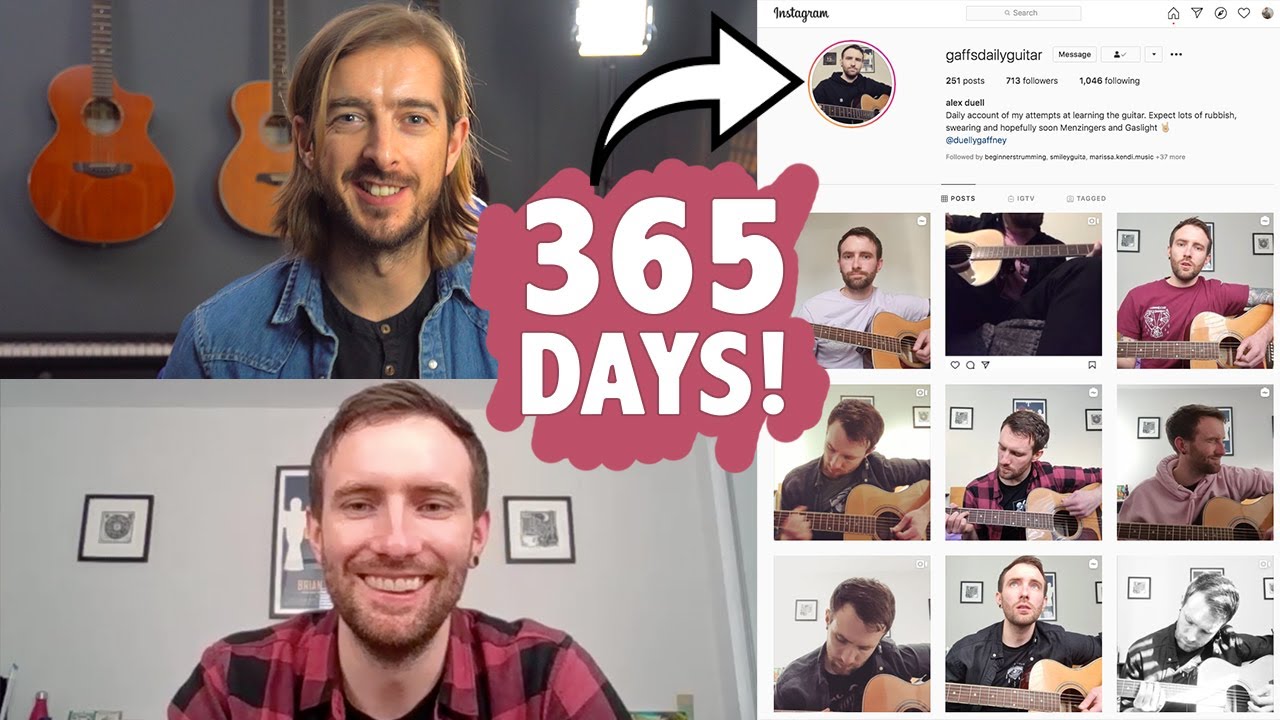
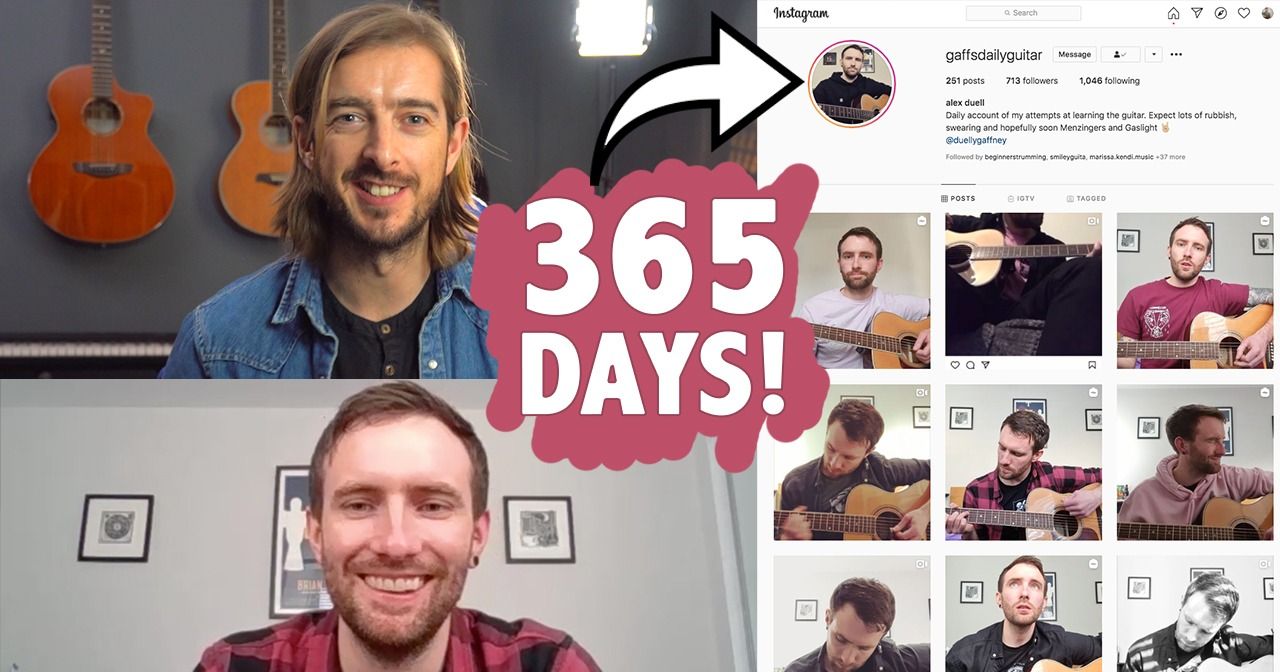
In this video, I chat to Alex Duell about his journey learning guitar online.
Alex has been learning for exactly 1 year and has shared his progress daily on his instagram page https://www.instagram.com/gaffsdailyguitar/
Top tip for learning song from Ultimate Guitar.com chord sheets!
Alex wasn't aware of the very cool feature with online chord sheets where you can get rid of any barre chords etc and make the chords easier for a song you want to learn. See this video below for how to do that and give it a go yourself!!
How to make chords EASIER using UltimateGuitar.com