
Noel Gallagher Player Study and Jam Track
In this video
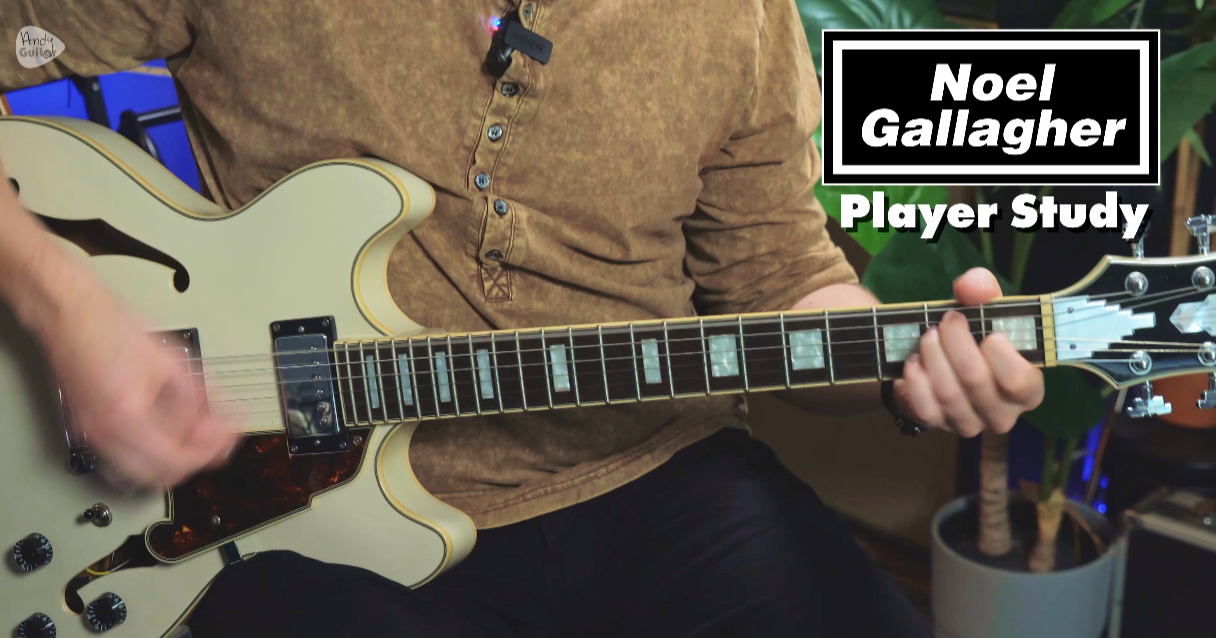
This lesson brings multiple Grade 3 skills together over a single Oasis-style chord progression, shifting from practising techniques in isolation to combining them musically. Working over a loop of C major, E major, A minor, and F major to F minor, you’ll apply vibrato, bending, directional picking, and major scale lead lines in context — which is where the real progress happens at intermediate level.
What you will learn:
• First-finger vibrato using the inside of the index finger
• The relationship between bending and vibrato as the same wrist movement
• Directional picking as an alternative to strict alternate picking
• Lead lines drawn from Don’t Look Back in Anger, The Hindu Times, and Champagne Supernova
• How to transpose licks into different keys using your knowledge of the fretboard
First-finger vibrato using the inside of the index finger
Vibrato on the first finger is one of the most expressive tools in rock and blues guitar, and it requires building a callus on the inside of the index finger. This comes from consciously using the inside of the finger every time you fret a note in a riff or lick context — it won’t happen from scale practice alone. The Hindu Times is a great reference for how this sounds in an Oasis context, with its wide, confident vibrato on sustained notes.
The relationship between bending and vibrato as the same wrist movement
A whole-tone bend and vibrato are technically the same movement — the only difference is speed. Bending is a slow, controlled push to a target pitch; vibrato is a rapid, repeated version of the same push. Understanding this connection means you can practise one and improve both. The movement comes from the wrist rotating, not from the fingers pushing — and once that clicks, both techniques become much more consistent and controlled.
Directional picking as an alternative to strict alternate picking
When moving between strings, strict alternate picking (always alternating down-up regardless of direction) isn’t always the most efficient approach. Directional picking means using a downstroke when the next note is on a lower string and an upstroke when it’s on a higher string. This follows the natural path of the pick and reduces wasted motion. We apply this to a specific lick from Don’t Look Back in Anger, breaking down the exact pick direction for each note so you can feel the difference.
Lead lines drawn from Don’t Look Back in Anger, The Hindu Times, and Champagne Supernova
Each lead line in this lesson targets a different combination of skills. The Don’t Look Back in Anger lick uses the directional picking pattern and a hammer on. The Hindu Times reference focuses on first-finger vibrato with a clean tone and Tube Screamer. The Champagne Supernova ending lick brings bending and vibrato together. These aren’t exact transcriptions — they’re Oasis-style lead ideas in C major that teach you the techniques within a musical framework.
How to transpose licks into different keys using your knowledge of the fretboard
The most important takeaway from this lesson is that once you understand what notes you’re playing relative to the root note, you can move any lick to any key. The Don’t Look Back in Anger lick in C major becomes a She’s Electric lick when you move it to a different position. This is the point where you stop being a player who copies tab note-for-note and start becoming a player who understands what they’re doing — and that’s what makes you a genuinely independent intermediate guitarist.
Jam Track
Audio Jam Track
Intermediate Electric Level 3
Recommended Songs
Enjoying this course? Want to test out your new skills? Find out my recommended song tutorials that accompany this course and get total access to the site by signing up today!