
A Major Chord & A5 Power Chord
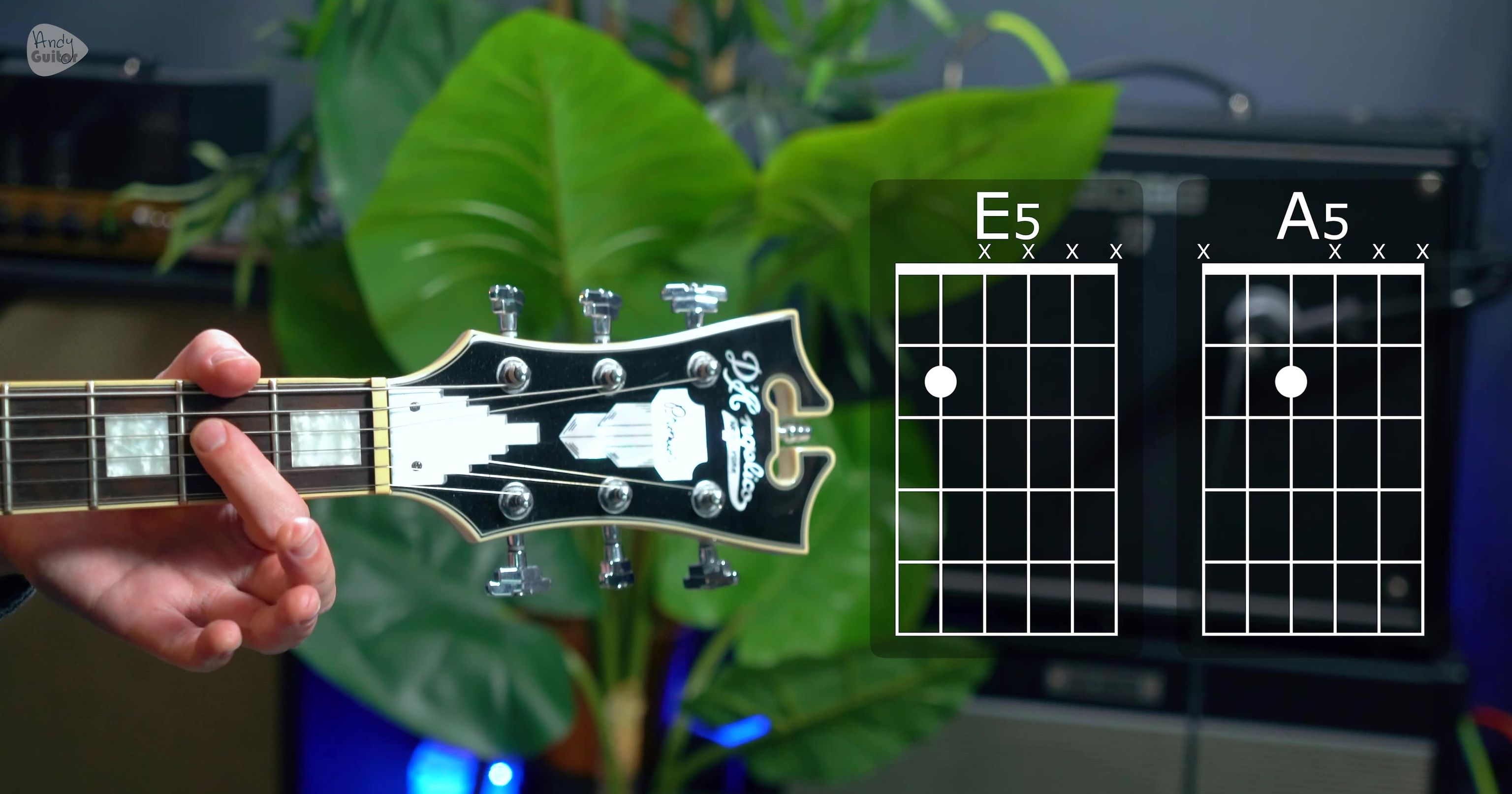
Here's how I recommend we learn the A major chord, and here's what it sounds like. Here it is with a little more overdrive. And this is our 2nd essential major chord alongside the E major. Which is why I recommend we learn it like this. However, especially on electric guitar, this second fret can be awfully narrow, and if you are struggling to get three fingers how I show here, although anything new is always a struggle, um, so don't be too distracted from this, especially if you need help with the change. But we do have the option to have 3 in a line here. Let me talk you through this. Whichever way you wanna play it, the diagram's gonna look the same. And it is 3 fingers placed down from string 2 on fret 2 on strings 23, and 4. In a line, we would place them like this because we want to get all fingers as close to this side of the fret as possible, but even I need to have my fingers on this angle, and that is especially true when we have good chord playing technique, which is the elbow into the side. Relaxed and a chair with good back support, not slumped on the sofa like this kind of thing, which is awfully tempting I know when you're chilling out and wanting to practise guitar, but please sit upright, elbow into the side, fingers on an angle facing towards you or towards your strumming hand shoulder, and fingers 12, and 3, and we strum this time from string 5 like this. The second option and the preferred option because of the chord change, playing a chord isn't hard, playing changes is the thing we'll have to practise. Index finger goes in the middle of the other two, it's on string 3, middle finger above, third finger below. Feels a little bit funny compared to the other one. And again we strum from string 5, and I actually have my thumb sat on top, which I'll talk more about in a second. It's not like this, it's just sat on top. But the reason I'd recommend going for this one is when we change, we can lift off fingers 2 and 3, slide or scooch that index finger just over the fret wire here, so from fret 2 to fret 1, bind that E major chord. And then playing the E major chord in no time. Middle finger and 3rd finger lift off, slide that index over, above and below, 2nd fret. Boom, there's our A major chord. And these are major chords, plus we're strumming a lot of strings, so E major. Lift off, slide over, above, below, A major. Mute, lift off 2 and 3, slide the index over to fret 1, middle finger, 3rd finger, and that's what we repeat to practise, scooch, press down, strum. Lift, scooch, press down, strum. So 123. Even starting to do some of these at the same time. Like this and basically trying to change between these as swiftly as possible, or if you really really prefer this A major, 3 in a line is an option. It does have its advantages for certain guitars of certain hand shapes and sizes. With this A major chord, we do again have a one finger option, and we actually have a one finger option here to play a full A major chord. This is not what I'd be teaching on acoustic guitar, but for electric guitarists, this can be really powerful, especially when I'm suggesting that people learn this A major chord, but it's a real squish with your fingers and you maybe have bigger hands and you think that's a disadvantage. And it just isn't, especially when you default to playing the A major that I play, most commonly, which is just one finger, the index finger like this. Now this won't fall together for. Even most people, but for some of you watching, this will become your default A major chord, and it will be much easier than this or this. And as a guitar teacher, I just wanna share that with you. This is what I do most of the time, and I'm holding down still. The diagram's no different cause I'm holding down 23 and 4 at the second fret with the index finger, but I have to pinch and then have a flat kind of this part of my finger here, this first, up to the first knuckle. But I'm very much pinching here between this part and the palm of my hand, sort of the base of the thumb, so that I can kink this finger out and actually string 1 and 2 still ring out. Now that's a kind of late beginner, early intermediate thing to really nail that for most people, but for some of you watching that will just fall together and maybe you've got some experience and you're starting to find that, ah, I can actually do that cos it's similar to something I've tried before, so hopefully that's connected. However, it's also really similar to the one finger A chord as in the power cord, which is like this. Where we don't have to strum string 12, or 3 at all. We just strum to play the A power chord, the A string. And then the string that we have our first finger on, and we do that with the strumming hand just with again a little twist of the wrist really. And then we mute, twist of the wrist, the pick is just above string 5, inside the strings, and then it kind of strums out. And that makes for a very easy chord change between the E5 power cord. And the A5 power cord. And I just wanna fess up. That this is what I would first of all be encouraging. A rock guitarist to do. In their first lesson. Of electric guitar. With some overdrive, even more overdrive than that if you fancy. But the more overdrive you have, the more you have to focus on good muting and being careful with your picking hand. Get good. That silence. With this muting, you're in control of your guitar here with the palm muting. Outside of the palm of the hand, silence, that's all on this hand, not on the chord playing hand. You're also in charge of the volume because it's the amount of gain or distortion or overdrive, which makes a guitar sound like this, as opposed to sounding like this. Same volume, less gain, or just on the clean amp setting, somewhere in between the two is called crunch. That's the E major. That's the A major With this easy chord change, we have to be more careful with the strumming hand. Cause we can't rely. On the sweetness of the major and minor chord, we have to strum the E5 chord from the E string, from string one. And the A power chord from string 5, which is an A. And at this point, I want to quickly run through the name of your open strings, which we did in the tuning video, but Eddie ate Dynamite, Goodbye Eddie, or elephants and donkeys grow big ears, say that one back to me, elephants and donkeys, they do, don't they, they grow big ears. And elephants and means that's the first two chords, cause we had the thickest string, string 6, elephants. And And we have an E5 power cord and an A5 power cord. And straight away, we're kind of rocking, that's pretty cool, right? Basically lesson one, chord, two chords, and we can even start playing songs with that. However, We cannot sacrifice full major chords, even though it can be tempting if that's the genre that you're into, but especially if you want to strum anything, we need that dexterity. There's nothing else that's gonna be a substitute for this, there's no exercise I can give you that's gonna get you to this end result quicker than just changing between the E major and finding that E major, give it in a strum, lifting off, slide over, middle finger above, third finger below. And that's essentially your practise routine for most of this level, to get this chord changed, great. And around about a second or two between chords. And we have a couple of tactics with this. First of all, first of all, we can do 1 minute changes. We can do how many chord changes can you do in a minute. You literally time yourself with a 62nd stopwatch or an app on your phone. You strum the You strum the A, you go between them. And we're strumming all six strings, we're not worrying about the strumming hand, entire focus is over here and you're just trying to beat your previous time every time. That's something that I would highly encourage. The second one is that you can do this silently, you can do silent practise or even air changes, where we're just changing like this. Changing silently, but you have to be really vigilant with where you're placing your fingers, but especially if, you know, you're conscious of noise or anything like that, you can practise these chords silently anytime you need to, and then the final step of this, we actually make the shape of the chord in the air before we press it down, and that is how. We get to the next level with our chord changes, that's what we'll be aiming for later in this beginner's course. So I'll leave that with you, have those two options. You have the E5 and A5 power chords, which are super fun and exciting, but very limiting in terms of the sounds that we're gonna get. And the full major chords, E major and A major. Which I'll be giving more help and more tips with throughout this level and even the next level, which we can play real songs with, but we need that extra dexterity of our fingers, and that's what gives us that sweet, major chord sound. And that's how we can start strumming along to songs even on electric guitar, essentially in the same way as we would do on acoustic, but we're gonna give you some different song choices and some different jam track options in the next upcoming videos.
In this video
I guide you through learning the A major chord and the A5 power chord, two essential shapes for electric guitar. We'll look at:
Finger placement options
My advice on clean chord changes
The A5 power chord perfect for rock and blues styles!
A Major Chord Variations:
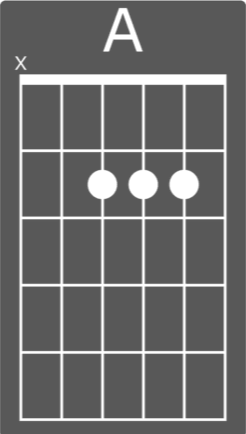
Traditional “3-in-a-line” shape can be cramped—especially on electric guitars
Easier version: place the index finger between the other two for more space-efficient fingering
Advanced option: barre with one finger across strings 2, 3, and 4 for quick transitions
Posture & Technique Tips:
Sit upright with good back support
Keep your elbow tucked in and fingers angled towards your strumming hand
Aim for clean fretting near the fret wire for clarity
Chord Change Strategy:
Practice sliding the index finger from A major to E major (and back)
Focus on finger efficiency over perfect tone in early stages
Work toward doing multiple finger movements simultaneously for speed
Power Chords for Rock Beginners:

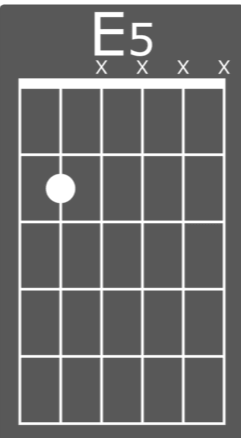
E5 and A5 power chords are easy and effective for rock sounds
Only play the necessary strings (E5 = strings 6 & 5; A5 = strings 5 & 4)
Great for high-gain distortion tones with muting and strumming control
Muting & Tone Control:
Use palm muting with your strumming hand for clean stops
Gain and distortion affect tone—more overdrive demands more muting precision
Control your volume and crunch settings for different rock tones
Fun Mnemonic for String Names:
“Elephants And Donkeys Grow Big Ears” to remember E-A-D-G-B-E
Encouragement:
You don’t need perfect form immediately—experiment with shapes that suit your hand
Even just two chords (E5 & A5) can get you started playing fantastic songs
Beginner Electric Level 1
Recommended Songs
Enjoying this course? Want to test out your new skills? Find out my recommended song tutorials that accompany this course and get total access to the site by signing up today!