
Boys Dont Cry - The Cure
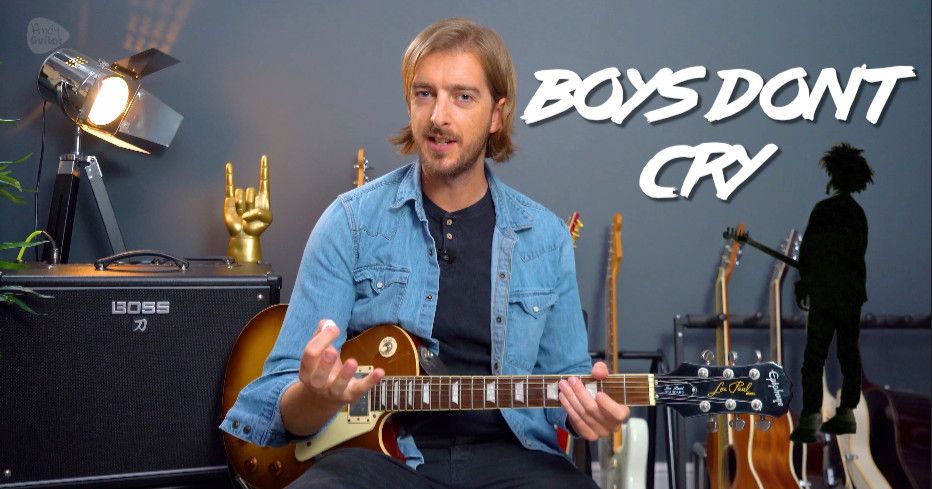
Alright, so that lead line that you've just heard me play actually uses something called the A major scale. Now I am gonna show that scale, it's not absolutely essential that you learn this, but it does include most of the notes that make up this melody, and playing the notes in an order, so low to high. Is kind of like learning your ABC before you start talking and kind of you writing sentences and reading sentences, because music absolutely is a language. So I will show this briefly, just as a bit of background, and if you wanna do more of this kind of thing, learning the scale and then the lead line would be absolutely the best thing to do. So here's the scale. And then that melody. Actually starts from the 3rd note of that scale, so 123. And then it goes up from there. So to play that melody, we need to take your first finger and we're gonna place it at the 2 fret of string 2. So fret 12, string 12, we're just here. We're then gonna use your middle finger and place it just here. Now when we're placing your fingers at a fret, we always want to be at this side of the fret area, the side closest to you. If we're over here, we or even in the middle, we have to press down a lot harder, and we actually want to press down as light as possible. But so that the note actually rings out. All the stuff that you're doing with open chords absolutely applies here, but we need to pay attention to each finger as we place it down. I'm also on this angle, so I'm kind of set up like as if I was playing a D chord, thumbs sat on top, not right over, just sat on top. And then I'm also slightly gripping here, like I'm just going in for a handshake for the guitar neck, which puts my fingers. On this angle. This angle's super important for the world of indie, rock, blues, lead guitar. Uh, electric guitar stuff, we always want to be on this kind of angle, especially for string bending. When we do string bending later on, this is gonna be essential, but for now, just try and grip the neck like this, and then your first finger. Like that, and that will be superb. Middle finger next, so we lift off that first finger, middle finger, fret 3 of string 2. And then the next note is the open, thinnest string. We play the first note twice, and that gives us that opening signature part. That happens again. Hopefully this is simple for you, but if you're struggling, keep your right hand picking motion as small as possible, and I also rest kind of the base of my thumb, um, on the strings here as well, when I'm playing strings 1 and 2. And as we move to thicker strings, we can keep it on this part of the guitar as well, but for lead guitar stuff, we tend to be on strings 12 or 3, and resting the base of your thumb on those thicker strings around the uh. Bridge pickup just here is a really good thing. I'm also holding a pick with my thumb on top and the first finger here, you can hold it like this, but it's much better if we hold a pick like this. That melody again. We're then gonna play the rest of the notes from the scale on string one. Open finished string. Chord playing hand or fretting hand set up still on this angle, which will enable us to play the 2nd fret of string one with the 1st finger. 4th fret with the middle finger. 5th fret with the 3rd finger. Now if you struggle with this and you're a real beginner, you can just play. All of this with one finger. Everybody's got to start somewhere, don't let that put you off, but ideally this angle of our fingers, rather than having to stretch like this, look, I, I can't stretch my third finger to here if my fingers are like this, but on this angle. I can because I'm stretching like this, kind of like this is why chord playing's so important. I'm doing a very similar stretch here to how I play a C chord. Like this So open, open. Second fret. 4th threat 5th threat That gives us The final part we need to learn just comes down all that same set of notes, but it is a little bit quicker, so this is a little bit more tricky, but here it is. Just those 3 notes. And then it starts again immediately, and this is the thing with this uh lead line. It repeats and repeats just like a guitar riff, and it is a guitar riff in many ways, but because we're on the thinner strings, we're essentially playing a lead solo here. This is really exciting if this is the first kind of time you've been playing single notes or lead guitar at all, so please give this one a go. If you need to pause this video and give it a little bit of time, that's totally fine. One more time, nice and slow, the full thing, and I'll just play it twice so you can see how it loops. Now once you can do that, I want you to play along with me to a loop of the chords, and we're gonna start off at 50% speed of the original recording. Let me just show you again that major scale that all these notes come from. In this melody, and we can play that up, which is. And we want to learn that first of all going up the scale but then also going up and back down to get the most benefits. So I've now got the chords to this song in my looper pedal. I'm gonna give us a count in, we're at 50% speed, which is 65 BPM. And there's a rhythm to this, so you'll just need to copy what I'm doing, maybe you'll need to rewind this a couple of times, but when you're ready, grab your guitar and join in with me, playing along to the chords in. 1234. So that was 2 repetitions, and please rewind this video, uh, just a few seconds just to do that a few times. Make sure you can play 2 repetitions in time with that first one before you go for this next one. This, uh, one is 90 BPM. So we're quite a bit faster, but it's not gonna feel too much different, um, initially as we speed up. It feels a lot different as we get closer to the tempo of the song. That's when we really have to go by small amounts. But 90 should be totally fine. Join in with me. Ian. 1234. So hopefully that's something that you can play along to. Remember this does take practise, so you will have to watch that part of the video and play along to it a few times to really get it. You can recreate this same thing yourself, uh, the chords that I was playing are just an A major, B minor barcode, C minor, and then a D, and then it comes down. Those same chords again and just down, down, up, up, down. And we just repeat that using a looper pedal. I've got a separate video for how to use a looper pedal, I'll leave that in the description, definitely check that out. And um this is one that if you want to revisit this song later, you know, over the next few days, you can try and increase that BPM and perhaps eventually try playing along to the original recording, though that is of course quite a bit faster as they normally are.
In this video
I'm teaching you the lead line from "Boys Don't Cry" by The Cure, which uses the A major scale. I'll show you the scale first - it's not absolutely essential that you learn it, but it includes most of the notes that make up this melody. Playing notes in order from low to high is like learning your ABCs before you start talking and writing sentences, because music absolutely is a language.
Finger Positioning
Place your first finger at the second fret of string two. When placing fingers at a fret, always be at the side closest to you. If we're over the other side or even in the middle, we have to press down a lot harder. We want to press down as light as possible while the note rings out. I'm set up like playing a D chord - thumb sat on top, not right over, just sat on top. I'm also slightly gripping here like going in for a handshake with the guitar neck, which puts my fingers on this angle. This angle is super important for indie rock, blues, lead guitar, electric guitar stuff, especially for string bending later on.
The Melody
The melody starts from the third note of the A major scale. First finger second fret string two, middle finger third fret, then open thinnest string. We play the first note twice to get that opening signature part. The rest of the notes come from the scale on string one - open, second fret with first finger, fourth fret with middle finger, fifth fret with third finger. If you're a real beginner struggling with this, you can play all of it with one finger. Everybody's got to start somewhere. But ideally this angle of our fingers enables the stretch - I can't stretch my third finger to the fifth fret if my fingers are flat, but on this angle I can because I'm stretching like playing a C chord.
Final Section
The final part comes down all that same set of notes but a little bit quicker. It repeats and repeats just like a guitar riff. Because we're on the thinner strings, we're essentially playing a lead solo here. This is really exciting if this is your first time playing single notes or lead guitar at all. Once you can do that, play along with me to a loop of the chords at 50% speed (65 BPM) and then 90 BPM. The chords are A major, B minor bar chord, C-sharp minor, then D. You can recreate this yourself using a looper pedal - I've got a separate video for that in the description.
Enjoying this video?
Try this course - Solid Intermediate Guitar
Level 6 completes Grade 4 — legato speed licks, major seventh chords, the Hendrix and Frusciante rhythm-lead style, and triads on the top three strings: the skills that finally let you see the whole neck.