
E Minor Pentatonic Scale on 1 String
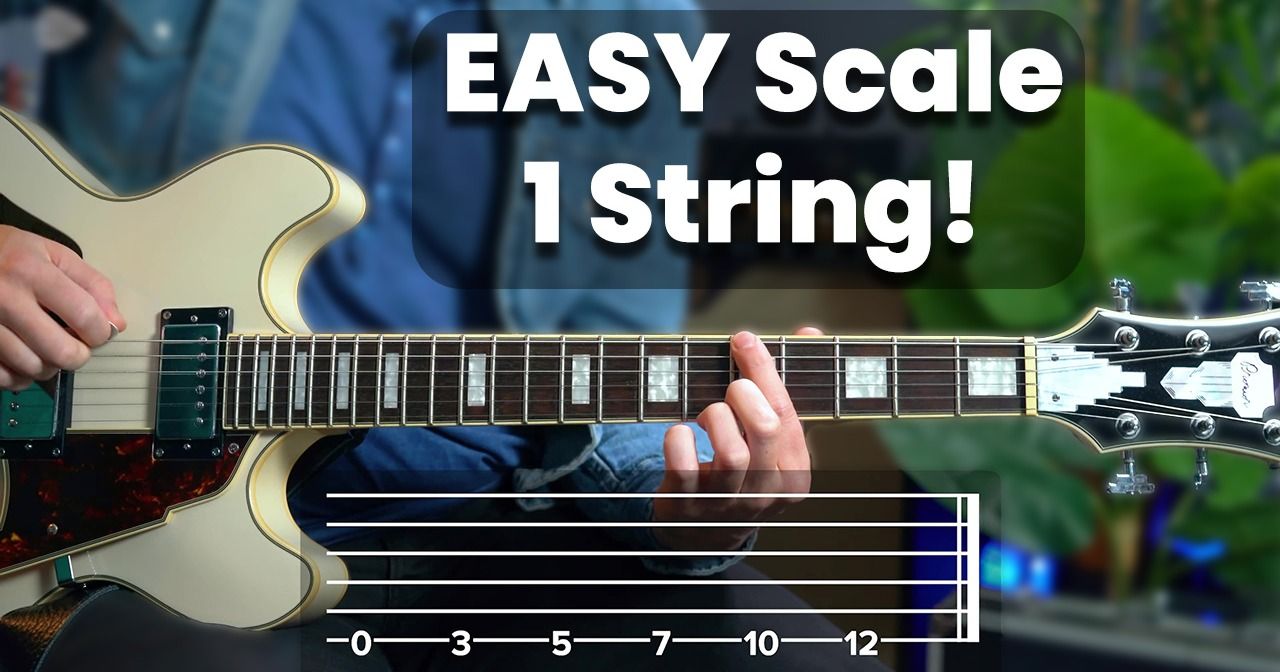
In this video, we're gonna look at something you should be really excited about. However, it has the word scale in the title, and scales can really put people off from wanting to practise or learn guitar. When I was learning, I thought scales were invented by guitar teachers to make me hate learning guitar. I just wanted to play riffs, lead, I wanted to be in a band, I wanted to play my favourite songs. However, what I really wanted. To do in this video is just start to demystify the guitar neck a little bit, and actually get to know what these dots are for on the top of the guitar, and even these inlays, like these wonderful block inlays, these white parts, which are called mother of pearl inlays, or perhaps dots on your guitar. I want to show you how we can use these to navigate the neck a little bit, no matter. Where they are, and we're gonna do that by learning 5 notes which make up the minor pentatonic scale. And if you've been learning guitar for any amount of time, you've probably heard those words before, that minor pentatonic, especially on YouTube. But what we're gonna do here in this video, is all we're gonna do is pick string 6, and we're gonna start off with the open string. Super easy. Now when you do that, I'd recommend we hold the pick in between the first finger on the side of the index finger, thumb on top, and that be how we hold a pick and we essentially pick from underneath and on top of the string out. And we pick out with a slight twist of the wrist. That's what I recommend. Many of you will hold a pick with two fingers and then the thumb, and that is fine. That's not gonna limit you for now, and it can be really annoying to hold the pick between your index finger and thumb and drop it all the time because that is going to happen. And it's really frustrating, but actually dropping your pick is a good thing. It means that you're not holding your pick with too much tension, and tension is a bigger enemy to your progress than dropping your pick, even though it's annoying, so it's OK. Slight twist of the wrist, however you hold that pick, and after picking. String 6, just the open string, we're gonna put the index finger on what on most guitars is the first dot on your guitar here. Now in this one it's actually the 2nd on some Gretch guitars and D'Angelio's like this, it's the 2nd dot, but either way, this is the 3rd fret. And we're just gonna pick Like this. So we've got open string. The 3rd fret. In most cases, the next dot. And we're gonna follow the dots for a little while. We're gonna go to the next dot, which is fret 5, so 345, index finger again, pick string 6, slight twist of the wrist, pick out. And that's our next note. Note number 3, so we've done 123. Stick to the dots, stick to the inlays. Next one. Thret 7. And now we have an anomaly. We have a dot that we're not gonna play, we're gonna go 1 above. I hate this dot on the 9th fret. I really think it just shouldn't be there. I believe it should be at the next one, cause this is the most common scale on guitar. And most riffs, a lot of riffs you'll learn in this course and beyond, go from the 10th fret to fret 12, which are here. And here. And remarkably for you, go to that 9th fret. However, this is how most guitars are laid out. If I compare it to the neck on this Gibson SG, you can see how that's the 1st dot on the guitar, so that's where we would start. We go to the next dot, next dot, and then we have the double dot here, the one between the last dot and the double dot at 12th fret. We need this one to be here. And that's what we use these dots for, we don't really have to count or think about even what notes we're playing, we don't have to think this is an, for example, an E or a D. We just go 1012. And then we, for example, to play this scale, open, 357, 10, not 9, it would be 10. And then 12, and then we're playing the E minor pentatonic scale, the same scale that is used in Back in Black by AC DC and so many other classic riffs, not just in the rock genres. This is how to play pop music, country, folk. Basically all the common popular genres as we call it. So let me show you this one more time. Now you choose this time whether you have. Very clean sound. Lots of overdrive and distortion or distortion and effects and go crazy, but no matter how you play this, please only let string six ring out. Use your index finger and we pick the open string, then fret. The 3rd fret on that 3rd fret dot. And you're at this side of the dot as well, not in the middle of the fret, up against the wire. That's the trick. We then go to 5. 7. All of those on the inlays or on the dots. Next one's above this dot, and we go above before we get to the double dot. And that's how we use these dots to navigate the fretboard, whether we have loads of overdrive. Or a really clean sound, or lots of effects. And we're going crazy Finally, we can do all of this in reverse, and that's how we practise scales. Remember that awful word? Look at what it's enabling us to do, it's enabling us to move up and down the fretboard, actually pretty easily, just by looking at where these dots are, and we're thinking about this 9th fret and we're going 1 above. But we can start at 12. And we can come down. To 10 7. 53. And 0, and we can do that super clean. And be kind of blues or sixties style, we can do it with loads of overdrive. And be like Guns N Roses, and maybe add some delay. But either way, If it's not sounding like that, and you're getting maybe all of this, and we don't want that, we just want. That string 6 ringing out, and really no other sounds, and it's best to check that. With different sounds. And we're just using the index finger, even if. We use lots of overdrive, and you can slide that first finger as well, get used to that, plenty of bands do that. And that is the E minor pentatonic scale, and that's what we'll need to do to be able to play our first jam track, which is in the next video.
In this video
I take you through the E minor pentatonic scale using just the 6th string!
If the word scale makes you want to run, don’t worry—this is an easy, fun way to start unlocking the fretboard and finally understand what those dots on your guitar neck are actually for.
You’ll learn the five notes you need to play countless iconic riffs and get comfortable moving up and down the neck using only your index finger.
Why this matters:
Learning a scale can be fun and practical, not boring or overwhelming
This scale is used in rock, pop, blues, country, and more
Helps demystify the guitar neck using inlays (dots) as guides
What you’ll learn:
The 5 notes of the E minor pentatonic scale on string 6:

How to use the dots on the neck to navigate frets without memorising note names
Playing the scale up and down, and how that sets the foundation for riffs and improvising
Picking advice:
Hold your pick between thumb and index finger (or however is comfy)
Pick with a slight twist of the wrist
Dropping the pick is okay— it means you’re not too tense!
Dot/inlay insight:
Ignore fret 9 (even though it has a dot) and go to 10
The dots are your roadmap—especially the double dot at fret 12
Practice tips:
Only let string 6 ring out—no other strings
Try clean tones, overdrive, or full distortion—it’s up to you
Practice both ascending and descending the scale
Sliding with your index finger is encouraged—lots of bands do it!
Next steps:
This scale prepares you for your first jam track, coming in the next video!
Beginner Electric Level 1
Recommended Songs
Enjoying this course? Want to test out your new skills? Find out my recommended song tutorials that accompany this course and get total access to the site by signing up today!