Stop Thinking of Rhythm & Lead as Separate Things
In this video
At this level we want you genuinely confident combining rhythm and lead playing — the thing Hendrix and John Frusciante are famous for, but which actually runs through every style of music. So we're pulling it right back to Stand by Me by Ben E. King, moved into the key of C so the whole bassline fits on one string. The job in this lesson is to sound like two instruments at once: a bass player holding down the line, and a rhythm guitarist adding the chord stabs. Get this working and you've laid the bedrock for the Hendrix-style jam later in the module — and for the playing of Steve Cropper, Johnny Marr, and plenty of Led Zeppelin too.
What you will learn:
• Why Stand by Me in the key of C — and how the bassline maps onto a single string
• Barre chords as quick stabs: the approach that finally makes barre chords painless
• Root note and chip: the beginner idea that becomes an intermediate technique
• Adding the bassline one piece at a time until chords and bass lock together
• Where to take it next: learn about Steve Cropper and look at Knock on Wood in depth
Why Stand by Me in C?
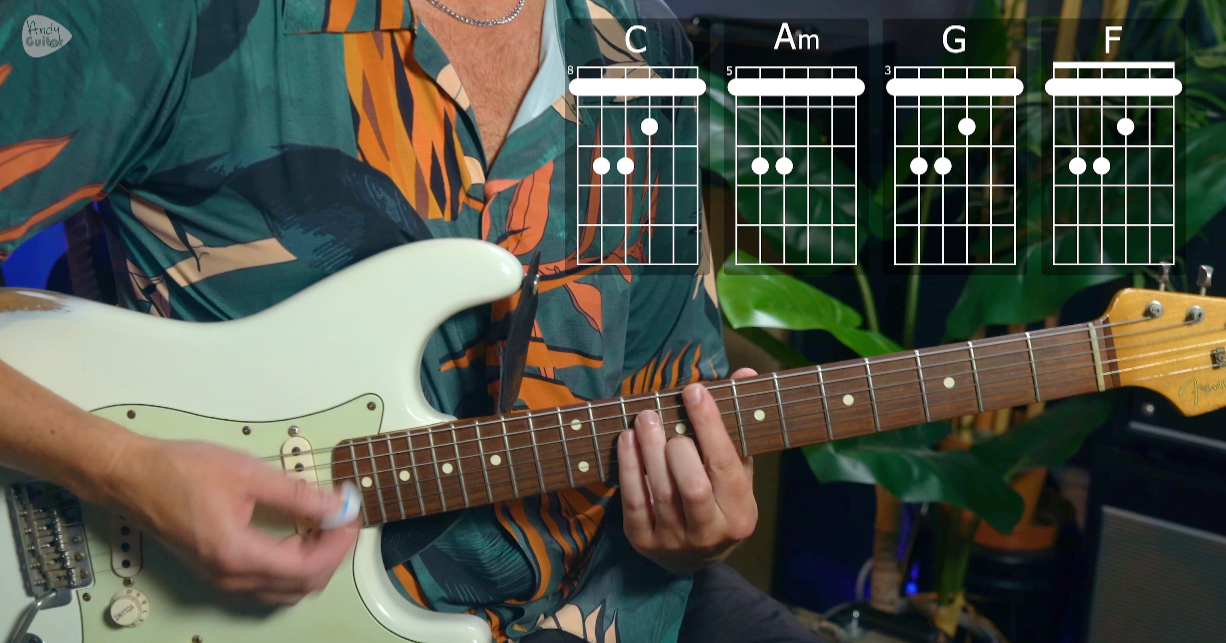
In the original key of A, the lowest note of the bassline isn't available on the guitar. Move the song to C and the whole line sits on one string — descending through the C major scale from the eighth fret: eight, seven, five, three, one. Get confident playing that line up and down first, because it's the melodic half of everything that follows. The chords become C major, A minor, F and G, all played as barre chords so they can work as short stabs.
Interactive Tab
Become a member to access this interactive tab section.
Barre chords as quick stabs
If you've never quite got on with barre chords, this lesson is a gift. You're not holding the shapes down for long at all — you make the shape quickly, play the stab, then relax your fingers and your hand. That means you can practise this over and over without the dreaded barre chord cramp. It also trains the exact skill that matters most for this style: forming and releasing shapes fast, rather than gripping them.
Root note and chip
The starting pattern is one we touched on in the beginners course: play the root note, then a short muted chord chip. Do it on A minor and you're essentially playing Natural Mystic by Bob Marley. At intermediate level, this same idea becomes the frame for two-instrument playing — root note as the bass, chip as the rhythm guitar. Don't let the strum ring out: relax the hand but keep the barre shape in place.
Adding the bassline one piece at a time
The bassline pattern is eight-eight-three-seven-eight-eight, and the chord stab lands on the second of the repeated notes, just before beat two, on every chord. Count it slowly — one, two, three, four — and build it one chord at a time, starting on the C. This is where the dexterity from X's up the fretboard and all your hammer-on and flick-off work starts to pay off. Notice how the sound changes depending on whether your stab favours the thicker or the thinner strings — that's a texture you can control.
Where to take it next
Once this one's down, try the same approach with any famous bassline you know — even something as simple as Seven Nation Army by The White Stripes, using E minor, C and B. And for the perfect recap of this entire style, study Steve Cropper, particularly Knock on Wood: it starts with basic barre chords, and the verse rhythm part is the ideal introduction to the whole Hendrix and Frusciante approach we're building through this module. for bonus points check out this whole course 'Learn How To Play Like Hendrix, Frusciante & SRV'
Intermediate Electric Level 6
Recommended Songs
Enjoying this course? Want to test out your new skills? Find out my recommended song tutorials that accompany this course and get total access to the site by signing up today!